
Lieferung heute & morgen

Qualitätsgarantie

Willkommens-Angebote freischalten: KOSTENLOSE Lieferung | Bis zu 80 % RABATT | Kostenlose 30-Tage-JoyPlus-Testphase
App herunterladen
A dead car battery or a flat tire rarely happens at a convenient time. For drivers who value independence from roadside assistance services, a multifunctional emergency kit can be a smart addition to their vehicle. A device that combines a jump starter with an air compressor offers a practical solution for two of the most common breakdown causes.
This article serves as a guide. It explains the essential features to look for when making your selection and presents a range of devices with different specifications. The goal is to provide you with a solid basis for making an informed decision, so you can find the right device for your needs.
Selecting the right device depends on several technical factors. The following three points are particularly relevant for a decision that meets your needs.
The Peak Current, measured in Amperes (A), is one of the most important metrics for a jump starter. It indicates the maximum current the device can deliver for a short period to start an engine.
Always check the manufacturer's specifications for compatibility with gasoline and diesel engines (measured in liters of displacement) to ensure the power is sufficient for your vehicle.
An integrated compressor, also known as a 12V car tire inflator, is the second core feature of these combination devices. Its performance is determined by the maximum pressure (measured in PSI or Bar) and the air flow rate (liters per minute).
The internal battery determines not only the jump-starting power but also the device's safety and longevity.
Additional features such as USB ports for charging mobile devices, an integrated LED flashlight with an SOS function, and robust, reverse-polarity-proof clamps complete the utility of a portable jump starter.
Here is a selection of devices that cover different needs. The descriptions are based on data provided by the manufacturer.
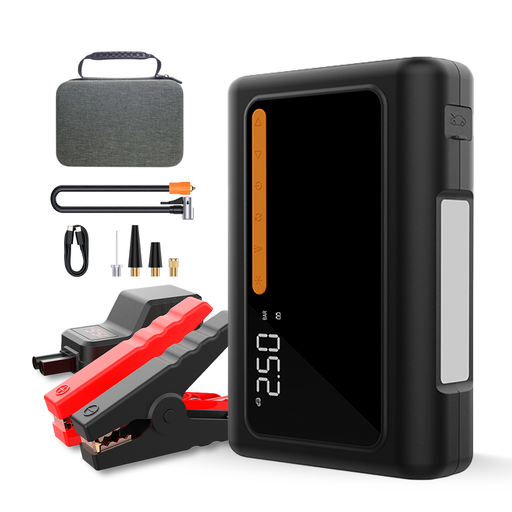
Why it stands out: The GK01 model uses a sodium-ion battery. According to the manufacturer, this technology allows for operation in an extreme temperature range of -40°C to 80°C and a high cycle life of over 6,000 charge cycles. The self-discharge rate is stated to be around 1% per month, which reduces maintenance.
Pros:
Who is it for? For users looking for a durable, low-maintenance device that can remain in the car even in extreme temperatures and offers both jump-starting capability and a powerful compressor.
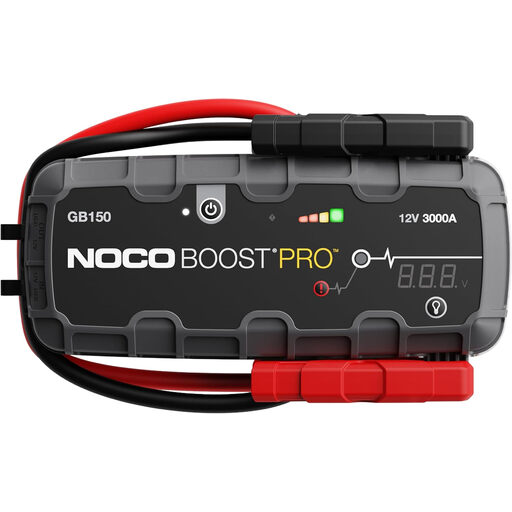
Why it stands out: The NOCO Boost GB150 is a dedicated 12V jump starter booster that focuses on maximum starting power. With a peak current of 3000 A, it is designed for very large engines—according to NOCO, for gasoline engines up to 9.0L and diesel up to 7.0L. It is important to note that this model does not have an integrated compressor.
Pros:
Who is it for? For owners of vehicles with large-displacement engines (e.g., large SUVs, RVs, vans) who primarily need an extremely powerful and robust jump starter and can do without an integrated compressor.
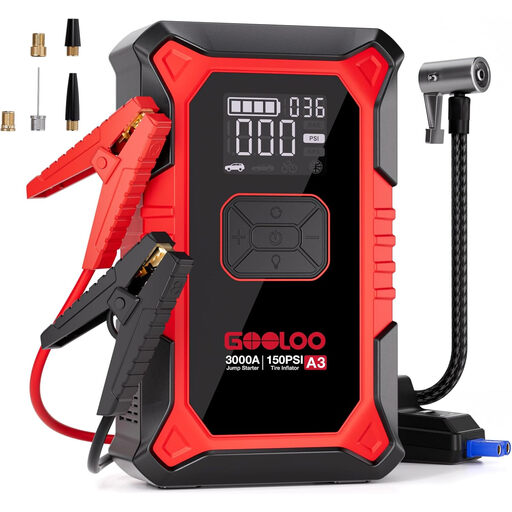
Why it stands out: The GOOLOO A3 is an all-rounder that combines high starting power with a versatile compressor. It offers a peak current of 3000 A and is suitable, according to the manufacturer, for gasoline engines up to 9.0L and diesel engines up to 6.5L. The compressor features 5 preset modes, which simplifies operation.
Pros:
Who is it for? For users who want a powerful all-in-one solution that is suitable for both large engines and various inflation tasks, and who value ease of use.
The products presented cover a variety of use cases. If you are looking for other models or specific features, you can find a wider selection in our category.
? Discover more portable rechargeable jump starters
Most manufacturers recommend fully charging the device every 3 to 6 months, even if it is not used. This ensures the battery is ready for an emergency and helps maintain its lifespan. Models with very low self-discharge, such as those with sodium-ion technology, may need to be charged less frequently. Please refer to the specific manufacturer's instructions.
A portable jump starter is designed to start 12-volt lead-acid batteries, which are found in most cars, motorcycles, and light commercial vehicles. The crucial factor is that the device's peak current is sufficient for your vehicle's engine size (displacement) and type (gasoline/diesel). For 24-volt systems, such as those used in some trucks or buses, special jump starters are required.
The Peak Current is the absolute maximum value the battery can deliver for a fraction of a second. The Starting/Cranking Current is the current the device can sustain for several seconds to turn the engine over. The starting current is often the more practically relevant but less frequently advertised value. However, a high peak current generally indicates higher starting power.