
Lieferung heute & morgen

Qualitätsgarantie

Willkommens-Angebote freischalten: KOSTENLOSE Lieferung | Bis zu 80 % RABATT | Kostenlose 30-Tage-JoyPlus-Testphase
App herunterladen
A dead car battery or a flat tire rarely comes at a good time. For drivers of SUVs, RVs, or vehicles with large engines, a breakdown can quickly become a costly and time-consuming ordeal. A jump starter with air compressor promises an independent and quick solution. However, the market is flooded with devices featuring exaggerated performance claims and hidden defects. This guide will help you separate the wheat from the chaff and make an informed purchasing decision.
As a Joybuy Product Recommendation Officer, I analyze product data to provide you with objective, practical advice that protects you from common purchasing traps.
Before you invest, you should be aware of the most common marketing promises that often lead to disappointment.
To avoid these traps, focus on three verifiable metrics.
Distinguish between Peak Amps and Cranking Amps. While peak current indicates the maximum short-term output, the cranking current is the relevant figure for the starting process. For a jump starter for diesel and gasoline engines with large displacement (e.g., over 3.0L diesel or 5.0L gasoline), a device with a high, stable starting current is required. Look for manufacturer specifications that explicitly state compatibility with certain engine sizes (e.g., "up to 9.0L Gasoline / 8.0L Diesel").
A good 12V portable air compressor should not only reach a high maximum pressure of up to 150 PSI (approx. 10.3 Bar) but also offer a sufficient airflow rate. A value of over 25 liters per minute is a good benchmark for an acceptable inflation time for a standard passenger car tire. An automatic shut-off feature upon reaching the target pressure is an important convenience and safety feature.
The battery's capacity, specified in milliampere-hours (mAh), determines how many jump-start attempts are possible or how many times you can charge your smartphone. A capacity of over 15,000 mAh is recommended for multifunctional devices. Pay attention to the self-discharge rate and the recommended charging frequency (e.g., every 3-6 months). Modern devices also offer multiple USB ports (12V jump starter with USB) and function as a fully-fledged power bank for on-the-go use.
Based on these objective criteria, we have identified several models that represent a considered choice for specific user groups.
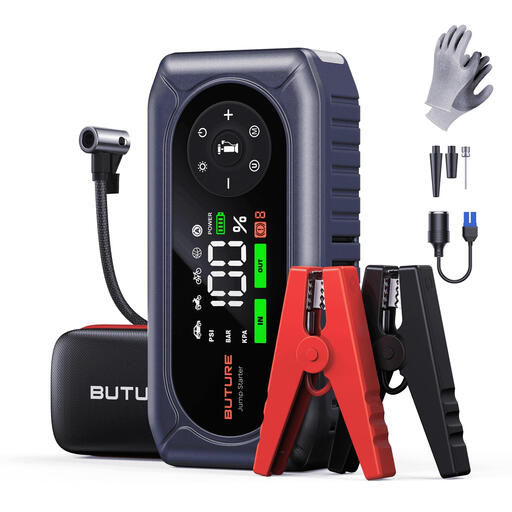
Why This Fits Their Persona: Ideal for drivers of large SUVs, RVs, or light commercial vehicles who need a complete and reliable solution for the most common breakdowns. This device combines a powerful 4500A battery booster with a fully-featured 150 PSI tire inflator, making it a true multifunctional roadside assistance tool.
The device avoids the "weak combo device" trap. According to the manufacturer, it provides enough power for engines up to 9.0L gasoline/8.0L diesel and a compressor with preset modes and automatic shut-off that is practical for real-world use.
Combines 5 functions (jump starter, compressor, power bank, LED light, 12V DC output) in a rugged housing. Its suitability for extreme temperatures (-20°C to 60°C) ensures year-round reliability.
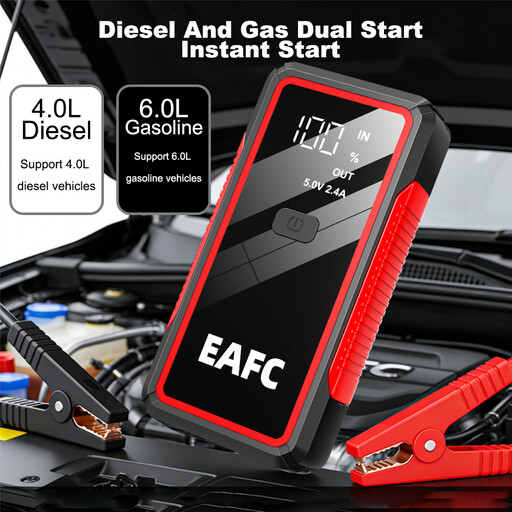
Why This Fits Their Persona: A solid choice for owners of compact and mid-size cars who need a reliable jump starter and power bank function but can do without an integrated compressor. The performance is designed for most common engines (up to 6.0L gasoline / 4.0L diesel).
This device focuses on its core competency: jump-starting. It avoids the trap of integrating an underpowered compressor, instead offering dependable performance for its specified vehicle class at an attractive price.
Compact design and excellent value for money. The 10000mAh battery also serves as a useful power bank for electronic devices. The wide operating temperature range of -10°C to +85°C is a plus.
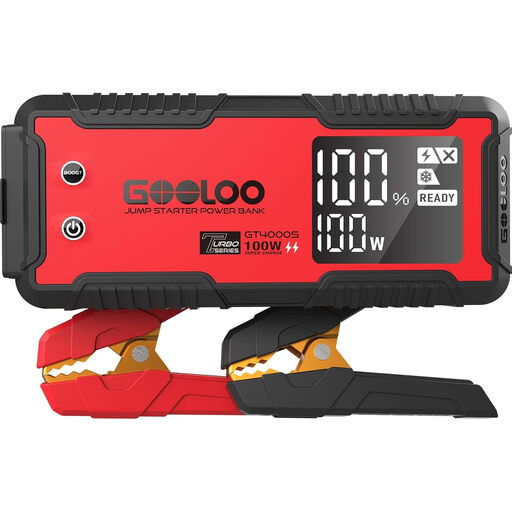
Why This Fits Their Persona: Perfect for owners of vehicles with very large engines (up to 10.0L diesel) who place maximum value on starting power and fast recharging capabilities. Those who already own a separate compressor will find this to be a high-performance, dedicated jump starter.
This model bypasses the self-discharge trap with its extremely fast 100W two-way charging feature. According to the manufacturer, a 5-minute charge is sufficient for one jump-start, making the device ready for use even on short notice.
The 100W fast charging is a clear standout feature. The device can not only be charged quickly but can also power laptops up to 100W. The high peak current of 4000A provides ample reserve for demanding starting procedures.
We've compiled a complete, up-to-date list of products that fully meet these strict selection criteria and safety standards.
1. How often do I need to charge a jump starter with an air compressor? This largely depends on the model and the battery technology used. As a general rule, it is recommended to fully charge the device every 3 to 6 months to maintain the battery's lifespan and ensure it is ready for an emergency. Always refer to the specific manufacturer's instructions.
2. Can I really start a large truck engine with a 4500A battery booster? The "4500A" rating refers to the peak current. Whether a jump-start is successful depends on the engine design, outside temperature, and the condition of the vehicle's battery. A model like the BUTURE BC02 is rated by the manufacturer for diesel engines up to 8.0L displacement, which covers most SUVs, RVs, and light commercial vehicles. However, these devices are not suitable for heavy-duty trucks with 24V systems.
3. Is a portable compressor with 150 PSI sufficient for an RV tire? A pressure of 150 PSI (approx. 10.3 Bar) is generally sufficient. However, the crucial factor for large tires is the airflow rate (liters per minute). An integrated compressor is designed as an emergency tool to bring a tire back to a drivable pressure or to correct the pressure. Fully inflating a large, flat RV or truck tire can take a significant amount of time. It is a roadside assistant, not a full workshop replacement.