
Lieferung heute & morgen

Qualitätsgarantie

Willkommens-Angebote freischalten: KOSTENLOSE Lieferung | Bis zu 80 % RABATT | Kostenlose 30-Tage-JoyPlus-Testphase
App herunterladen
A dead car battery or a flat tire always happens at the worst possible time—usually on your way to work or at the start of a vacation. A multifunctional jump starter with compressor promises a quick fix for both problems. But the market is flooded with devices making bold claims. Many drivers invest in a supposed all-in-one gadget that fails when it's needed most.
As your Joybuy Product Recommendation Officer, I'm here to help you separate the wheat from the chaff. We'll highlight the three most common pitfalls that lead to a bad purchase and show you which technical specs truly matter.
Many devices look powerful at first glance but prove to be unreliable in practice. Watch out for these typical flaws to avoid a poor investment:
To find a reliable car jump starter, don't be dazzled by marketing buzzwords. Instead, focus on these three verifiable metrics.
The peak current, measured in Amps (A), is an important indicator of performance. It's crucial that this value matches your vehicle's engine.
Always check the manufacturer's specifications for the maximum recommended engine size for both gasoline and diesel engines. This is a more reliable indicator than the amperage figure alone.
An air compressor's performance is measured in PSI (Pounds per Square Inch) or Bar. For car tires, ratings up to 150 PSI (approx. 10.3 Bar) are standard and sufficient. However, more important than the maximum pressure are the airflow rate (often specified in L/min) and an auto-shutoff feature. This function allows you to pre-set the target pressure. The compressor stops automatically once the desired tire pressure is reached, preventing over-inflation and making operation convenient and safe.
The battery's capacity, measured in milliamp-hours (mAh), determines how many jump-starts are possible and how many times you can charge your smartphone or other devices. A good power bank with jump-starting capability should offer at least 15,000 mAh. Modern devices also feature USB-C ports with Power Delivery (PD), enabling fast charging of the jump starter itself as well as connected laptops or tablets. This is a significant advantage over older models with slow charging times.
We have selected products from our range that are tailored to specific user needs and purposefully avoid the pitfalls mentioned above.
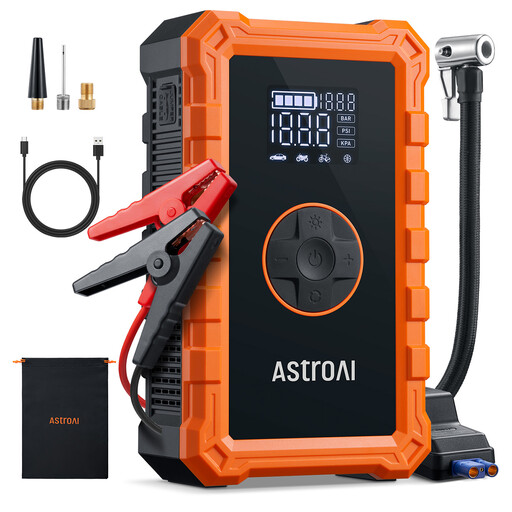
Why This Fits Their Persona: Ideal for drivers of standard passenger cars who need a compact, straightforward, and reliable solution for the glove box. The device combines sufficient power for most gasoline and smaller diesel engines with an easy-to-use compressor.
The large 2.4-inch display clearly shows the target pressure and real-time pressure, and the auto-shutoff feature prevents user error. This bypasses the "inefficient compressor" pitfall.
Large, Clear Display: All essential information is readable at a glance, which makes it much easier to use during a breakdown. Compact Design: All accessories can be stored inside the unit.
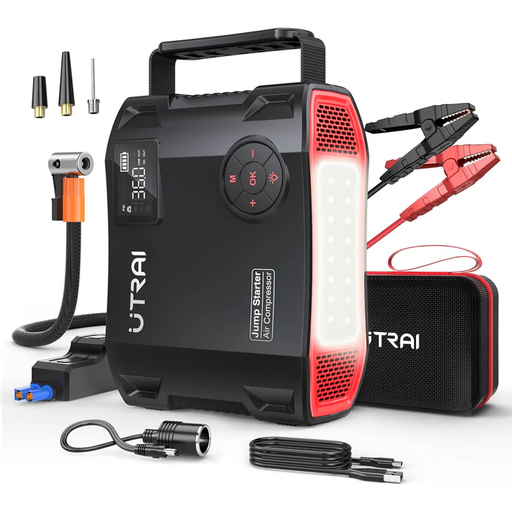
Why This Fits Their Persona: For campers, boat owners, and adventurers who need an off-grid power supply. This device is more than just a roadside emergency kit; it's a mobile power station for the road.
With a 27,000 mAh capacity and up to 6 months of standby time, it counteracts the "rapid self-discharge" problem. Furthermore, its compressor with a 45 L/min airflow is significantly more powerful than many competing products.
160W DC Output: Can directly power devices like portable coolers or dash cams. High Performance: 6000A of peak current can start even large engines, and the 1600-lumen light illuminates any breakdown scene.
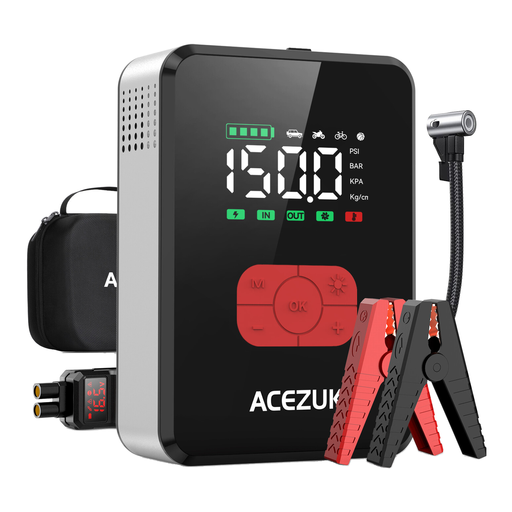
Why This Fits Their Persona: Designed for owners of SUVs, vans, RVs, or vehicles with large-displacement diesel engines, where conventional jump starters fall short.
This device directly addresses the "misleading peak current ratings" pitfall by providing a massive 7000A of power, designed for diesel engines up to 12L. The smart clamp with a display also prevents user error.
Extreme Starting Power: The 7000A peak current is suitable for almost any 12V engine. Smart Clamp with Display: Shows the status and warns against incorrect connections, maximizing safety.
We have compiled a complete, up-to-date list of products that fully meet these strict selection criteria and all relevant safety regulations.
Even when not in use, the battery is subject to a slight self-discharge. It is recommended to fully charge the device every 3 to 6 months to maintain the battery's lifespan and ensure it is ready for an emergency. Always refer to the manufacturer's specific instructions.
Yes, but it is crucial to choose a model with a sufficiently high starting or peak current. Due to their higher compression, diesel engines require significantly more power to start than gasoline engines. Look for models explicitly rated for diesel engines and check the recommended maximum engine size in the product specifications.
Do not run the compressor continuously for longer than recommended by the manufacturer (often a maximum of 10 minutes) to avoid overheating. Allow the unit to cool down between uses. Use the pressure pre-set function to set your vehicle's correct tire pressure and prevent damage to the tire.