
Lieferung heute & morgen

Qualitätsgarantie

Willkommens-Angebote freischalten: KOSTENLOSE Lieferung | Bis zu 80 % RABATT | Kostenlose 30-Tage-JoyPlus-Testphase
App herunterladen
A dead car battery or a flat tire always happens at the worst times—usually early in the morning on your way to work or at night on a deserted country road. A multifunctional jump starter with a compressor promises a quick, independent solution. But the market is flooded with devices making bold promises. Many drivers invest in a supposed all-in-one miracle device, only for it to fail when they need it most.
As your Joybuy Product Recommendation Officer, I'm here to help you spot the common marketing traps and make an informed decision. We'll focus on the technical specs that really matter, ensuring your next roadside emergency kit is a worthwhile investment, not a costly mistake.
Before we look at the important features, you should be aware of the three most common problems that lead to frustration and wasted money:
To make a smart choice, focus on these three core areas. They determine whether a battery booster with a compressor will be a reliable assistant in an emergency.
The performance of a 12V jump starter is determined by two values:
Pro Tip: For common gasoline engines up to 2.5L displacement, devices with 1500–2000 A peak current are often sufficient. For larger gasoline engines or diesel engines up to 3.0L, you should consider models with at least 2500 A. For SUVs, vans, or RVs, units starting from 3000 A are a safer bet.
A good integrated 12V car tire inflator is characterized by the following features:
A high-quality device protects both the user and the vehicle. Look for a comprehensive protection system with at least these features:
A rugged, shock-resistant casing and high-quality battery clamps are also indicators of a longer lifespan and reliable performance.
Here are three recommendations tailored to the different needs of drivers.
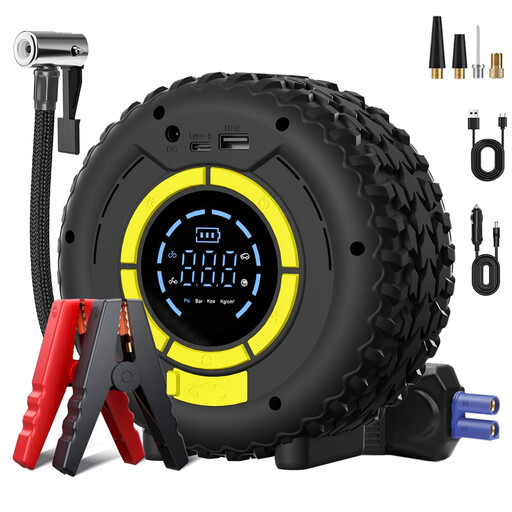
Why it's a good fit: Ideal for drivers of standard cars (gas/diesel) who want a compact, all-in-one solution for the most common roadside emergencies. It combines the essential emergency functions in a device that fits easily in the trunk.
It offers realistic performance for common vehicles instead of advertising exaggerated peak current ratings. The 150 PSI compressor with automatic shut-off is practical, not an empty promise.
Multifunctionality (jump starter, compressor, power bank, LED light) in a lightweight and portable design with a digital display for easy operation.

Why it's a good fit: Designed for owners of SUVs, vans, or vehicles with large diesel engines who need a reliable and powerful jump start, even in cold weather. Ideal for family trips and outdoor adventures.
The high peak current of 4500 A is designed for large engines and is supported by robust construction and cooling technology, ensuring reliable power delivery. The 10 protection features provide safety.
Very high peak current for engines up to 9.0L Gas / 8.0L Diesel. The powerful 150 PSI compressor and bright 500-lumen LED light make it a complete emergency tool.
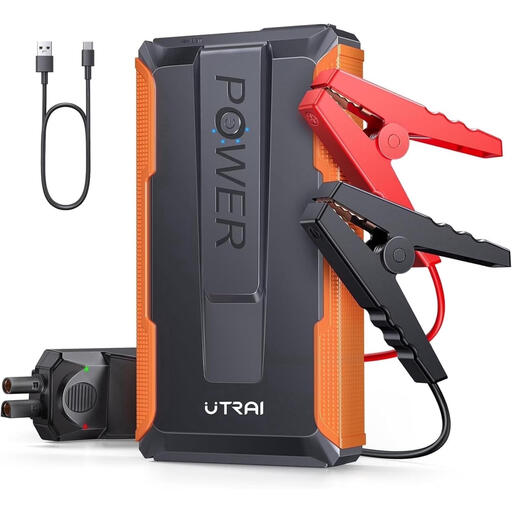
Why it's a good fit: Perfect for drivers who want an extremely small and lightweight jump starter for the glove box and can do without an integrated compressor, perhaps because they already own a separate tire inflator.
It focuses on one core function—jump-starting—and performs it reliably. This avoids the compromise of a weak compressor often found in cheap multifunctional devices.
Extremely compact and lightweight design. It also serves as a fast-charging power bank with a Quick Charge 3.0 USB port for charging smartphones.
We have compiled a complete, up-to-date list of products that fully meet these strict selection criteria and safety standards.
Even when not in use, the battery will lose its charge over time. It is recommended to fully recharge the jump starter every 3 to 6 months to maintain battery life and ensure it is ready for an emergency. Please refer to the manufacturer's specific instructions in the user manual.
A jump starter is designed to give a discharged battery the necessary boost to start the engine. However, it is not a battery charger. A deeply discharged or sulfated (damaged) battery may not be able to accept the starting current and may require maintenance with a special charger or need to be replaced.
Not necessarily. The key is that the device's power matches your vehicle's engine. An oversized unit for a small car offers no practical advantage and is often larger and more expensive. Focus on getting sufficient power for your specific engine type (gas/diesel) and displacement from a trusted brand.