
Lieferung heute & morgen

Qualitätsgarantie

Willkommens-Angebote freischalten: KOSTENLOSE Lieferung | Bis zu 80 % RABATT | Kostenlose 30-Tage-JoyPlus-Testphase
App herunterladen
A dead car battery or a flat tire rarely happens at a convenient time. Whether it's the middle of the night, on a remote country road, or on your way to an important appointment—a breakdown is always a hassle. A jump starter with a compressor promises to be a reliable all-in-one solution for such emergencies. However, the market is flooded with devices whose advertised performance specs often overpromise and underdeliver.
Many drivers invest in such a multi-function device only to find it's useless in a real emergency. To save you from making a bad purchase, we'll highlight the most common pitfalls and show you which technical specifications truly matter.
Common Pitfalls When Buying:
To make an informed decision, don't be swayed by marketing buzzwords. Instead, focus on these three verifiable performance metrics.
The peak current (Peak Amps) is the maximum current the device can deliver for an extremely brief moment. Far more important, however, is the cranking current (Cranking Amps), which describes the continuous power required to start an engine. Due to its higher compression, a diesel engine requires significantly more cranking current than a comparable gasoline engine.
Nearly every portable compressor on the market advertises a maximum pressure of 150 PSI (approx. 10.3 Bar). This value is more than enough for car tires. The crucial, yet often undisclosed, metric is the airflow, measured in liters per minute (L/min). It determines how quickly the tire will inflate.
The capacity, often given in milliampere-hours (mAh), determines how many jump-start attempts or smartphone charges are possible. A car jump starter power bank with 15,000 mAh to 20,000 mAh offers a good balance of performance and portability. Also, look for modern charging ports like USB-C with fast charging capabilities (e.g., 18W) so the device itself can be recharged quickly. A high-quality, portable jump starter should be able to hold its charge for several months.
Based on the objective criteria mentioned above, we have identified devices that represent a well-thought-out solution for specific user groups.
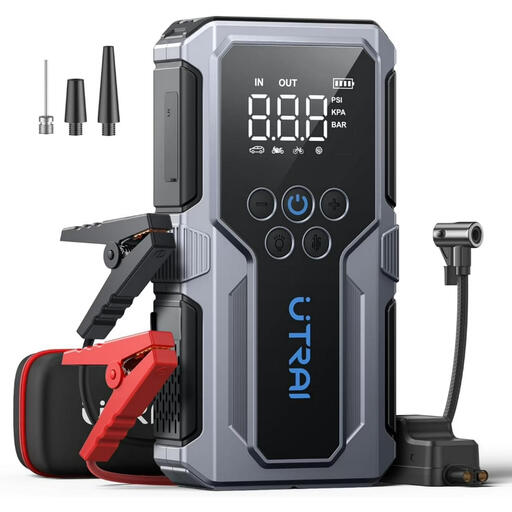
Why This Fits Their Persona: This device offers a balanced combination of jump-starting power for common gasoline and smaller diesel engines, along with a practical compressor. It's ideal for the average driver who needs reliable emergency equipment for daily use and family trips.
The large LED display shows real-time tire pressure, and the auto-shutoff function prevents over-inflation. This bypasses the 'inefficient compressor' trap by enabling precise, controlled use.
The 2-inch LED display, which clearly shows battery level and tire pressure, is a significant advantage over devices with simple indicator lights. The 10 built-in safety protections ensure safe handling.
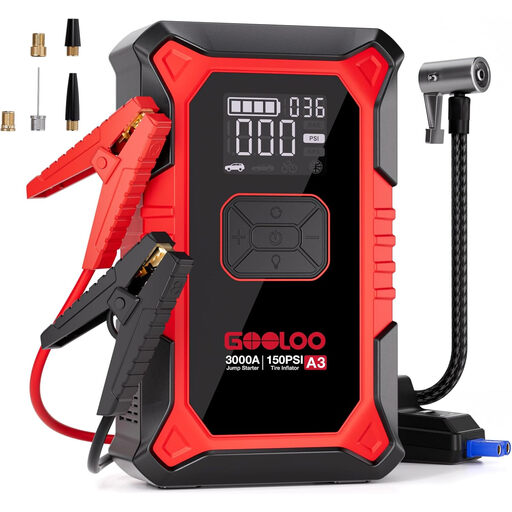
Why This Fits Their Persona: Designed for owners of large-displacement vehicles (up to 9.0L gas/6.5L diesel), campers, and outdoor enthusiasts. The 'BOOST' function for deeply discharged batteries and the compressor's high airflow make it a robust choice for demanding conditions.
This device directly addresses the 'exaggerated peak current' trap by providing a 'BOOST' button for a forced jump-start. The high airflow of 35 L/min ensures the compressor works quickly and efficiently.
The combination of 3000A peak current, a dedicated 'BOOST' function, and a fast compressor (35 L/min) offers a high level of performance for challenging situations. Five preset inflation modes simplify operation.
We have compiled a complete, up-to-date list of products that fully meet these strict selection criteria and safety standards.
To preserve battery life and ensure it's ready when you need it, we recommend fully charging the device every 3 to 6 months, even if it hasn't been used. Store it in a cool, dry place and avoid leaving the device permanently in your car, especially during extreme summer heat or winter cold.
Yes, most models with a maximum pressure of 150 PSI are capable of inflating a completely flat tire. However, the time required depends on the tire size and the compressor's airflow (L/min). For a standard passenger car tire, this can take anywhere from 10 to 20 minutes. This function is designed for emergency use, not for regular workshop use.
No, not necessarily. Diesel engines, especially in cold weather, require a much higher cranking current than gasoline engines. When choosing a diesel jump starter, you should pay close attention to the manufacturer's specifications regarding the maximum supported engine displacement for diesel vehicles. Devices with a high peak current (e.g., 2000A or more) and a verifiably strong cranking current are required for this purpose.