
Lieferung heute & morgen

Qualitätsgarantie

Willkommens-Angebote freischalten: KOSTENLOSE Lieferung | Bis zu 80 % RABATT | Kostenlose 30-Tage-JoyPlus-Testphase
App herunterladen
A dead car battery or a flat tire always happens at the worst possible time. A combo unit that can both jump-start a car and inflate tires seems like the ideal solution for your glove box or trunk. However, the market is flooded with products making lofty promises that they often fail to deliver in practice. Before you make a decision, it's crucial to understand the most common pitfalls that can lead to a costly mistake.
As your Joybuy Product Recommendation Officer, I've summarised the key points you should consider to find a reliable and durable device.
Many devices look impressive on paper but prove useless in an emergency. Pay special attention to these three weak points:
To avoid these traps, you should focus on three verifiable core parameters. These determine whether a jump starter with a compressor is a worthwhile investment or just another unreliable gadget.
The peak current is the most important indicator of a jump starter's power. It must match the size and type of your engine. Due to their higher compression, diesel engines require significantly more power than gasoline engines of the same size.
A good car tire inflator is defined by more than just its maximum pressure.
A car jump starter power bank must be ready for action in an emergency. The quality of the internal battery is critical for this.
Based on these objective criteria, we have identified several models that represent a smart choice for specific user groups.
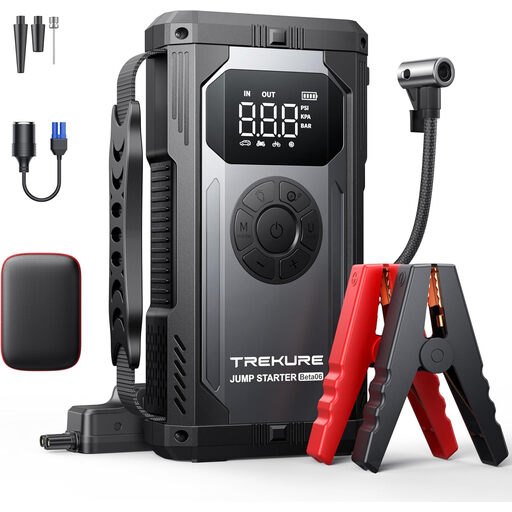
Why It's a Match: Ideal for the typical driver of a sedan, wagon, or mid-size SUV. It combines high starting power, sufficient for most gasoline and many diesel engines, with a functional compressor. This covers the two most common breakdown causes with a single device.
With a specified inflation speed of 35 L/min and an auto-shutoff feature, the compressor is a fully-fledged tool, not just a token feature. The 5500A peak current provides enough reserve power to avoid the trap of being too weak.
A combination of high peak current and a practical compressor with a preset function. The LCD screen clearly displays all relevant data.
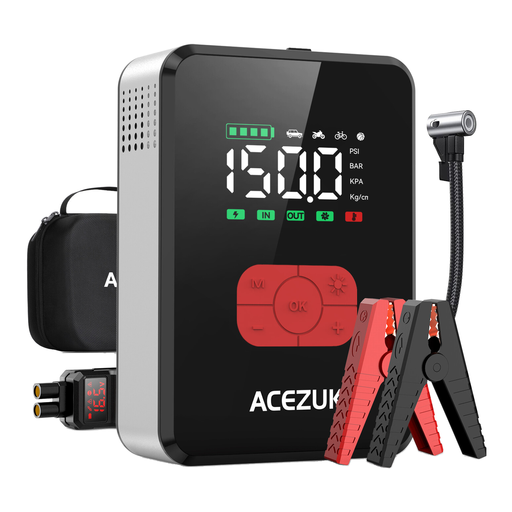
Why It's a Match: Designed for owners of large SUVs, vans, RVs, or vehicles with large-displacement diesel engines. The manufacturer-stated peak current of 7000A delivers the necessary power for demanding starts where weaker devices would fail.
This device addresses the trap of exaggerated performance claims by providing a very high current for engines up to 12L diesel (according to the manufacturer). The smart clamp with its own display also actively prevents incorrect connections.
Extremely high peak current for maximum compatibility with large engines. The patented clamp with a display and warning buzzer provides an additional level of safety for the user.
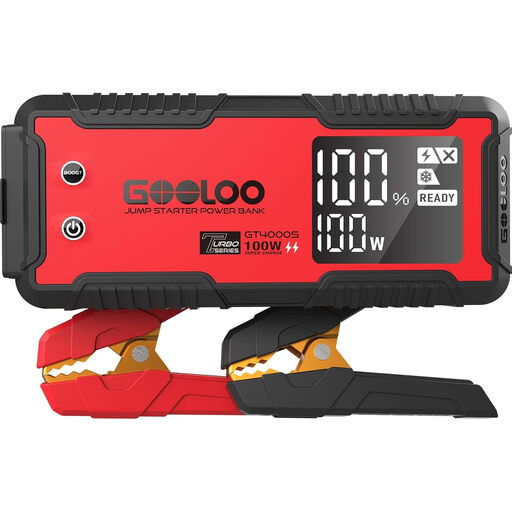
Why It's a Match: Perfect for users who prioritise maximum jump-starting power and fast recharging in a compact package, and who may already own a separate compressor. This device is a pure jump-starting specialist without an integrated compressor.
It avoids the trap of rapid self-discharge through its extremely fast recharging capability. According to GOOLOO, the device is fully charged in just 1.2 hours. It focuses on doing one job—starting—very well, without compromises from extra features.
100W two-way fast charging and a high starting power of 4000A for engines up to 10L diesel (according to the manufacturer) in a relatively compact housing.
We have compiled a complete, up-to-date list of products that fully meet these strict selection criteria and safety regulations.
How often should I charge a jump starter with a compressor? This depends on the self-discharge rate of the specific model. As a rule of thumb, check the charge level every 3 to 6 months and recharge the device if necessary. This ensures it is fully ready for use in an emergency. Always follow the manufacturer's recommendations.
Can I use the integrated compressor to inflate a truck tire? Most integrated compressors are designed for passenger car tires. Although they can often reach the necessary pressure, their air flow rate is too low for the large volume of a truck tire. The inflation process would take an extremely long time and could cause the device to overheat. For commercial vehicles, a dedicated 12V or 24V heavy-duty compressor is the better choice.
What is the difference between peak current and cranking current?Peak current (Peak Amps) is the maximum current the device can deliver for a fraction of a second. It often serves as a marketing metric. Cranking current (Cranking Amps) is the more practical value. It describes the current that can be sustained for several seconds to turn the engine over. However, a high peak current is often a good indicator of a correspondingly high cranking current.