
Lieferung heute & morgen

Qualitätsgarantie

Willkommens-Angebote freischalten: KOSTENLOSE Lieferung | Bis zu 80 % RABATT | Kostenlose 30-Tage-JoyPlus-Testphase
App herunterladen
A dead car battery or a flat tire always happens at the worst time—usually far from the nearest garage. A jump starter with a compressor promises a quick and straightforward solution. But the market is flooded with devices boasting impressive numbers and bold marketing claims. In an emergency, many of these multi-function units prove to be inadequate, leading to frustration instead of the roadside assistance you need.
As your Joybuy Product Recommendation Officer, I'm here to help you separate the wheat from the chaff. We'll highlight the most common pitfalls to avoid when buying and show you which technical specs truly matter, so you can make an informed decision for your vehicle and your safety.
Many buyers focus on the biggest numbers on the packaging—a mistake that manufacturers deliberately exploit. Watch out for these three typical marketing traps:
To avoid falling into these traps, you should check three core parameters before buying. These determine whether a jump starter with an air pump is suitable for your vehicle and will work reliably in an emergency.
The current required for a jump start depends directly on your engine. A simple rule of thumb is:
Always check the manufacturer's specifications for the maximum engine displacement for both petrol and diesel engines.
A good electric tire inflator should do more than just build up high pressure.
The battery's capacity determines how many times you can jump-start your car or charge your smartphone.
Based on these objective criteria, we have identified several models that represent a suitable solution for different types of drivers and vehicles.
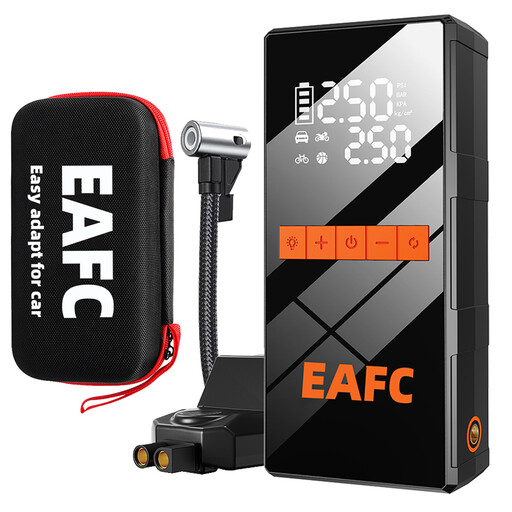
Why this unit is a good fit: Ideal for owners of small petrol cars or motorcycles looking for a compact and affordable emergency kit to keep in the trunk. It covers the basic needs of jump-starting and tire inflation without being overloaded with unnecessary features.
The unit specifies a realistic peak current of 1200 A, designed for petrol engines up to 4.0L. It avoids the trap of exaggerated amperage ratings and delivers honest performance for its intended vehicle class.
A compact 4-in-1 design (jump starter, compressor, power bank, LED light) at an attractive price point. The smart safety clamps protect against user error.
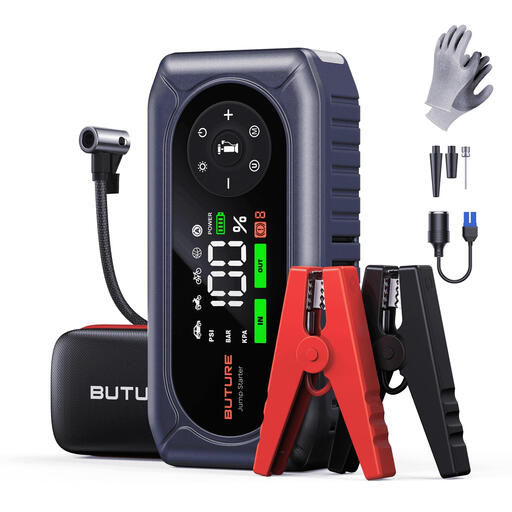
Why this unit is a good fit: Engineered for demanding conditions and large engines. Anyone who drives an SUV, a van, or a vehicle with a large-displacement diesel engine needs the high power reserve offered here to avoid being stranded, especially in the cold.
With 4500 A of peak current and suitability for diesel engines up to 8.0L, this device directly addresses the pitfall of underpowered jump starters. Its reliability in extreme temperatures (-20°C to 60°C) counteracts the problem of power loss in the cold.
Extremely high peak current for maximum compatibility. The cooling system and 10 smart protection features ensure high operational safety even during demanding jump-starts.
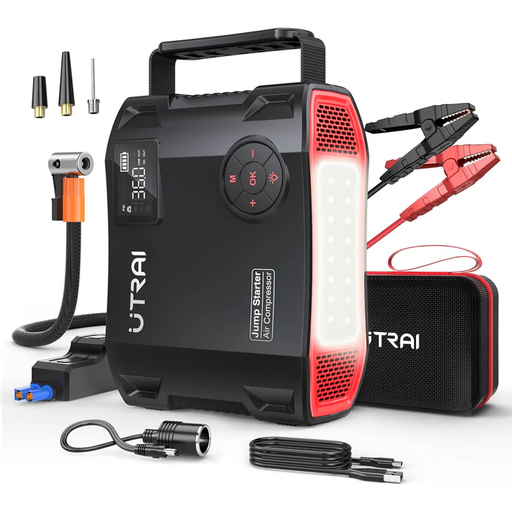
Why this unit is a good fit: For users who want more than just an emergency tool. With an extremely high peak current, large battery capacity, and a DC output for powering coolers or vacuum cleaners, it's the ideal companion for camping trips and long journeys.
This model avoids the weak compressor trap with a high airflow rate of 45 L/min. The large 27,000 mAh battery capacity and fast-charging function ensure the device is always ready, even with intensive use as a power bank.
Enormous power for both jump-starting and the compressor. The additional 12V-16V DC output (up to 160W) expands its use cases far beyond that of a simple emergency kit.
We have compiled a complete, up-to-date list of products that fully meet these strict selection criteria and UK safety regulations.
1. How often do I need to charge a jump starter with a compressor? Most manufacturers recommend fully charging the device every 3 to 6 months, even if it's not used. This compensates for the battery's natural self-discharge and ensures it has enough power in an emergency. Check the specific recommendations in your device's manual.
2. Can I use a jump starter to revive a completely dead battery? Yes, many modern devices have a "Boost" or "Force Start" function. This bypasses the standard safety checks and supplies power even when the vehicle's battery is so discharged that the device can no longer detect it. However, this function should be used with caution and only according to the instructions, as the reverse polarity protection is often disabled in this mode.
3. Is a higher peak current always better? Not necessarily. An extremely high peak current is only useful if you have a vehicle with a very large engine (especially a diesel). For a standard petrol car, a 4000 A unit is overkill and unnecessarily expensive. It's more important that the peak current and starting current match your vehicle's engine displacement and type. A balance of power, battery capacity, and quality is more crucial than a single, maximum amperage rating.