
Lieferung heute & morgen

Qualitätsgarantie

Willkommens-Angebote freischalten: KOSTENLOSE Lieferung | Bis zu 80 % RABATT | Kostenlose 30-Tage-JoyPlus-Testphase
App herunterladen
A dead car battery or a flat tire always happens at the worst possible time. A jump starter with an air compressor promises to solve both problems with a single device. However, the market is flooded with models whose performance claims often overpromise and underdeliver. Many drivers invest in a multi-function device, only to discover in an emergency that the peak current is too weak for their engine, or the compressor can't inflate the tire to the target pressure.
As your Joybuy Product Recommendation Officer, I'm here to help you separate the wheat from the chaff. We'll highlight the most common pitfalls and show you which technical specs really matter, so you can make an informed decision.
Before you decide on a model, you should be aware of the typical marketing traps that often lead to disappointment.
To avoid the pitfalls mentioned above, focus on the following objectively measurable criteria. These determine whether a 12V jump starter will work reliably in an emergency.
The peak current is the maximum amperage the device can deliver for a short burst to start the engine. The required power depends on the displacement and type of your engine.
A compressor's performance is measured in Bar or PSI (Pounds per Square Inch). A typical car tire requires a pressure between 2.2 and 2.5 Bar (~32-36 PSI).
The battery capacity, specified in milliampere-hours (mAh), determines how many jump-start attempts are possible or how many times you can charge your smartphone. A good car jump starter power bank should offer at least 15,000 mAh. Also, look for fast-charging ports (USB-C PD), an integrated LED flashlight with an SOS function, and a clear display that shows the battery level and tire pressure.
Here are some models that represent a smart choice for different user profiles based on their technical specifications.
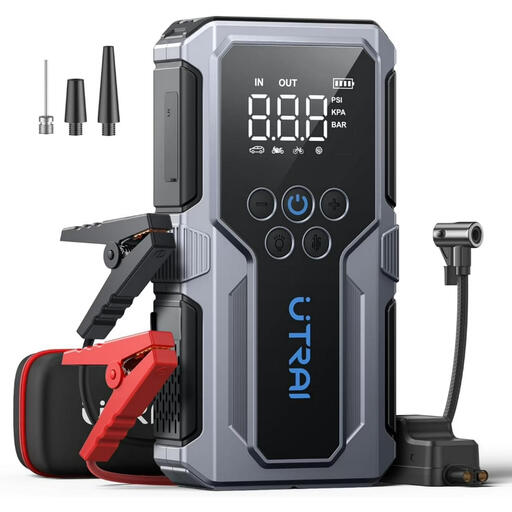
Why This Fits Their Persona: Ideal for campers, owners of large SUVs or diesel vehicles, and anyone looking for a comprehensive emergency solution on the go. The combination of high jump-starting power and a full-featured compressor covers the most common breakdown causes.
With a stated peak current of 3000A, it's designed for large gasoline (up to 8.5L) and diesel engines (up to 6.5L). The 150 PSI compressor with digital pressure preset and auto-shutoff bypasses the problem of underpowered inflator modules.
Comprehensive 5-in-1 functionality (jump starter, compressor, power bank, LED light, 10 safety features) in a compact housing. The clear LCD display shows all relevant information.

Why This Fits Their Persona: Perfect for drivers of standard passenger cars (gasoline or smaller diesels) who want a compact and reliable jump starter for the glove compartment. The focus is on the core function, without the extra bulk of a compressor.
This device focuses on one job, avoiding the compromise of a weak multi-function device. The 2000A peak current rating is a realistic and sufficient power level for most common vehicles (up to 7L gas/6L diesel).
Very compact design for easy storage. The LED display clearly shows the battery status, and the integrated safety features ensure safe use.
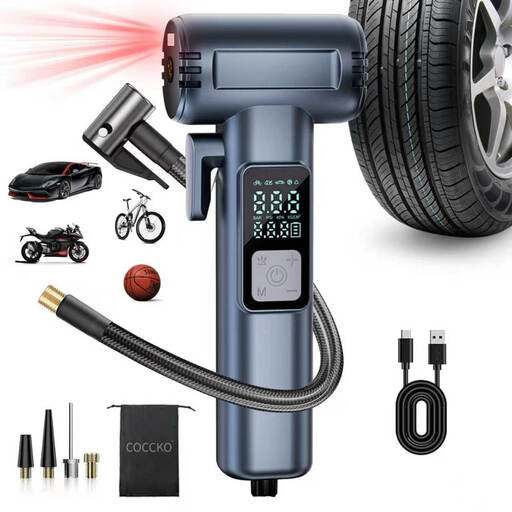
Why This Fits Their Persona: For users whose main focus is on regular tire pressure checks and quick top-offs in case of pressure loss. Ideal for car, motorcycle, and bicycle riders who prefer a cordless and handy solution.
This device is a specialized electric tire inflator and doesn't promise jump-starting capabilities. It delivers solid compressor performance of up to 10.3 Bar and a fast inflation rate, which avoids the pitfall of a weak add-on module.
Cordless operation thanks to a 4000 mAh battery. The smart LCD display with auto-shutoff and the additional emergency tools (safety hammer, seatbelt cutter) offer high practical value.
We have compiled a complete, real-time updated list of products that fully meet these strict selection criteria and rigorous safety standards.
1. How often do I need to charge a jump starter with a compressor? Even when not in use, the battery will slowly discharge. It is recommended to fully charge the device every 3 to 6 months to maintain the battery's performance and ensure it is ready for an emergency.
2. Can I use a 3000A jump starter on smaller engines? Yes, that is perfectly safe. Modern jump starters are equipped with intelligent protection circuits. The device only delivers as much current as the vehicle's starter motor requests. A higher amp rating simply means a larger power reserve, which is particularly advantageous in cold temperatures or with a deeply discharged battery.
3. What is the difference between peak current and cranking amps? Peak current (or Peak Amps) is the maximum current the device can deliver for a fraction of a second. Cranking amps is the current that can be sustained for several seconds to turn the engine over. Cranking amps is the more practical, real-world value, but it is less frequently advertised by manufacturers. A high peak current is often an indicator of a solid cranking current as well.