
Lieferung heute & morgen

Qualitätsgarantie

Willkommens-Angebote freischalten: KOSTENLOSE Lieferung | Bis zu 80 % RABATT | Kostenlose 30-Tage-JoyPlus-Testphase
App herunterladen
A dead car battery or a flat tire always happens at the worst possible time—be it on your morning commute, a long road trip, or a cold winter day. A jump starter power bank with compressor promises a quick and straightforward solution. However, the market is flooded with devices whose performance claims often promise more than they can deliver. Many drivers invest in a multi-function tool, only to discover in an emergency that it's unsuitable for their vehicle.
As your Joybuy Product Recommendation Officer, I'm here to help you separate the good from the bad. We'll shine a light on the most common pitfalls and show you which technical specs truly matter, so you can make an informed decision and not fall for empty marketing promises.
Before you choose a model, you should be aware of the typical flaws in low-quality devices that lead to frustration and unnecessary expense.
To avoid a bad purchase, you should focus on three objective technical features. These will determine if a device is right for your needs.
Peak current is a starting point, but the crucial question is: What engine size is the car jump starter designed for? Manufacturer specifications like "suitable for up to 9.0L Gas / 8.0L Diesel" are the most reliable indicator here. A small car with a gasoline engine requires significantly less power than an SUV with a diesel engine. As a rule of thumb:
A good 12V tire inflator should reach a maximum pressure of at least 100 PSI (approx. 7 Bar), with 150 PSI (approx. 10 Bar) being even better. This ensures that even tires on larger vehicles can be fully inflated. Look for the following features:
The capacity of the internal battery, specified in milliamp-hours (mAh), determines how many times you can jump-start a car or how long you can charge your smartphone before the power bank for the car itself needs to be recharged. A high capacity is beneficial, but safety features are even more important. A high-quality 12V jump starter will have smart clamps with protection against:
Based on the criteria above, we have identified a few models that represent a smart choice for specific user groups.
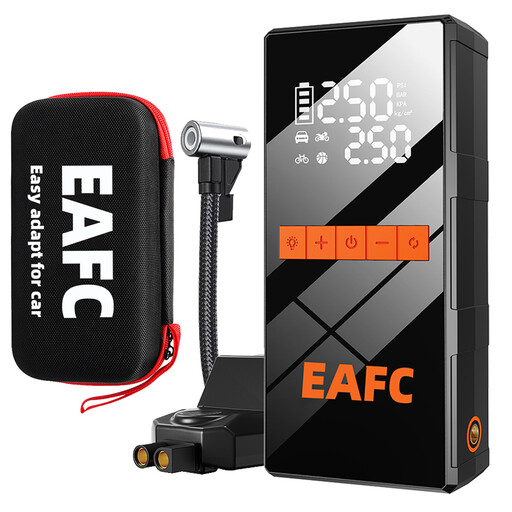
Why This Fits Their Persona: This model offers a solid all-in-one solution for drivers of gas engines up to 4.0L. It's compact enough for the glove compartment and reliably covers the most common breakdowns (dead battery, flat tire) in daily use without breaking the bank.
It avoids the trap of unrealistic performance claims by clearly defining its engine compatibility. The 150 PSI compressor with auto-shutoff is designed for standard car tires and is practical for real-world use.
Combines 4 functions (jump starter, compressor, power bank, LED light) in a very compact and affordable package.
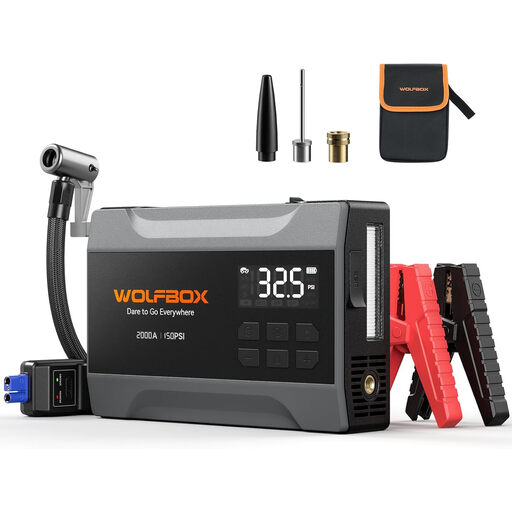
Why This Fits Their Persona: With 2000A of peak current, this device offers enough reserve power for mid-size gas engines (up to 5.0L) found in many SUVs and crossovers. The powerful compressor is ideal for the larger tires of this vehicle class and for camping gear.
It avoids the compressor trap by integrating a robust 150 PSI inflator that doesn't overheat at higher pressures and can reliably fill an SUV tire.
A good balance of increased starting power (2000A) and a capable compressor designed for the demands of larger car tires.

Why This Fits Their Persona: For owners of RVs, vans, or large-displacement diesel vehicles, maximum power isn't a luxury—it's a necessity. The BUTURE BC02 delivers the necessary force with 4500A of peak current to reliably start even large engines (up to 8.0L diesel).
This device sidesteps the trap of empty promises with demonstrably high performance. Its 10-level protection technology and cooling system directly address the safety and durability shortcomings of cheaper alternatives.
Extremely high peak current for large engines; comprehensive safety package; robust design for demanding conditions.
We've compiled a complete, up-to-date list of products that fully meet these strict selection criteria and safety regulations.
To preserve the life of the internal battery and ensure the device is ready in an emergency, it's recommended to fully charge it every 3 to 6 months, even if it hasn't been used. Most models have a charge level indicator that shows you the current status.
Yes, models with a powerful compressor (e.g., 150 PSI) are designed for this. Note that inflating a completely flat tire can take several minutes. It's advisable to follow the manufacturer's specifications for the compressor's maximum continuous runtime (often around 10 minutes) to prevent overheating.
Modern jump starters with smart jumper cables are designed to be very safe. They have built-in protection mechanisms that prevent sparking, short circuits, and damage from reverse polarity (connecting the clamps incorrectly). Typically, indicator lights on the clamps will signal whether the connection is correct and safe before you initiate the jump-start process.