
Lieferung heute & morgen

Qualitätsgarantie

Willkommens-Angebote freischalten: KOSTENLOSE Lieferung | Bis zu 80 % RABATT | Kostenlose 30-Tage-JoyPlus-Testphase
App herunterladen
A dead car battery or a flat tire can happen unexpectedly and always at the worst possible time. In moments like these, a reliable multi-function tool in your trunk is crucial for getting back on the road quickly. A jump starter with a compressor combines two essential roadside assistance functions into one compact device. However, the market is flooded with products making lofty promises. This guide will help you separate the wheat from the chaff and make an informed purchasing decision.
As a Joybuy Product Recommendation Officer, I analyze product data for you and filter out the crucial information so you don't fall for exaggerated marketing.
Before you invest, you should be aware of the three most common problems that occur with low-quality devices, leading to frustration instead of a quick fix.
To avoid these pitfalls, focus on verifiable technical data. These three core parameters determine the reliability and usefulness of your device.
The most important task is starting your vehicle. Pay attention to two values here: the peak current (Peak Amps) and the cranking current (Cranking Amps). The peak current is a short burst, but more important is the cranking current, which must be sustained for several seconds. A good 12V jump starter should provide clear information about its compatibility with engine sizes (e.g., "for gasoline engines up to 6.0L"). Check if the device is designed for your 12V electrical system, which is the case for almost all cars, motorcycles, and RVs. Such a battery booster makes you independent of roadside assistance.
A powerful portable air compressor is defined by two key metrics:
Modern devices also offer an auto-shutoff feature, where the desired target pressure is preset. This prevents over-inflation and ensures safety.
The capacity of the internal battery, specified in milliamp-hours (mAh), determines how many times you can jump-start a car or charge a smartphone. A solid car jump starter power bank should offer at least 8000 mAh to be prepared for multiple uses. Useful additional features that round out a good roadside emergency kit include an integrated LED light with different modes (solid, strobe, SOS) for use in the dark, as well as various adapter nozzles for balls, bicycle tires, or air mattresses.
Based on these objective criteria, we have identified products for different user groups.
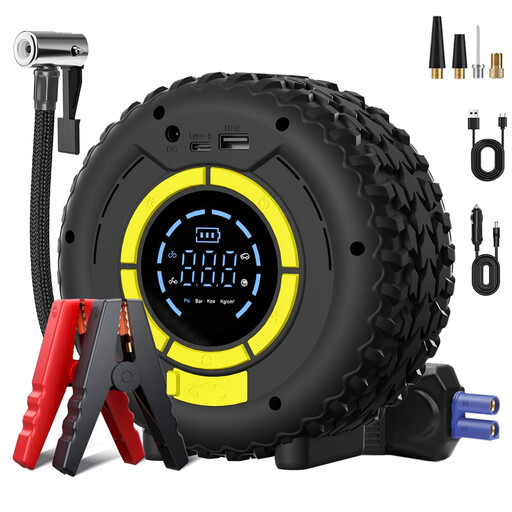
Why It's a Good Fit: Ideal for drivers who want a compact, all-in-one solution for the most common breakdowns—a dead battery and a flat tire—without having to carry multiple devices.
The digital LCD display shows tire pressure accurately, avoiding the problem of imprecise gauges. Its compatibility with both gasoline and diesel vehicles, along with a wide operating temperature range (-20°C to 60°C), indicates a robust design.
Combines a 120W jump starter with a 150 PSI compressor. The 8000 mAh capacity also serves as a power bank. Four intelligent modes for the compressor simplify operation.

Why It's a Good Fit: Perfect for users whose main concern is tire maintenance. Ideal for car, motorcycle, and bicycle riders who need a fast, cordless, and very compact solution for on-the-go use.
Addresses the pitfall of slow compressors with a specified airflow rate of 35 L/min. The smart LCD display with auto-shutoff ensures precise results and prevents damage from over-pressurization.
Focuses on fast, cordless inflation. At under 500g, the device is extremely lightweight and portable. The 4000 mAh battery is rechargeable via USB-C and can also power other devices.
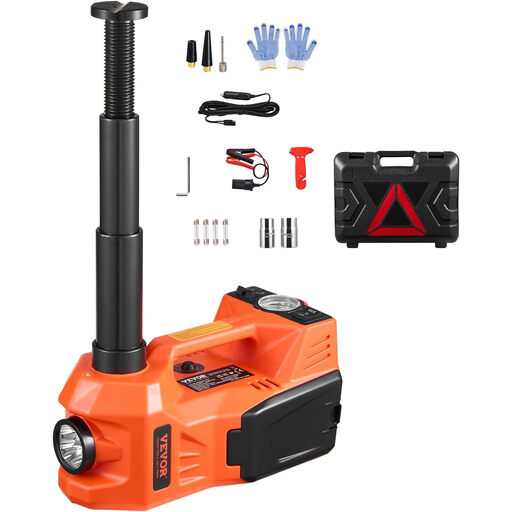
Why It's a Good Fit: For vehicle owners, especially of SUVs or light trucks, who want to be prepared for a full tire change and wish to avoid the manual effort of a conventional car jack.
This is a specialized tool, not an overloaded gadget. Its design for a lifting capacity of up to 5 tons indicates a robust and durable construction, optimized for its intended purpose—safely lifting vehicles.
Allows a vehicle to be lifted in about 2 minutes at the push of a button via the 12V cigarette lighter socket. The kit also includes a built-in pump and an emergency hammer, making it a comprehensive tool for tire changes.
We have compiled a complete, up-to-date list of products that fully meet these strict selection criteria and UK safety regulations.
1. How often do I need to charge a jump starter with a compressor? It is recommended to fully charge the device every 3 to 6 months, even if it has not been used. This maintains the health and performance of the battery. Always refer to the manufacturer's specific instructions in the user manual.
2. Can I inflate any car tire with such a device? Most of these combination devices are designed for standard tires on cars, motorcycles, and bicycles. Compare the maximum pressure (PSI/Bar) of the device with the recommended pressure for your tires. For very large tires, such as those on trucks or large RVs, a more powerful, dedicated compressor may be required.
3. Is a 12V jump starter suitable for my diesel vehicle? This depends on the device and the engine. Diesel engines often require a higher current to start than gasoline engines. Therefore, carefully check the product specifications. Reputable manufacturers will state which engine sizes (in liters of displacement) and types (gasoline/diesel) their device is suitable for.