
Lieferung heute & morgen

Qualitätsgarantie

Willkommens-Angebote freischalten: KOSTENLOSE Lieferung | Bis zu 80 % RABATT | Kostenlose 30-Tage-JoyPlus-Testphase
App herunterladen
A dead car battery or a flat tyre always happens at the worst possible time. A jump starter with an air compressor promises to solve both problems with a single device. However, the market is flooded with models making grandiose marketing claims that often fail to deliver in practice. As your Joybuy Product Recommendation Officer, I'll help you separate the wheat from the chaff and make an informed decision. We'll highlight the three most common pitfalls buyers fall into and show you what really matters.
Many devices look convincing at first glance, but crucial weaknesses are often revealed in the details. Pay attention to these points to avoid a bad purchase.
To find the right portable jump starter for your needs, you should carefully examine three core features. These determine reliability and safety when it counts.
The required peak current depends directly on your vehicle's engine. As a rule of thumb:
The maximum pressure, often indicated in PSI or BAR, shows the limit to which the compressor can inflate (e.g., 150 PSI). Just as important is the airflow rate, measured in litres per minute (L/min). A higher value means the tyre inflates faster. A good jump starter with an air compressor should be able to inflate a car tyre from 0 to approx. 2.5 BAR (36 PSI) in under 5-7 minutes. A precise, automatic shut-off function is essential to avoid damaging the tyre.
The capacity, given in milliampere-hours (mAh), determines how many jump-start attempts are possible and how many times you can charge your smartphone. A good power bank with jump starter functionality not only provides energy for the car but also serves as a portable power source for USB devices. An integrated LED torch with various modes (solid, strobe, SOS) completes a good car emergency kit and is invaluable during a breakdown at night.
Instead of presenting an overwhelming list, we have selected models that fit specific user profiles and avoid the pitfalls mentioned earlier.
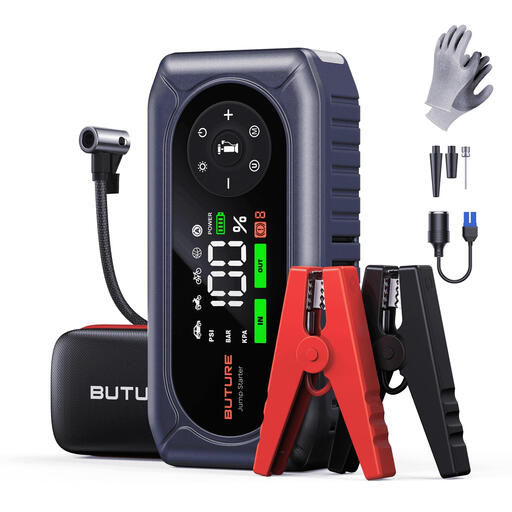
Why This Fits Their Persona: Ideal for drivers of SUVs, estate cars, or vans who need a reliable all-in-one solution for family trips and daily use. The high power output covers even larger engines, and the compressor is equally practical for car and bicycle tyres.
The 4500A peak current is rated for petrol engines up to 9.0L and diesel engines up to 8.0L, providing a realistic power reserve. Its cooling technology reduces heat build-up, preventing the compressor from falling into the overheating trap. 10 built-in safety protections are included.
5-in-1 functionality (Jump Starter, Compressor, Power Bank, LED Light, 12V Port). The digital compressor with 5 presets and automatic shut-off is particularly user-friendly.
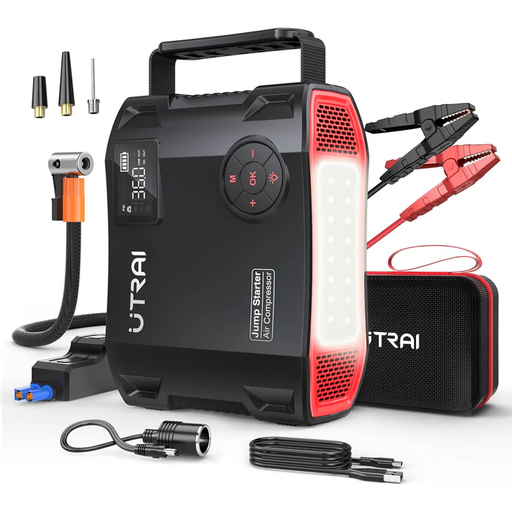
Why This Fits Their Persona: Perfect for owners of motorhomes, vans, or large diesel SUVs. Anyone who needs maximum starting power and refuses to compromise will find this device suitable. It's also great for powering 12V appliances like portable coolers.
Directly addresses the weak peak current pitfall with 6000A and compatibility for diesel engines up to 10.0L. The high 27000mAh battery capacity ensures endurance, and the compressor delivers a high airflow rate of 45L/min, which helps prevent overheating.
Very high starting power and battery capacity. The additional 12V-16V DC output (up to 160W) is a clear differentiator and significantly expands its use cases. Fast charging via 18W USB-C.
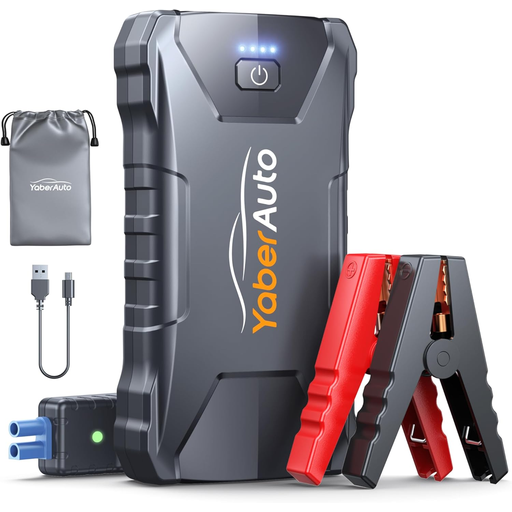
Why This Fits Their Persona: For drivers of small to mid-size cars who want an extremely compact device that fits in the glove box. This model focuses on the core functions of a jump starter and power bank without the extra bulk of a compressor.
This model sidesteps the weak compressor trap by intentionally omitting one. It focuses on reliable starting power (2000A for up to 7.0L petrol) and integrates 10 safety features into a very lightweight (0.340 kg) package.
Extremely compact and lightweight, fits easily into the glove compartment. Its function as a 13800mAh car jump starter power bank is very useful for daily use and travel. The LCD screen clearly displays the remaining battery level.
We have compiled a complete, up-to-date list of products that fully meet these strict selection criteria and UK safety regulations.
1. How often do I need to charge a jump starter with an air compressor? Even when not in use, the battery will slowly self-discharge. To maintain battery life and ensure the jump starter is ready for an emergency, most manufacturers recommend fully charging the device every 3 to 6 months.
2. Can I use a jump starter on a completely dead or deeply discharged battery? Many modern devices feature a "Boost" or "Force Start" function. This bypasses the standard safety checks to jump-start batteries with very low voltage (sometimes below 3V). However, this function should be used with caution and exactly according to the manufacturer's instructions, as some automatic protection mechanisms may be disabled.
3. Is a higher peak current always better? Not necessarily. The crucial factor is compatibility with your vehicle. A device with 4000A peak current offers no practical advantage for a small car with a 1.4L petrol engine compared to a 1500A model, but it will usually be more expensive and larger. Choose a device whose performance class matches your largest vehicle (e.g., family SUV or diesel van).