
Lieferung heute & morgen

Qualitätsgarantie

Willkommens-Angebote freischalten: KOSTENLOSE Lieferung | Bis zu 80 % RABATT | Kostenlose 30-Tage-JoyPlus-Testphase
App herunterladen
A dead car battery or a flat tyre never happens at a convenient time. These breakdowns can cause significant stress, especially on your way to work, during a holiday, or in bad weather. A multifunctional jump starter with a built-in compressor offers a reliable solution to get you back on the road quickly and independently. This article serves as an objective buying guide to help you understand the technical specifications and find the right device for your needs.
The market is flooded with options. To make an informed decision, a few technical parameters are crucial.
The peak current, measured in amperes (A), is the most important metric for a car jump starter. It indicates how much energy the device can deliver in a short burst to start the engine. A higher peak current is necessary for larger engines, especially for a diesel jump starter.
Always check the manufacturer's specifications regarding compatibility with petrol and diesel engines (engine displacement in litres).
The integrated compressor is more than just an add-on. Its performance, indicated in PSI (Pounds per Square Inch) or Bar, determines how quickly and effectively you can inflate tyres. A rating of 150 PSI is a good standard, sufficient for most car, motorcycle, and bicycle tyres. Look for additional features like an auto-shutoff function that stops inflation once the target pressure is reached to prevent over-inflation.
The battery capacity, measured in milliampere-hours (mAh), determines how many jump-starts are possible and how often you can charge external devices. Many models double as a power bank with jump-starting capabilities and feature USB ports (e.g., Quick Charge 3.0) to charge smartphones or tablets. A built-in LED light with various modes (flashlight, strobe, SOS) is a valuable aid during nighttime breakdowns and enhances safety.
Based on the criteria mentioned above, we have curated a selection of devices that cater to different needs.
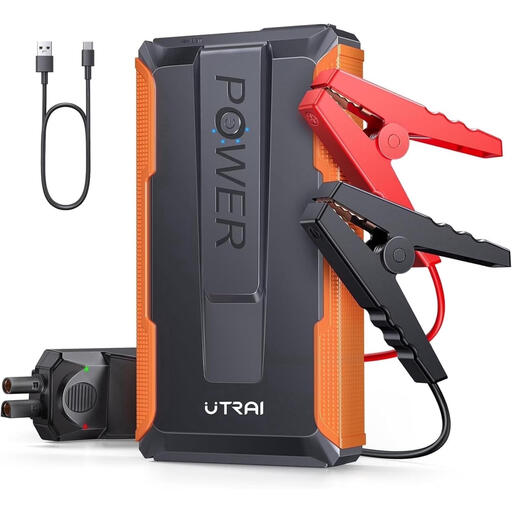
Why It Stands Out: The UTRAI T1 combines solid jump-starting power with a very compact and rugged design. The smart clamps with an audible alarm make it exceptionally safe, even for novices.
Pros:
Who Is It For? This model is an excellent choice for commuters and families with standard cars or SUVs. It offers a well-balanced combination of power, portability, and safety features for everyday emergencies.
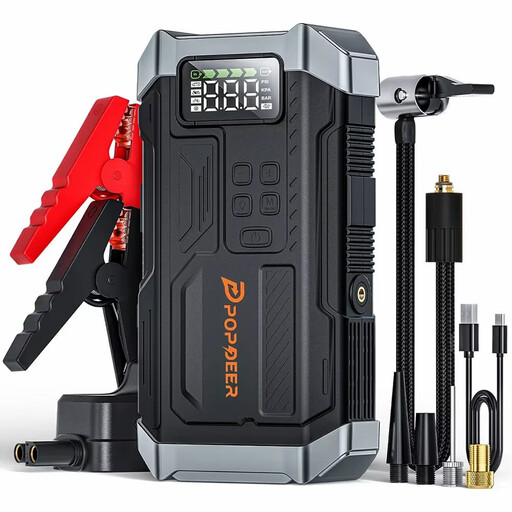
Why It Stands Out: With a peak current of 5000 A and a high-performance compressor, the POPDEER PD-JA3 is built for demanding tasks. Its ability to start vehicles even with deeply discharged batteries makes it an especially versatile tool.
Pros:
Who Is It For? Ideal for owners of large vehicles like vans, RVs, or high-performance diesel SUVs. It's also perfect for outdoor enthusiasts who need a single, powerful device for various emergencies.
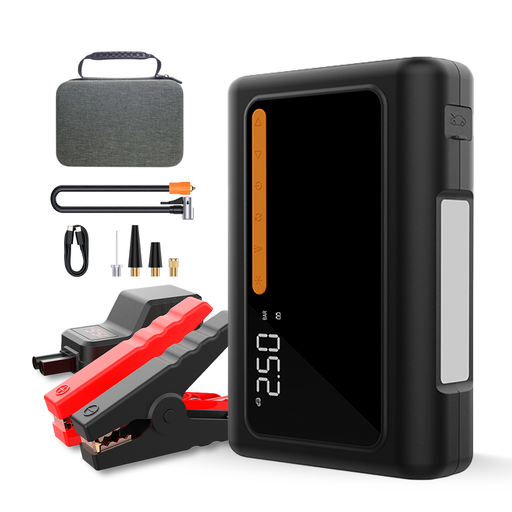
Why It Stands Out: The GOKKCL GK01 features an innovative sodium-ion battery. This technology offers key advantages in terms of safety and longevity, especially in extreme temperatures.
Pros:
Who Is It For? Perfect for drivers in regions with very cold winters or hot summers. Anyone who prioritises maximum safety, durability, and low maintenance will find this to be a future-proof solution.
The requirements for a portable jump starter are as unique as the vehicles and their owners. If the models presented here don't perfectly match your needs, there are more options to explore.
Discover our full range of High-Performance Car Battery Starters to find the perfect device for your requirements.
The required amperage depends on the engine type and displacement. As a rule of thumb:
This depends on the battery technology and the manufacturer's specified operating temperature range. Standard lithium-ion batteries should not be permanently exposed to extreme heat (above 60°C) or cold (below -20°C). Models with special technology, like the GOKKCL GK01 with its sodium-ion battery, are designed for a broader temperature range (-40°C to 80°C) and can therefore be left in the vehicle with greater peace of mind.
Modern jump starters have multiple protection mechanisms to prevent damage to the device, the vehicle's electronics, and injury to the user. The most important ones are: