
Lieferung heute & morgen

Qualitätsgarantie

Willkommens-Angebote freischalten: KOSTENLOSE Lieferung | Bis zu 80 % RABATT | Kostenlose 30-Tage-JoyPlus-Testphase
App herunterladen
A dead car battery or a flat tire always happens at the worst possible time. A jump starter with a compressor promises a quick solution, combining two essential tools into one device. However, the market is crowded, and many products don't live up to their advertising claims. As your Joybuy Product Recommendation Officer, I'll help you separate the wheat from the chaff and find a reliable device for your needs. We'll highlight the most common pitfalls and the technical specs that truly matter.
Many drivers invest in a combination device only to find it useless in an emergency. This is often due to exaggerated marketing promises and hidden flaws.
To avoid a bad purchase, you should focus on objective, verifiable parameters. These three criteria are crucial for selecting a functional device.
The peak current is the maximum amperage the device can deliver for a brief moment to start the engine. The required power depends on your vehicle:
Therefore, pay close attention to the manufacturer's specifications regarding compatibility with gasoline and diesel engines. A suitable car battery booster is the foundation of a functional roadside emergency kit.
The battery capacity, measured in milliamp-hours (mAh), determines how many times you can jump-start a car or charge your smartphone before the device itself needs recharging. However, the technology used is more important than the number alone. Modern lithium-ion batteries are the standard, as they are compact and powerful. Some newer models use sodium-ion batteries, which, according to manufacturers, may offer greater cycle stability and a wider operating temperature range. A good portable jump starter for gas & diesel should be able to hold its charge for several months.
An integrated cordless tire inflator is only useful if it actually works. Look for the following features:
A good jump starter with an air pump has an easy-to-read display showing the current pressure and comes with various adapters for balls or bicycle tires.
Based on the criteria above, we have selected a few models from our range that are suitable for different user profiles.
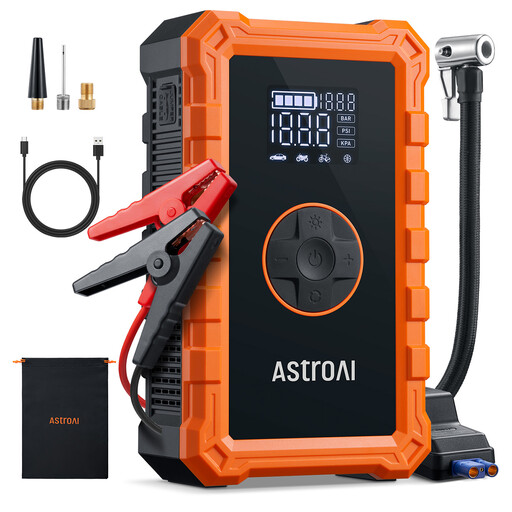
Why This Fits Their Persona: Ideal for owners of small to mid-size cars who want a reliable all-in-one emergency solution without breaking the bank. The device is compact and easy to use.
The performance specs (1500A peak, 150 PSI) are realistic for the stated engine compatibility (up to 6.0L Gas/3.0L Diesel). The compressor's auto-shutoff feature prevents user error.
Combines a jump starter, compressor, power bank, and LED light in a compact design. The large 2.4-inch display clearly shows all relevant information.

Why This Fits Their Persona: Perfect for drivers of SUVs, station wagons, or larger sedans. It offers high power reserves for daily commutes and long road trips, ensuring you're prepared for any eventuality.
With 4500A peak current and compatibility for large engines (up to 9.0L Gas/8.0L Diesel), the device delivers the necessary power even under load. 10 built-in safety features minimize the risk of user error.
Very high jump-starting power for its class. The LCD screen clearly displays all important data, and the 500-lumen LED light is a practical tool for roadside emergencies in the dark.
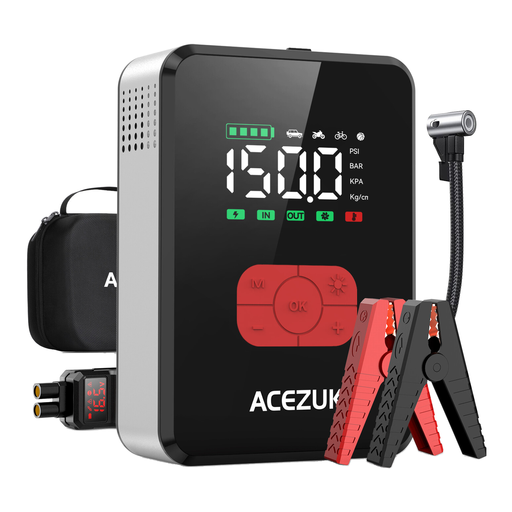
Why This Fits Their Persona: Designed for owners of RVs, vans, boats, or vehicles with large-displacement diesel engines who need maximum starting power and reliability, even in extreme conditions.
With 7000A peak current and a 26800mAh capacity, this device is built for the most demanding tasks. Its compatibility with diesel engines up to 12L is a clear, verifiable specification.
Enormous power reserves for nearly all 12V vehicles. The patented clamp with an integrated display and warning buzzer provides additional safety during use.
We've compiled a complete, up-to-date list of products that fully meet these strict selection criteria and safety regulations.
Even when not in use, the battery loses its charge over time. Most manufacturers recommend fully charging the device every 3 to 6 months to maintain battery life and ensure it's ready for an emergency. Please refer to the specific instructions in your device's manual.
Yes, most of these devices are designed for a wide temperature range, often from -20°C to +60°C (-4°F to 140°F). Therefore, they can typically be left in the vehicle. However, avoid exposing the device to direct sunlight for extended periods in the summer, as extreme heat can damage the battery.
Peak current (or Peak Amps) is the maximum current the device can deliver for a fraction of a second. Starting current (or Cranking Amps) is the current that can be sustained for several seconds to turn the engine over. The starting current is technically a more meaningful metric, but it is not specified by most manufacturers. Therefore, the peak current serves as a common, albeit imperfect, benchmark for the performance of a 12V jump starter.