
Lieferung heute & morgen

Qualitätsgarantie

Willkommens-Angebote freischalten: KOSTENLOSE Lieferung | Bis zu 80 % RABATT | Kostenlose 30-Tage-JoyPlus-Testphase
App herunterladen
A jute rug brings natural texture to living rooms, bedrooms, hallways and entryways. At the same time, models can differ considerably in their material composition, weave, weight, dimensions and care requirements. Choosing based solely on colour or price can quickly mean overlooking important details.
Typical purchasing mistakes include:
A rug made from 100% jute consists entirely of the specified jute fibres. This creates a distinctive, subtly irregular surface and a naturally muted colour palette. Other variants may incorporate a cotton pattern, as with the “Juna Essence” model. According to the product description, this design combines jute with a geometric cotton pattern.
The term “natural rug”, on the other hand, initially describes only the style or the use of natural materials. It does not automatically confirm a specific fibre content. Anyone looking for a natural jute rug should therefore pay attention to the following details:
Product claims such as “sustainable”, “environmentally friendly” or “recyclable” should also be interpreted carefully. According to the product description or manufacturer information, this is presented accordingly for the “Lola” and “Nitin” models. However, this does not constitute general proof of their overall environmental impact, including transport, packaging or disposal.
Before buying, it is advisable to mark out the intended area with masking tape or sheets of newspaper. This makes it easier to check whether doors, drawers and chair legs can still move freely.
For a rectangular jute rug, the longer side should align with the room or furniture arrangement. A runner should not be so wide that doors catch on it. On smooth floors, a suitable rug pad is recommended to keep the rug more securely in place.
Weight can indicate the amount of material used, but it does not replace an inspection of the edges, underside and overall workmanship. The “Natural Bengal” is listed with a material weight of 2700 g/m² and a pile height of approximately 1 cm. Its distinctive zigzag weave in natural and grey sets it apart visually from plain-colour models.
A handwoven jute rug may feature slight variations in texture, colour and shape. This is not unusual with natural fibres, but it should be taken into account when planning your interior. Models with a clearly defined geometric cotton structure, such as “Juna Essence”, are particularly well suited to modern, Scandinavian and nature-inspired interiors. A simple natural design, by contrast, also complements rustic or boho-inspired rooms.
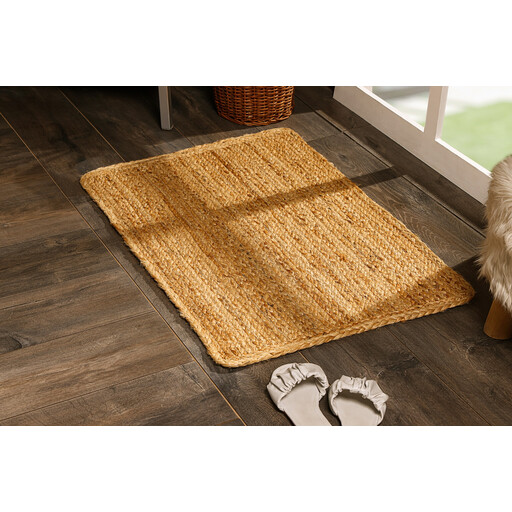
Why does it fit the brief? Its compact dimensions suit small areas, entryways or anyone looking for their first natural-fibre rug in a rented apartment.
The product details specify 100% pure jute together with the exact dimensions of 90 × 60 cm. This makes it possible to verify both the material and the space requirements before buying.
Natural-coloured jute, a height of 1 cm and a weight of 1 kg according to the product data.
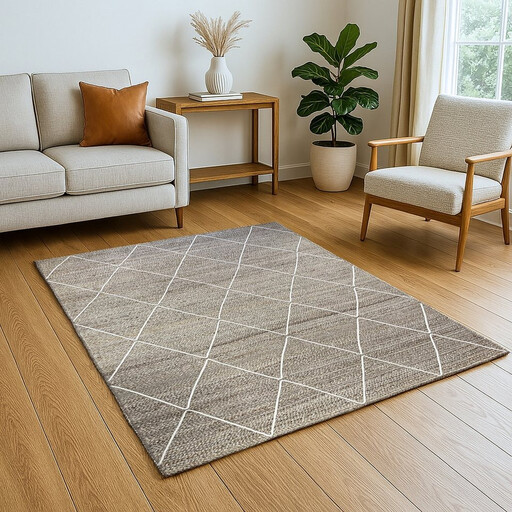
Why does it fit the brief? The combination of a jute texture and geometric cotton pattern complements modern, Scandinavian and nature-inspired interiors.
The product description explicitly identifies both jute and cotton. Anyone looking for a 100% jute rug can therefore classify this blended material correctly.
150 × 100 cm, a natural-grey look and handmade construction according to the product description.
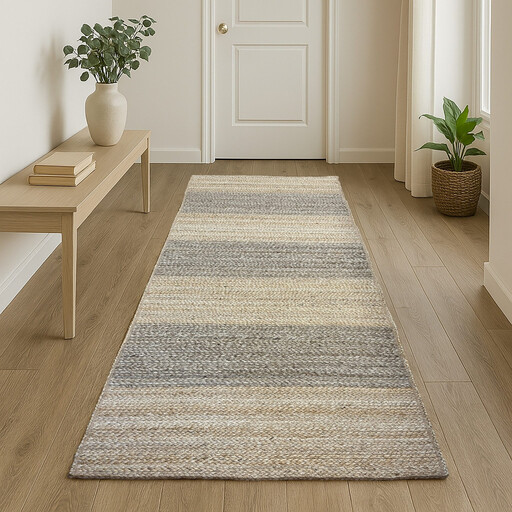
Why does it fit the brief? Its elongated format is designed for hallways, entrance halls and transitional areas. The two-tone zigzag pattern adds a distinctive visual accent.
The 80 cm width and material weight of 2700 g/m² are clearly specified. This simplifies planning and replaces vague claims about durability.
250 × 80 cm, approximately 1 cm high and a net weight of 6 kg according to the product data.
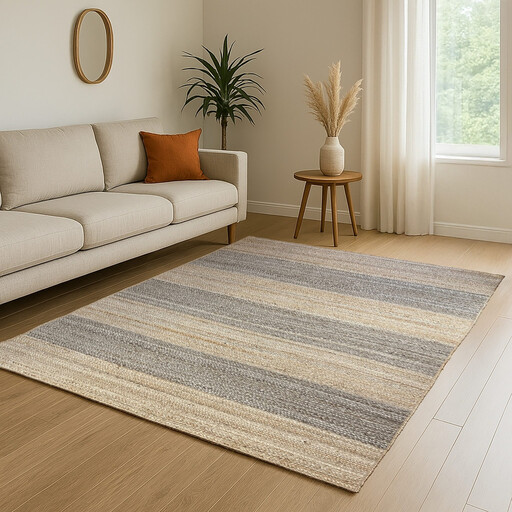
Why does it fit the brief? Its generous dimensions can visually unite a seating group or define an open-plan living area.
At 250 × 200 cm, with a net weight of 14 kg and a material weight of 2700 g/m², the dimensions relevant to room planning are clear in advance.
Two-tone natural-grey design, zigzag weave and high material weight according to the product data.
The complete selection of jute rugs and jute runners makes it easier to compare dimensions, colour and material composition.
Jute should be vacuumed regularly using a suitable low suction setting. Smaller rugs can be carefully shaken outdoors to remove loose dust particles. Spilled liquids should be blotted up immediately with an absorbent cloth whenever possible. Excessive soaking, harsh cleaning products and consistently high humidity can damage the natural fibres.
A non-slip rug pad is recommended on smooth floors. It can help stabilise the rug and prevent it from shifting underfoot. If you have underfloor heating, check the manufacturer’s instructions. Open flames and powerful heat sources should not be placed close to a jute rug.
Depending on use, care, weave and location, a jute rug can remain attractive for different lengths of time. It is therefore not possible to state a reliable, universally applicable lifespan. In high-traffic areas, precise material specifications, sufficient weight and a suitable underlay are more important than a general marketing claim.
Yes, the living room is one of the most common applications. The key considerations are a dry location, sufficient clearance for furniture and a non-slip rug pad on smooth flooring. In areas directly beside frequently opened balcony doors, contact with moisture should be avoided.
Regular, gentle vacuuming is generally the appropriate basic care routine. Spilled liquids should be absorbed immediately while still dry. Wet cleaning should only be carried out if it is expressly permitted in the care instructions.
That depends on the room and furniture arrangement. Before buying, mark out the intended area with masking tape. For a larger seating group, a format such as 200 × 140 cm or 250 × 200 cm can visually connect the furniture. For smaller areas, 150 × 100 cm or 170 × 120 cm is often easier to integrate.