
Lieferung heute & morgen

Qualitätsgarantie

Willkommens-Angebote freischalten: KOSTENLOSE Lieferung | Bis zu 80 % RABATT | Kostenlose 30-Tage-JoyPlus-Testphase
App herunterladen
A jute rug works well with modern, rustic and Scandinavian interiors. Its natural fibres add texture and warm tones to your room. But there’s more to choosing a rug than looks alone. Inaccurate measurements, unclear material descriptions and unsuitable care can all mean that a rug doesn’t meet your expectations in everyday use.
This guide explains what to look out for before buying a jute rug, and which styles suit different homes.
A rug measuring 200 × 140 cm covers a considerably larger area than one measuring 150 × 80 cm. With runners, the length is often listed first. So always check which measurement refers to the length and which to the width.
A simple way to plan is to mark out the dimensions on the floor with masking tape. This lets you check before buying that doors, chairs and cupboards will still have enough room.
Descriptions such as natural jute rug, natural-fibre rug or Natural Living often refer to the look. On their own, they don’t tell you whether the rug is made entirely from jute. If you’re looking for a rug made from 100% jute, check the material description carefully.
For example, a sisal and jute rug may combine different natural fibres. That’s not necessarily a drawback, but it won’t meet your needs if you’re looking for pure jute.
Jute is a natural fibre and should be protected from prolonged damp. A jute rug is generally a good choice for indoor living rooms, bedrooms, hallways and entrance areas. It’s less suitable for places that are often exposed to water, such as right next to a shower or bath.
The texture should also suit your household. Braided or woven jute may feel different underfoot from a flat synthetic rug. If you have young children or pets, or often move chairs around, consider using a non-slip underlay, provided it’s suitable for your floor.
Look for a clear description such as jute or 100% pure jute. A high proportion of jute can create a natural look, while cotton patterns or other fibres may add extra design details.
The weave affects both the look and feel of a rug. A distinctive zigzag pattern, like the Natural Bengal design, creates a decorative, textured effect. A simpler surface, like the Lola model, is easier to pair with different interior styles.
These guidelines can help you choose the right size:
A rectangular jute rug is usually easy to line up with walls, sofas and dining tables. Before buying, also take into account the rug’s height of around 1 cm and the clearance beneath doors.
A rug’s weight can give you an idea of how densely the material is made. The product details for the Natural Bengal list a density of 2.700 g/m². According to the product details, the 250 × 200 cm model weighs 14 kg. This can help keep the rug in place, but also makes it less easy to move.
Weight and density aren’t a substitute for a non-slip underlay. Always check how well the rug grips your particular floor.
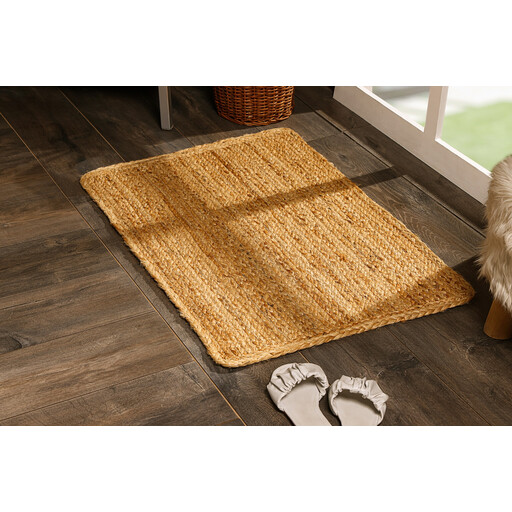
Why this product suits this home: Its compact size is ideal for smaller homes, a single accent area or as a first 100% jute rug.
The clearly stated size reduces the risk of ordering a rug that’s too large for a small room. The material is described as 100% pure jute.
90 × 60 cm, around 1 cm high and, according to the product details, 1 kg net weight.
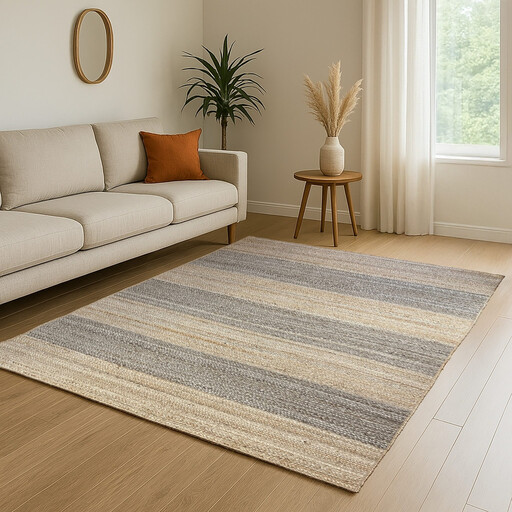
Why this product suits this home: Its large rectangular shape and two-tone zigzag pattern work well in a thoughtfully planned living room with a Natural Living or rustic style.
The dimensions are clearly stated, making it easier to check that the rug will suit a large seating group. The product details also specify a weight of 14 kg and a material density of 2.700 g/m².
250 × 200 cm, 1 cm high, natural and grey tones, and a two-tone jute look.
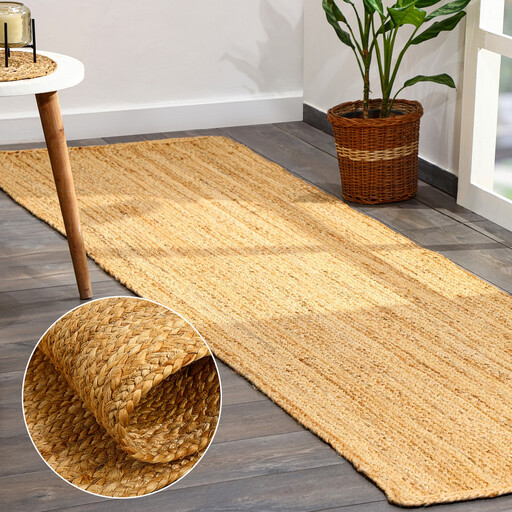
Why this product suits this home: This long jute runner is designed for hallways, passages and long entrance areas with plenty of foot traffic.
The length of 300 cm and width of 80 cm are clearly specified for a narrow walkway. This makes it easy to measure the area accurately before ordering.
100% pure jute according to the product description, 300 × 80 cm and, according to the product details, 6 kg net weight.
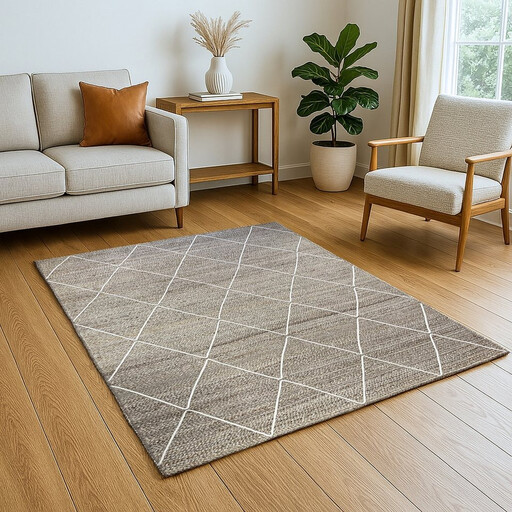
Why this product suits this home: Its geometric cotton texture complements the natural jute look, making it a good fit for modern, Scandinavian or nature-inspired rooms.
The specific dimensions help you plan the room rather than choosing a rug based on looks alone. The material description mentions jute and a geometric cotton pattern.
200 × 140 cm, around 1 cm high, 8 kg net weight and a clearly described geometric pattern.
We’ve put together a complete, regularly updated list of products that meet these strict selection criteria and fully comply with the safety regulations in force in the EU.
Vacuum your jute rug regularly using a low suction setting. You can carefully shake it out to remove loose dirt. Try to keep it dry, as natural fibres can be affected by moisture. Treat stains as soon as possible, following the care instructions for your particular rug.
A suitable underlay beneath furniture can help reduce dents and slipping. If you have underfloor heating, follow the guidance from both the rug’s manufacturer and your flooring manufacturer.
Yes, you can use a jute rug in your living room as long as the room is dry and the rug is the right size for your seating group. A suitable non-slip underlay may be a good idea on smooth floors.
How long it lasts depends on the weave, level of use, care, moisture and flooring. There’s no reliable way to give a single lifespan that applies to every rug. Regular, gentle cleaning and keeping the rug dry can help it stay in good condition.
A jute runner doesn’t use electricity, so its main ongoing cost is the effort involved in caring for it. Running costs are generally limited to cleaning and, if needed, a suitable underlay. What matters is keeping the runner dry in the area where you use it and looking after it regularly.