
Lieferung heute & morgen

Qualitätsgarantie

Willkommens-Angebote freischalten: KOSTENLOSE Lieferung | Bis zu 80 % RABATT | Kostenlose 30-Tage-JoyPlus-Testphase
App herunterladen
A baguette baking tray can make it easier to bake several long loaves in a domestic oven. However, not every baguette tray on the market will give you even results. Key factors include how well the tray holds its shape, your oven’s dimensions, how to care for the coating and how much dough you plan to bake.
This Joybuy Product Recommendation Officer buying guide explains which details to check before you buy and which models suit different baking habits.
A non-stick coating can make it easier to remove the bread. However, it will only stay in good condition for longer if you avoid using metal knives, scouring pads or harsh cleaning products on the baguette tray. You should also check claims that a tray is “dishwasher-safe” rather than taking them at face value. According to the product details, many coated bread tins are designed for hand-washing only.
A baking tray with an external length of 38 cm may fit a standard oven, but oven interiors, shelf positions and runners vary from one appliance to another. So, before you buy, measure your oven’s internal width and depth. Also check whether the tray needs to go in crossways or lengthways.
Material descriptions such as stainless steel, steel or cast iron don’t, on their own, tell you how a tray will perform in your oven. The material’s thickness, the tray’s design and the oven temperature all affect browning. A heavy cast-iron model, for example, retains heat for longer, while a lighter steel tray may be easier to handle and store.
A 3-baguette baking tray is handy if you want to bake several loaves at once. It cuts down on the number of batches and makes it easier to portion the dough evenly. Always compare the external dimensions and, where available, the usable dimensions of the wells.
For smaller households or individual loaves, a classic loaf tin may be more suitable. A French bread tray usually has long, narrow wells, while a sourdough bread tin often needs greater capacity and higher sides.
For coated trays, the manufacturer’s stated maximum temperature is an important guide. According to the product details, the first baguette tray featured here is heat-resistant up to 230 °C and measures 38 × 25 × 2 cm. Other models, for example, are rated for temperatures up to 240 °C or 250 °C.
Cast iron retains heat particularly well, but it is considerably heavier. Stainless steel and coated steel are easier to move around in everyday use. A stainless steel baguette tray may therefore be a good choice for regular baking if weight and cleaning matter to you.
Before you buy, check:
For delicate surfaces, silicone or wooden utensils are a good choice. Let the tray cool completely before washing it with warm water and a mild washing-up liquid. This won’t automatically extend its lifespan, but it will help avoid unnecessary wear to the surface.
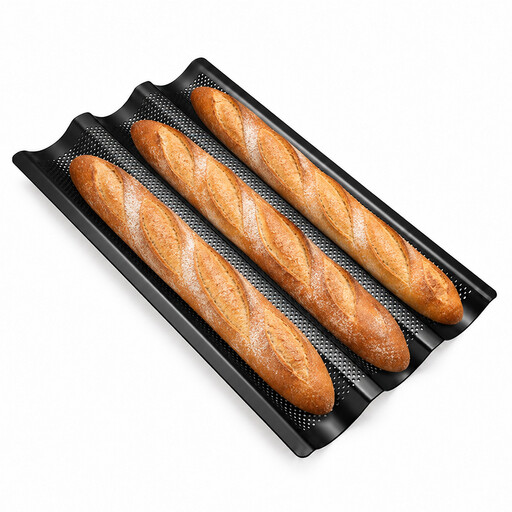
Why this product suits this type of baker: Measuring 38 × 25 × 2 cm, this tray is designed for three long loaves. It’s a good fit if you want to bake several baguettes at once without investing in a lot of bread-making equipment.
The dimensions and maximum temperature of 230 °C are clearly stated. The care instructions specifically rule out the dishwasher, harsh cleaning products and sharp metal utensils.
Three wells, a stainless steel construction according to the product description, and a coated surface to make it easier to release your bakes.

Why this product suits this type of baker: This tin is designed for loaves weighing up to 1,500 g. It could be an alternative to a classic baguette tray if you also plan to bake larger sourdough or sandwich loaves.
The product details specify steel, a ceramic coating, an enamelled base and heat resistance up to 250 °C. This makes it easier to assess the material and care requirements before you buy.
35 cm long, with capacity for a 1,500 g loaf and an enamelled base, according to the manufacturer. The tin is designed for hand-washing.
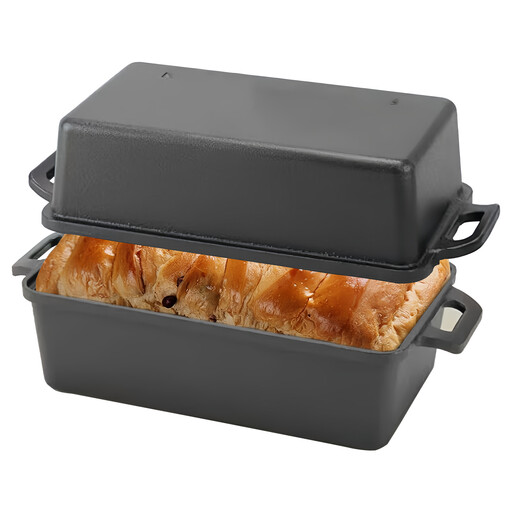
Why this product suits this type of baker: This set is aimed at frequent bakers who want to make sourdough, sandwich loaves or meatloaf and prefer a covered baking environment with a lid.
This two-piece design is more than just a loaf tin: according to the product description, one tin can be used as a lid. That makes its purpose clearer than broad claims about “versatile” baking equipment.
Cast iron, a stackable design and a lid, according to the product details. Wash by hand, then dry and oil the tins.
We’ve put together a complete, regularly updated list of products that meet these strict selection criteria and fully comply with the safety regulations in force in the EU.
Before using the tray for the first time, clean it according to the care instructions. If it has a coating, lightly grease it if recommended. Distribute the dough as evenly as possible between the wells so the loaves bake for a similar amount of time. If you’re making sourdough, also allow for the dough to rise: overfilled wells can overflow and make cleaning more difficult.
Always use oven gloves, as even lightweight metal trays get very hot after baking. Don’t place a hot tray directly on a delicate or wet worktop.
No. Many models are designed for standard domestic ovens, but whether a tray will fit depends on the oven’s internal dimensions and the direction in which it needs to be inserted. Before you buy, measure the width, depth and height of the available shelf space.
It depends on the coating and the dough. With a new non-stick tray, a thin layer of butter or oil can make it easier to release the bread. Follow the specific care instructions and avoid using too much fat, as residue can make cleaning more difficult.
There’s no reliable way to give a general lifespan. It depends on how often you use it, the temperature, how you store it and how you clean it. Scratches, peeling coating or warping are reasons to stop using the tin. You can avoid unnecessary wear by using it regularly without metal utensils or harsh cleaning products.