
Lieferung heute & morgen

Qualitätsgarantie

Willkommens-Angebote freischalten: KOSTENLOSE Lieferung | Bis zu 80 % RABATT | Kostenlose 30-Tage-JoyPlus-Testphase
App herunterladen
A kettle should heat water quickly, switch off safely and be easy to clean. But eye-catching designs, high wattage or generous capacity don’t automatically make for the right choice. What matters is whether the capacity, controls, materials and safety features suit your household.
A 2,200-watt electric kettle can heat water quickly. However, the actual time also depends on how much water you put in, its starting temperature, the mains voltage and limescale build-up. If you only need one cup, a larger model won’t necessarily save you time or energy. Try to fill the kettle with only the amount you need.
A 1.7-litre kettle is suitable for making several cups of tea or coffee. But if you live alone, a more compact 1.0- to 1.25-litre model may be easier to handle. A larger capacity often means more weight when pouring, as well as a higher minimum fill level. So check the MIN and MAX markings.
A retro kettle or glass kettle can look right at home in your kitchen. But a secure handle, an easy-to-read water level, a removable limescale filter and an easily accessible opening are more important. If you’re considering a traditional stovetop kettle, you’ll also need to check that it’s suitable for your hob and think about handling hot metal.
For a small household, 1.0 to 1.25 litres is often enough. Families or households with several tea drinkers may benefit from a capacity of 1.6 to 1.7 litres. Many electric models have a power rating of around 1,850 to 2,200 watts. Always compare wattage alongside capacity, rather than looking at it in isolation.
A kettle with temperature control can be useful if you enjoy different types of tea or use different brewing methods. Some kettles offer preset temperatures such as 60, 70, 80, 90 and 100 °C, while others let you choose from a wider range of settings. A keep-warm function maintains your chosen temperature for a limited time, but continues to use electricity.
The recommended temperature varies depending on whether you’re making black tea, green tea or coffee, and how you prepare it. Temperature control is most useful if you regularly use these settings. If you simply need boiling water, a model with automatic shut-off is usually enough.
A kettle with automatic shut-off stops heating once the water has boiled. Boil-dry protection switches the appliance off if there’s too little water in it, or none at all. These features reduce the risk of damage, but you should still follow the instructions when using your kettle.
Also look for:
A glass kettle lets you see the water level and may include LED lighting. However, the glass stays hot during and after boiling, so handle it with care. Stainless steel is hard-wearing, while plastic models are often lighter. Whichever material you choose, regular descaling is a good idea, depending on the hardness of your local water.
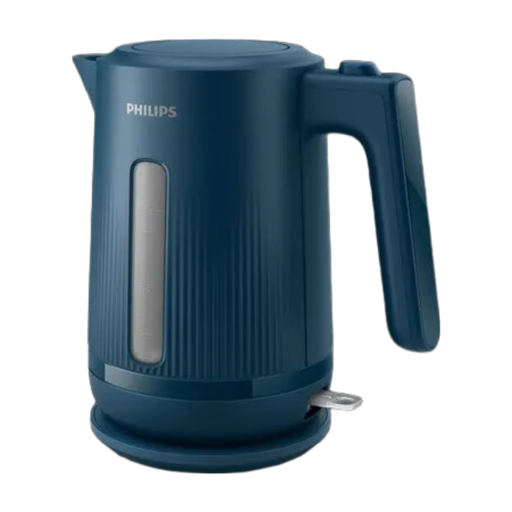
Why it suits this household: This model combines a 1.7-litre capacity with straightforward controls, making it a good fit for households that want to make several cups at once.
The visible water-level indicator makes it easier to fill the kettle with just the amount you need. Product information states that it has automatic shut-off and boil-dry protection.
1.7-litre capacity, 1,850–2,200 watts, cordless jug with base and illuminated water window.
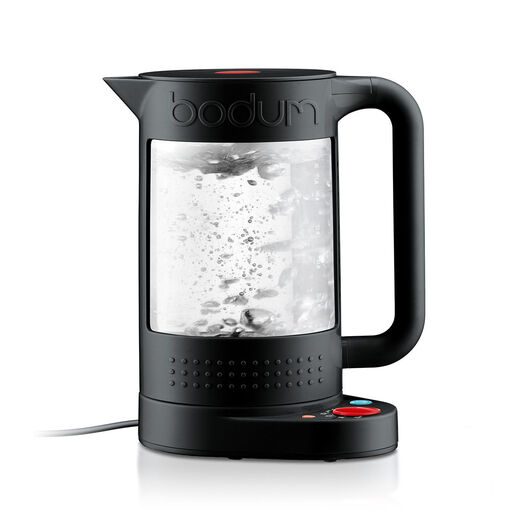
Why it suits this household: Tea lovers can choose from five temperature settings and use the keep-warm function for up to 30 minutes.
Choosing the temperature means you don’t have to boil water unnecessarily to 100 °C. The product description states that it has boil-dry and overheat protection.
Five settings from 60 to 100 °C, double-wall construction and a 1.1-litre capacity.
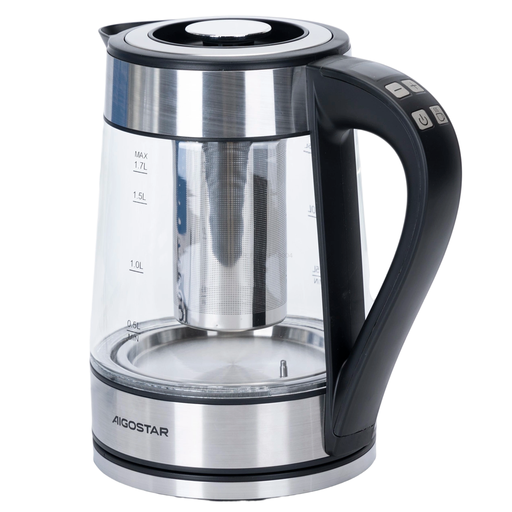
Why it suits this household: This model is for households that want to combine temperature control, keep-warm functionality and a clear view of the water as it heats, all in one appliance.
The 13-step temperature control and current temperature display make it easier to choose a precise setting than a simple on/off switch.
1.7 litres, touch controls, keep-warm function, memory function and removable filter.
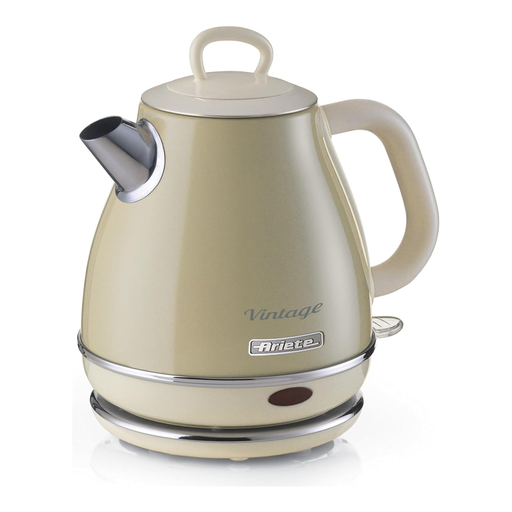
Why it suits this household: This 1-litre retro kettle is designed for smaller quantities. Its classic look is paired with a removable cordless jug.
Automatic shut-off adds a practical safety feature to the design. The cool-touch handle is designed to make pouring easier.
1-litre capacity, 1,600 watts, 360° base, stated noise level of 44 dB and a two-year warranty according to the product information.
We’ve put together a complete, regularly updated list of products that meet these strict selection criteria and fully comply with the safety regulations in force in the EU.
Consumption depends on the kettle’s power, the amount of water and how long it runs. A 2,000-watt appliance uses around 0.33 kWh in theory if it runs for ten minutes. In practice, it usually runs for less time. If you only need one cup, measuring out the right amount of water will reduce consumption more than choosing a lower wattage alone.
There’s no single lifespan that applies to every kettle. Common factors include limescale build-up, running the kettle dry, damaged cables and wear to the lid or switch. Regular descaling, observing the MIN and MAX markings and keeping the base dry can help keep it in good working order.
Temperature control can be useful if you enjoy different types of tea or prepare coffee in a specific way. If you only need boiling water, a model with automatic shut-off and boil-dry protection will usually do the job. The key is to choose a feature you’ll actually use day to day.