Who is this guide for?

Writing programme notes at a shared desk

If you’re writing alongside other people, a keyboard that’s easy to use and as unobtrusive as possible is important. CHERRY and Logitech describe certain models as quiet, although the actual noise level also depends on how you type and the room you’re in.

Editors who move between workstations

If you often change desks or devices, it’s worth checking the space available, connection type and rules for using shared input devices in advance. The German Social Accident Insurance (DGUV) recommends having clear rules for desk-sharing.

Frequent typists looking for comfort

If you edit long concert programmes, a split keyboard may be worth considering, provided its shape and size suit your workspace. Logitech describes the Ergo K860 as a split keyboard; this type of design needs to be checked for a comfortable individual fit.

What should you look for when choosing?

What matters What to check before buying Who is it important to?
Typing noise Check the manufacturer’s information for the specific keyboard and, if possible, assess its typing noise at your workstation. When I’m writing in a quiet room, I want to disturb others as little as possible. Around 29% of consumers would prioritise quiet typing.
Correction keys Check the German layout and the position of the arrow, function and, where applicable, number keys. For frequent text edits, I want the characters and navigation keys I need to be within easy reach. Around 29% of consumers would prioritise this ease of use.
Space and connection Check the space available, whether you need a cable or wireless connection, and whether personal devices are permitted at your workstation. If I move between workstations or bring my own keyboard, connecting and storing it needs to be practical. For around 24% of consumers, flexible use is the main priority.
Long writing sessions With split keyboards, consider the shape, space required, time needed to get used to it and cleaning options. For long writing sessions, I want to choose a layout that suits the position of my hands. Around 18% of consumers would prioritise this comfort factor.

Which buying mistakes should you avoid?

  • Assuming “quiet” guarantees a particular noise level

    CHERRY and Logitech describe certain models as quiet, but this doesn’t provide a comparable measurement for your specific desk.

    Use the claim to narrow down your options and, if possible, assess the typing noise in conditions similar to those at your workstation.

  • Choosing solely on the basis of the smallest design

    A compact keyboard may not have navigation keys or a separate number pad. This could matter when editing text or entering numbers frequently.

    Check the specific key layout and think about which keys you want to be able to reach easily when editing.

    If keys you use regularly are missing, you may have to spend more time navigating.

  • Assuming a split design will automatically suit you and be easy to clean

    A split layout needs to suit the position of your hands and may take time to get used to. The F.A.Z. Kaufkompass also notes that the gap on the Logitech Ergo K860 is difficult to clean.

    Check the fit and the space it requires. If the keyboard will be shared, check your workplace’s cleaning rules too.

    If you’re not used to a split layout, allow time to adjust and, if necessary, factor in extra cleaning.

Brands to consider

CHERRY

The STREAM KEYBOARD and STREAM KEYBOARD TKL are wired options for different space requirements; the STREAM KEYBOARD WIRELESS is a wireless alternative.

  • CHERRY describes the keystroke on its STREAM models with SX scissor-switch technology as quiet.
  • The TKL version doesn’t have a number pad. The wired models need a compatible connection, and the manufacturer’s claim isn’t a noise comparison across different models.

Logitech

The Pebble Keys 2 K380s is a portable multi-device keyboard; the Ergo K860 is a larger split keyboard.

  • Logitech says the Pebble Keys 2 K380s has quiet keys and lets you switch between three devices.
  • The split design of the Ergo K860 needs space and must suit the way you type. The F.A.Z. Kaufkompass notes that its gap is difficult to clean and that it doesn’t support a wired connection.

Perixx

The PERIBOARD-512 B is a wired split keyboard with a number pad; a German QWERTZ version is available.

  • Its design combines a split keyboard layout with a number pad.
  • Perixx notes that the split layout may take time to get used to. Check that its dimensions of 485 × 236 × 44 mm will fit on your desk.

Keychron

The K3 Max ISO-layout collection is aimed at those looking for a compact mechanical keyboard with a choice of DE-ISO layout.

  • Keychron lists a 75% layout, as well as Bluetooth, wireless and wired connections.
  • The layout and switches depend on the variant you choose. The connection options and layout alone don’t make it especially suitable for a quiet shared workspace.

Keyboards at Joybuy

This selection includes keyboards for writing concert programmes in German, moving between workstations, and different space and connection requirements.
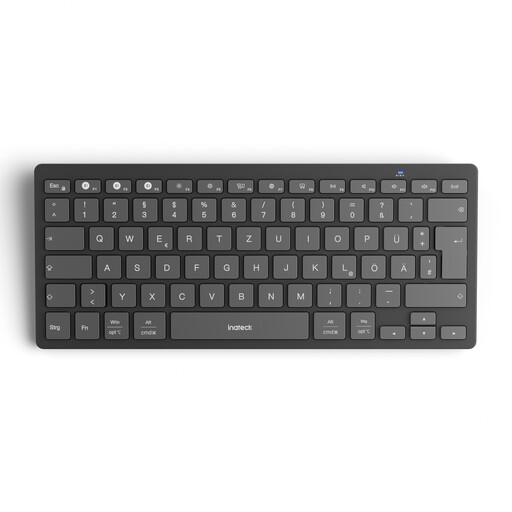
Inateck Bluetooth keyboard KB01003G with QWERTZ layout

Inateck KB01003G Bluetooth keyboard, QWERTZ

For a flexible workspace where you want to switch between several of your own devices.

Bluetooth connection for up to three devices; QWERTZ layout. The product description says the keys are quiet.

View at Joybuy
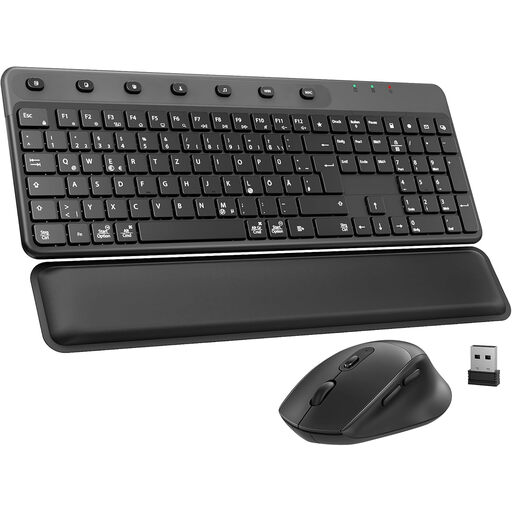
Full-size wireless QWERTZ keyboard and mouse set with number pad

Wireless QWERTZ keyboard and mouse set, full-size

For typing and entering numbers at your workstation when you want a full-size keyboard.

QWERTZ layout with number pad; 2.4 GHz connection via USB receiver. The keys are described as quiet. The wrist rest is detachable.

View at Joybuy
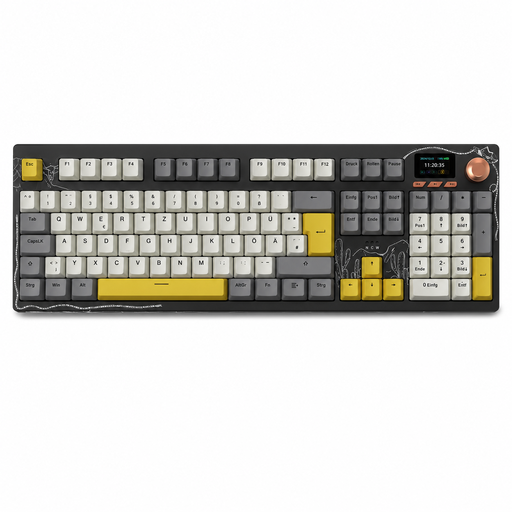
AJAZZ AK35I V4 mechanical keyboard with German QWERTZ layout

AJAZZ AK35I V4, German QWERTZ layout

For German-language text when you want a number pad and separate navigation keys close to hand.

104-key layout with number pad, navigation keys and function row. Bluetooth, 2.4 GHz and USB-C wired connections; mechanical keyboard.

View at Joybuy

Logitech MX Mechanical with German QWERTZ layout

Logitech MX Mechanical, German QWERTZ layout

For writing concert programmes in German and workflows involving several devices.

Mechanical switches described as quiet tactile; Bluetooth and Logi Bolt connections, with switching between up to three devices.

View at Joybuy
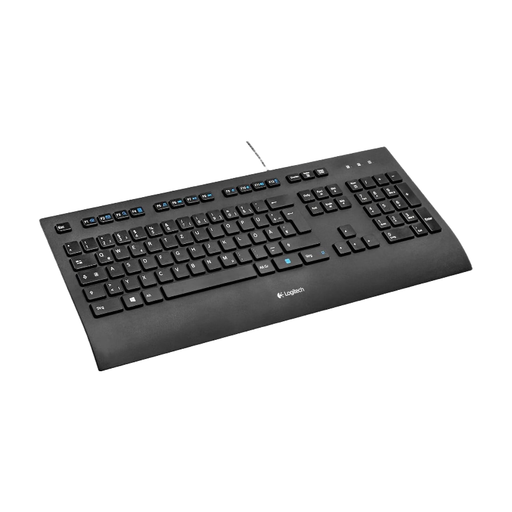
Logitech K280e wired keyboard with German QWERTZ layout

Logitech K280e, wired QWERTZ layout

For a fixed workstation where a wired keyboard with a German layout is suitable.

USB connection and large wrist rest.

View at Joybuy

Frequently asked questions

Do I need a number pad for writing a concert programme?

Not for writing text alone. If you often enter numbers using a separate number pad, it can be useful. Otherwise, a TKL keyboard such as the CHERRY STREAM KEYBOARD TKL saves space by leaving it out.

What should I check before connecting a portable keyboard?

Check whether Bluetooth is allowed on your work device, whether the operating system is supported and whether the variant you choose has the right layout. Logitech says the Pebble Keys 2 K380s lets you switch between three paired devices; they’ll need to be paired successfully first.

How should I manage a keyboard at a desk-sharing workstation?

Check with the relevant organisation whether you’re allowed to connect your personal keyboard or are expected to use a shared one. The German Social Accident Insurance (DGUV) recommends clear rules on cleanliness and tidiness. Clean shared devices in line with local guidance and the manufacturer’s care instructions.

Is a split keyboard suitable for writing longer texts?

It depends on whether the design and hand position suit you, and whether you have enough space for the keyboard. Perixx notes that the PERIBOARD-512 B may take time to get used to. If possible, try a split layout before committing to one.

Does the claim “quiet” mean a keyboard is less disruptive to others?

No. A manufacturer’s claim such as “quiet” isn’t a comparable noise measurement for your workstation. Use it to narrow down your options and, if possible, assess the typing noise in a similar setting.