Start by choosing a keyboard with a German layout and the keys you actually need for writing, coding and navigating. Then consider ergonomic, compact or adapted designs. If you have limited mobility or sight, an input aid tailored to your needs may be more important than a standard keyboard. No keyboard will automatically make the portal itself usable with a keyboard: you’ll need to check the website separately for keyboard functionality and a visible focus indicator.
Who should consider their keyboard choice?
Portal editors and developers
If you write historical content, use the web editor and test menus or forms without a mouse, look for the right characters and easy-to-reach navigation and function keys. W3C guidelines treat keyboard accessibility and visible focus as website features that need to be checked separately from the hardware.
People with input needs
If you have motor or visual requirements, key size, labelling and finger guidance can all make a difference. REHADAT describes a range of keyboards and input aids; the right option depends on what works for you.
People who do a lot of typing on the portal
If you enter lengthy source notes and place descriptions, you may want to factor in hand position, desk space and the time it takes to get used to a keyboard. The German Social Accident Insurance (DGUV) considers input devices part of an ergonomic workplace assessment.
What to look for when buying
Standard wired keyboard
A good fit if: you enter a lot of text and need arrow, function or number keys in their familiar positions.
Consider: A full-size keyboard takes up space, and its fixed key layout offers less scope for customisation.
Split keyboard
A good fit if: you’d like to try a split layout for longer typing sessions and have room for it at your workstation.
Consider: A new layout may take some getting used to, and the design alone won’t necessarily relieve any discomfort you experience.
Compact, customisable keyboard
A good fit if: you want to assign frequently used editor or development commands to keys yourself.
Consider: Check that the navigation and function keys you need are still easy to reach, and whether you’ll need a separate number pad.
Customised input aid
A good fit if: key shape, labelling, spacing or finger guidance are essential to how you use a keyboard.
Consider: The right option depends on your individual needs and the software you use.
| Criteria |
What to check before buying |
Who is this important to? |
| Layout and commands |
Check for a DE-ISO or QWERTZ version, along with the arrow, function and number keys you need. |
When I switch between place names, text and navigation in the editor, I need the right layout without having to rely on awkward secondary functions. That’s why around 36% of consumers put layout and access to commands first. |
| Keys suited to your needs |
Check key size, legibility and how easy the keys are to reach using your preferred input method. |
If my mobility or sight affects how I use a keyboard, I need to be able to reach and identify the keys I need with confidence. Around 29% of consumers prioritise an input method that suits their individual needs. |
| Hand position |
Try a split or standard layout, its width and any wrist rest at your workstation. |
For long typing sessions, I want to test my hand position at my own workstation rather than rely on the word ‘ergonomic’. Around 21% of consumers prioritise hand position when typing. |
| Connection |
Check that USB-A, any adapter you need, Bluetooth or a receiver will work with your computer. |
Whether I’m at a fixed or shared workstation, my keyboard needs to connect to my computer. Around 14% of consumers prioritise connectivity and switching between devices. |
Common selection mistakes
-
Assuming an ‘ergonomic’ keyboard will solve your personal discomfort
The right input method depends on the person and their workstation. Split models may also take some getting used to.
Before you decide, try out the hand position and the keys you actually need.
-
Choosing a compact keyboard without checking its layout
A compact layout may rearrange keys or move them to secondary functions. By contrast, the CHERRY KC 1000 has a dedicated cursor and number pad.
Make a note of the keys you use most often in the portal editor and check how you’ll access them on your chosen layout.
-
Confusing a hardware purchase with proof that a website is accessible
W3C guidelines cover keyboard accessibility and visible focus on the web interface. A different keyboard won’t automatically change how the portal has been built.
Plan your choice of input hardware separately from your keyboard test of the portal. Inaccessible controls can mean additional development and testing work.
Brands to consider
CHERRY
The KC 1000 is a standard wired keyboard with a documented German layout option.
- CHERRY lists USB-A, a cursor block and a number pad.
- The documented product length is 458 mm; its fixed layout takes up space and offers less scope for customisation.
Logitech
The ERGO K860 is a full-size split wireless keyboard.
- Logitech lists Bluetooth and a USB receiver as connection options.
- F.A.Z. Kaufkompass praised the typing feel but noted that it has no wired mode or backlit keys. The review applies to this model only.
Perixx
The PERIBOARD-512 B is a split wired keyboard available with a German QWERTZ layout.
- Perixx lists USB-A and a wrist rest.
- The listed dimensions are 485 × 236 × 44 mm; the manufacturer notes that it may take time to get used to the keyboard.
Keychron
The Q1 Max is listed with a 75% layout, QMK/VIA and a DE-ISO version.
- Customisable key assignments may be useful for development commands you set up yourself.
- Check that the compact layout and chosen switch option suit the way you work; neither guarantees a general ergonomic or productivity benefit.
Keyboards for German text and portal work
This selection includes keyboards with German layouts for portal text and editor work, from standard wired layouts to compact, customisable and split models.
 No image available
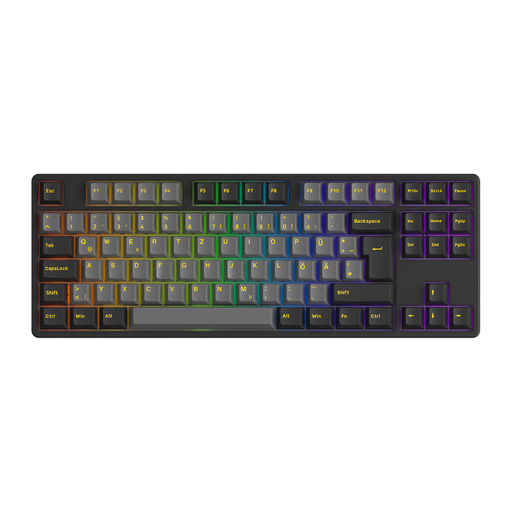
Akko 5087S V1 TKL, ISO-DE QWERTZ
For German text at a fixed workstation if you prefer a TKL layout and a wired connection.
ISO-DE QWERTZ layout; wired; hot-swappable switches; Akko V3 Pro Cream Yellow Switches.
View at Joybuy
 No image available
Ticktype EVO75, ISO-DE
For German text and frequently used editor commands if you want to customise the key assignments.
Tri-mode wireless; ISO-DE layout; VIA compatible; hot-swappable; Creamy Rye Switches.
View at Joybuy
 No image available
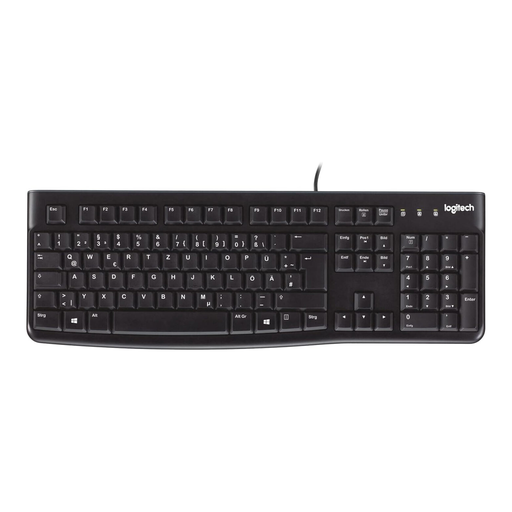
Logitech K120, German QWERTZ layout
For longer documents and navigation if you’re looking for a full-size wired keyboard with a number pad.
USB plug and play; full size; German QWERTZ layout; spill-resistant.
View at Joybuy
 No image available
Logitech ERGO K860, QWERTZ
For longer typing sessions if you prefer a split layout and a wireless connection.
Split keys; wrist rest; Bluetooth or USB receiver. No wired mode.
View at Joybuy
 No image available
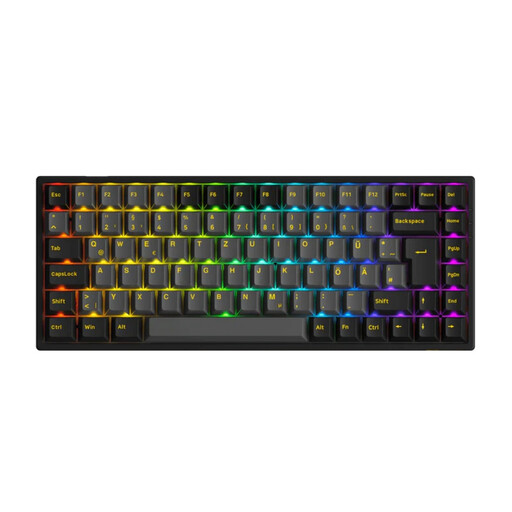
Akko 3084B Plus, 75%, ISO-DE
For German text at a workstation where you want to choose between several connection types.
75% layout; ISO-DE; Bluetooth, 2.4 GHz or USB-C; hot-swappable.
View at Joybuy
Frequently asked questions
Will a particular keyboard automatically make the portal usable without a mouse?
No. Check the website itself to see whether you can access its features using a keyboard and whether the focus indicator remains visible. W3C guidelines set out requirements for web content, not features of a particular keyboard model.
How should I start testing the portal with a keyboard?
Try typical tasks such as navigating, searching, completing forms and editing content without a mouse. For each control, check that you can carry out the action and identify the current focus. This is a targeted practical test, not a complete assessment of compliance.
What should I check with a split or programmable keyboard?
With a split model, allow for the possibility that it may take some time to get used to. With a programmable DE-ISO version, check the keys and commands you need in your own editor. For USB-A models, make sure your computer has a suitable port or that you have an adapter.
Do BITV 2.0 or the BFSG automatically apply to every local history portal?
No, not simply because of the subject matter. The Federal Monitoring Agency for Accessibility describes BITV 2.0 as applying to federal public bodies; the relevant rules should be checked for other public bodies. For private electronic commerce, the agency explains that a key BFSG criterion is an individual consumer request relating to a consumer contract. Whether these conditions apply to a particular portal depends on who operates it and what it does.
Who should I contact if something goes wrong after purchase?
For a consumer purchase from a business seller, your statutory rights relating to faulty goods are against the seller. Your Europe explains that goods bought in the EU are covered by a minimum two-year guarantee from the date you receive them; this is separate from any voluntary manufacturer’s or extended guarantee.


