Notebook users who write a lot
If you write for long periods on a notebook, you can position an external keyboard to suit the way you work. The DGUV recommends using an external keyboard and mouse for extended work on mobile devices.


Choose a keyboard to suit how long you write for, how much desk space you have, your preferred layout and how it connects to your computer. You don’t need a special keyboard for numbered subheadings. In Word, you can set up your outline using heading styles and a multilevel list, as Microsoft Support explains. A split design may be worth considering for long writing sessions, a compact keyboard if space is limited, and programmable keys for tasks you repeat regularly.
If you write for long periods on a notebook, you can position an external keyboard to suit the way you work. The DGUV recommends using an external keyboard and mouse for extended work on mobile devices.
If you’re editing chapters and subchapters with notes beside your computer, a TKL keyboard can leave more room for your documents. Microsoft Support explains that you can create a hierarchical numbering system in Word using heading styles and multilevel lists.
Choose based on what matters most to you: typing comfort, desk space, tasks you repeat regularly or a straightforward connection.
| Priority | What to check when buying | Who might find this important? |
|---|---|---|
| Comfort during long writing sessions | Split or separate design; room for your hands and mouse. | If I write long chapters on a notebook, I want to be able to position an external keyboard to suit the way I work. Shoppers who prioritise typing comfort are likely to make up around 40% of those searching for a keyboard for this guide. |
| Space and key feel | Choose TKL rather than full-size if you can do without the number pad; check the layout of the specific version. | If I keep a manuscript and mouse next to my keyboard, I want to free up space and choose a key feel that suits my surroundings. Shoppers whose main priorities are space and key feel are likely to make up around 30% of those searching for a keyboard for this guide. |
| Tasks you repeat regularly | Check software compatibility and which keyboard shortcuts are supported. | If I edit lots of chapters, I want to trigger commands I use regularly more easily, without managing the outline from the keyboard. Shoppers who prioritise this workflow are likely to make up around 20% of those searching for a keyboard for this guide. |
| Simple connection | Check that your computer has the right port and that the keyboard has a German layout. | If I want to start writing without a complicated set-up, I first check that the layout is right and that my computer has a suitable connection. Shoppers who value a straightforward connection above all else are likely to make up around 10% of those searching for a keyboard for this guide. |
A model may be available in different language layouts. A version described as having a US layout isn’t automatically a German QWERTZ keyboard.
Check the layout listed for the specific product version before you order.
If the key layout isn’t right, you may have to return the keyboard or find another version.
In Word, you set up hierarchy and numbering using styles and multilevel lists.
Set up your document structure first. Then decide whether programmable keys could complement the way you work.
A guarantee is an extra, voluntary promise. Your statutory rights when goods are faulty are separate.
Keep your proof of purchase and the specific guarantee terms. If an item is faulty, contact the seller first about your statutory rights.
The ERGO K860 has a split design, while the low-profile MX Keys S offers customisable functions. Which one suits you depends, among other things, on how long you write for and your preferred key layout.
The STREAM KEYBOARD TKL is a compact, wired option for writing if you rarely need the number pad.
The K8 Pro could be a good choice if you’re looking for a mechanical TKL keyboard with configurable keys and a specifically selected ISO layout.
The wired KB216 is a full-size option if your computer has a suitable USB port.
The following keyboards at Joybuy include compact and split designs, as well as wired and wireless models for writing with a German QWERTZ layout.
 No image available
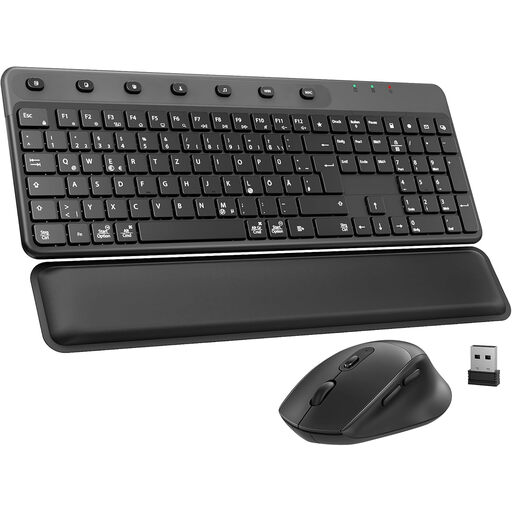
An option if you’re looking for a keyboard with a number pad and a mouse as a set.
2.4 GHz USB connection; full-size keyboard with a number pad and keys described as quiet; detachable wrist rest. The mouse has three DPI settings. Listed as compatible with Windows and Mac.
 No image available
The compact design may suit you if you want to save desk space and don’t need a number pad.
65% layout with German QWERTZ; tri-mode connection via 2.4 GHz, Bluetooth or USB-C. Features low-profile MX Speed switches and RGB lighting; colour: white.
 No image available
The split key layout is an option if you’d like to try this design for longer writing sessions.
Features a cushioned wrist rest and adjustable feet. Connects via Bluetooth or USB receiver; the description mentions customisable Fn keys and application-specific shortcuts.
 No image available
An option if you’re looking for mechanical switches and customisable shortcuts for writing.
Features tactile mechanical switches described as quiet, a German QWERTZ layout and Smart Backlighting. Connects via Bluetooth or Logi Bolt; the description mentions customisable shortcuts and connections to up to three devices.
 No image available
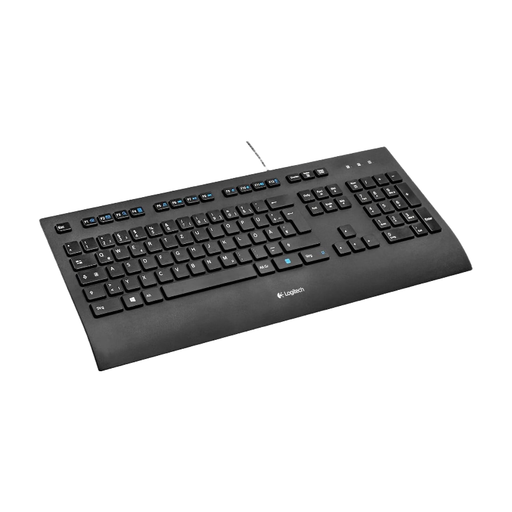
A wired option if your computer has a suitable USB port.
Features a German QWERTZ layout and wrist rest. The product description also mentions backlighting and a USB connection.
No. In Word, use built-in heading styles such as ‘Heading 1’ and ‘Heading 2’, along with a multilevel list, as Microsoft Support explains. Macro keys can help with entries you make regularly, but they don’t replace the document structure.
Word for Windows lets you assign keyboard shortcuts to commands, macros and formats. Check the existing assignments first. Microsoft Support notes that the steps may differ in Word for Mac and Word for the web.
Before buying, check that your computer has the connection you need: Dell lists USB Type-A for the German KB216, while Logitech lists Bluetooth and a USB receiver for the ERGO K860. If the wrist rest has a hard-to-reach gap, think about how you’ll clean it too; the F.A.Z. Kaufkompass mentions this for the ERGO K860.
No. In Germany, distance contracts generally come with a statutory right of withdrawal under § 312g BGB. The Verbraucherzentrale says the period is usually 14 days, although when it starts and what exceptions apply depend on the specific contract. Your statutory rights for faulty goods are against the seller, while a guarantee is an additional voluntary promise.