If your main priority is testing keyboard navigation, choose a keyboard where Tab, Shift, Enter, Escape and the arrow keys are easy for you to reach; a familiar full-size layout may be a good fit. For long writing sessions, the keyboard’s shape and typing feel may matter more, while custom layouts require extra setup. No keyboard can make the guide itself accessible: check its features and visible keyboard focus independently of the input device.
Who uses these keyboards?
People testing keyboard navigation
You repeatedly check whether the guide’s search, filters, venue details and dialogues can be reached and used without a mouse. Easy-to-reach standard navigation keys may matter more than extra macros. The W3C Web Accessibility Initiative identifies keyboard operability and visible focus as separate website requirements.
People who write for long periods
You create and update lots of venue descriptions and want to choose a keyboard based on hand position and typing feel, without assuming it will have a particular ergonomic effect. For screen-based workstations, the German Federal Institute for Occupational Safety and Health addresses requirements under ASR A6.
People who customise their key layout
You want to customise your layout for development work and are prepared to spend time setting it up and getting used to it. The key question is whether the software you want to use and the required key layers are supported by the specific keyboard variant.
What matters when buying?
Traditional wired full-size keyboard
A good fit if: you want familiar standard keys and a number pad for repeated navigation tests.
Consider: Check which connection you need; there is no evidence that the models mentioned offer programmable keys.
Ergonomic keyboard with a fixed split layout
A good fit if: you want to try a different hand position during long writing sessions while keeping a full-size keyboard with a number pad.
Consider: The layout may take some getting used to. For the Logitech model tested, F.A.Z. Kaufkompass notes that it has no key backlighting and cannot be used with a cable.
Customisable mechanical full-size keyboard
A good fit if: you want to set up custom layouts or macros for development work and prefer a full-size keyboard.
Consider: Layout, switches, software and connectivity vary by model; programmed shortcuts are no substitute for testing with standard keyboard controls.
Physically split keyboard with layers
A good fit if: you want to set the distance between the keyboard halves yourself and get used to your chosen layout.
Consider: The model tested has no dedicated arrow or F keys. German ISO keycaps and other options may differ from the standard configuration.
| Priority |
What to check before buying |
Who this matters most to |
| Navigation keys within easy reach |
Try Tab, both Shift keys, Enter, Escape and the arrow keys on the specific layout; if it has layers, test the combinations you need. |
If I repeat navigation tests often, I want to reach the keys I need without extra steps. Around 36% of consumers focus on navigation testing. |
| Comfort during long sessions |
Check the keyboard’s shape, the space it takes up and its typing feel; if you use a screen-based workstation, consider your overall working environment too. |
If I write and update lots of venue descriptions, I look for a hand position and key layout that suit me. Around 29% of consumers prioritise typing comfort. |
| Customisable key layout |
For the exact model, check which keys and layers can be programmed and which software you need. |
If I want to support recurring development tasks with custom layouts, I’m prepared to put in the setup time. Around 21% of consumers prioritise customisability. |
| German layout and connection |
Check for DE/QWERTZ or DE-ISO and confirm the exact configuration; for wired models, check the connection, and for wireless models, confirm the connection type and what’s included. |
If I write German place names and want to connect the keyboard to my computer, the key labels and connection need to be right. Around 14% of consumers mainly look at layout and connection compatibility. |
Common misconceptions when buying a keyboard
-
Confusing macro keys with website accessibility
Custom layouts can make development work easier, but they don’t show whether visitors can use all the guide’s features with their usual keyboard controls.
Also test the guide with standard keyboard commands and check that the keyboard focus remains visible.
-
Assuming compact or split models have dedicated navigation keys
For the Dygma Raise 2 model tested, F.A.Z. Kaufkompass notes that it has no dedicated arrow or F keys. This may change how you carry out repeated checks.
Try the key combinations you actually use on the layout of the specific model you’re considering.
Key layers may take extra time to set up and get used to.
-
Assuming German keycaps mean the whole layout is a perfect match
Dygma lists German ISO keycaps as an optional extra for the standard layouts shown. The key labels and the physical base layout are therefore not automatically the same thing.
Check the base layout, key labels, mapping and what’s included for the specific configuration, one by one.
Brands to consider when choosing a keyboard
CHERRY
Traditional office and slim keyboards are worth considering if a familiar layout and straightforward typing or testing are important to you.
- The KC 1000 is documented as having cursor keys, a number pad, a USB connection and a German variant.
- The manufacturer specifies a low-profile scissor mechanism for the KC 6000 SLIM.
- These features do not demonstrate programmable test sequences or a particular ergonomic effect.
Logitech
The ERGO K860 is an option for people who want a fixed split layout and a full-size keyboard with a number pad.
- F.A.Z. Kaufkompass highlights the typing feel of the model tested.
- The review notes that it has no key backlighting and cannot be used with a cable.
- The manufacturer’s claims about reducing physical strain are no guarantee of an individual benefit.
Keychron
The V6 Max combines a full-size layout with a customisable mechanical keyboard in the documented DE-ISO configuration.
- The manufacturer lists QMK/VIA, replaceable switches and wireless connections for the V6 Max.
- The layout and switches depend on the variant you choose, so check the exact configuration.
Dygma
The Raise 2 is aimed at people looking for a physically split, configurable keyboard to suit their own workflow.
- You can configure the keyboard halves to suit your preferred positioning.
- For the model tested, F.A.Z. Kaufkompass notes that it has no dedicated arrow or F keys.
- German ISO keycaps, wireless connectivity and the tenting mechanism may be optional extras; check the configuration and what’s included.
Keyboards at Joybuy
The Joybuy products below include wired and wireless keyboards with a German layout, from more compact designs to full-size models.
 No image available
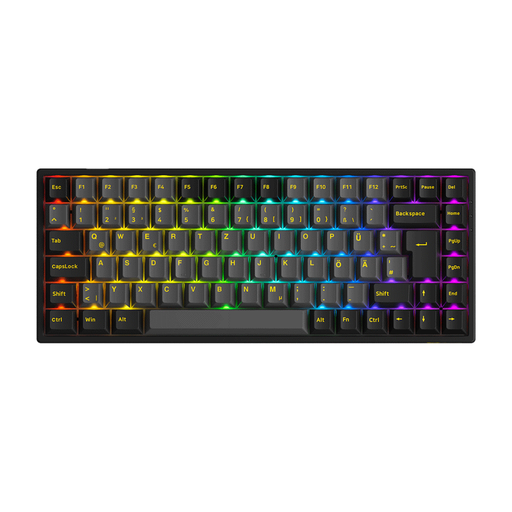
Akko 3084B Plus, 75%, ISO-DE, Black & Gold
The stated ISO-DE layout is relevant if you type in German; check whether the more compact arrangement works for your navigation tests.
75% layout; Tri-Mode with Bluetooth, 2.4G and USB-C; V3 Pro Cream Blue Switches; hot-swappable.
View at Joybuy
 No image available
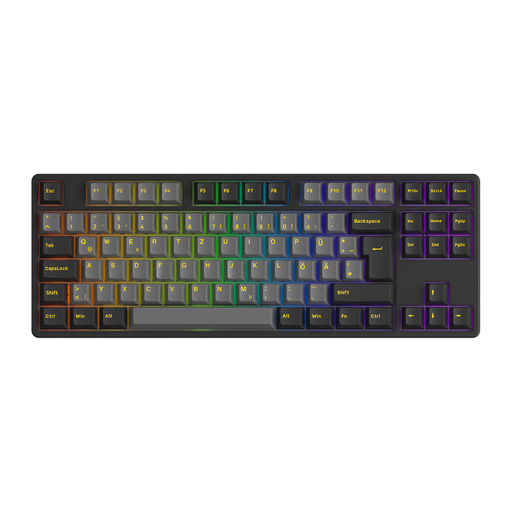
Akko 5087S V1 TKL, wired, ISO-DE, Black & Gold
The stated ISO-DE layout may suit German-language typing; check whether the TKL format keeps the keys you need within easy reach.
Wired; ISO-DE/QWERTZ; V3 Pro Cream Yellow Switches; hot-swappable.
View at Joybuy
 No image available
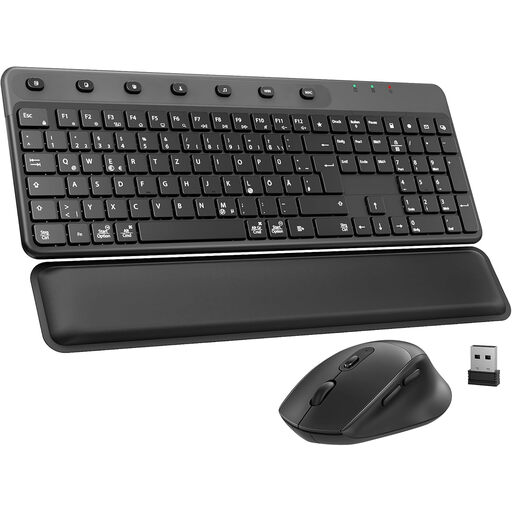
Wireless QWERTZ keyboard and mouse set with number pad
If you prefer a German layout and a number pad, this set is listed as a full-size keyboard.
QWERTZ; 2.4GHz USB connection; numeric keypad; detachable wrist rest.
View at Joybuy
 No image available
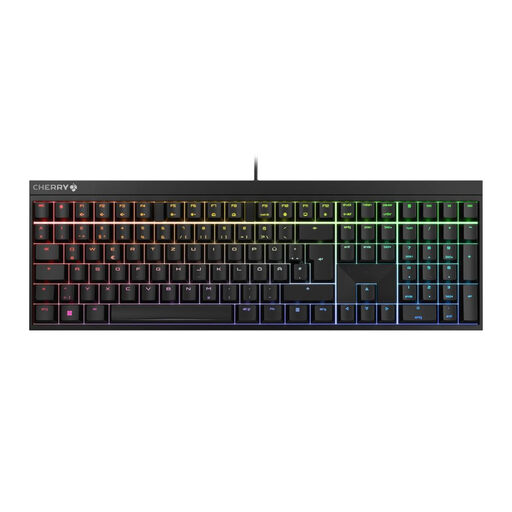
CHERRY MX 2.0S, German QWERTZ full-size layout
A German full-size layout with 110 keys may feel familiar for repeated navigation tests; check that USB-A is compatible with your computer.
Wired USB-A; 110 keys; CHERRY MX2A Red Switches; RGB backlighting.
View at Joybuy
 No image available
CHERRY MX-LP 2.1, 65%, German QWERTZ, white
The compact 65% format can save space; for your keyboard tests, check whether the navigation keys you need are practical to use in this layout.
German QWERTZ; Tri-Mode with 2.4GHz, Bluetooth and USB-C; MX Speed Switches.
View at Joybuy
Frequently asked questions
Can an ergonomic or programmable keyboard make the guide accessible?
No. A keyboard alone cannot make the guide accessible. Its features must be reachable through a keyboard interface, and keyboard focus must be visible. Check both directly in the guide, whatever keyboard you choose.
How do I set up a workstation for repeated keyboard testing?
Connect the keyboard using its interface and check which layout is actually configured. Then test the sequence of actions in the guide without a mouse. The manufacturer specifies USB-A for the CHERRY KC 1000. The German Federal Institute for Occupational Safety and Health’s guidance on screen-based work applies within the stated scope of workplaces and teleworking setups; it does not apply universally to every home workstation.
What should I check about accessories and configuration on customisable keyboards?
For the specific model, check whether the keycaps, wireless connections or tenting mechanism you want are included or listed as optional extras. The Dygma Raise 2 configurator lists these options separately, so the specification may depend on the configuration you choose.
Does a German venue guide have to comply with BITV 2.0 or BFSG accessibility requirements?
There’s no blanket answer without knowing who operates the guide and what features it offers. BITV 2.0 applies to websites and apps run by public bodies. BFSG covers, among other things, certain e-commerce services provided in response to an individual consumer’s request in relation to a consumer contract. Whether a particular guide is covered therefore needs to be assessed based on its operator and offering.


