Choose a keyboard based on whether the navigation and editing keys you need work with your writing software and operating system. Your software creates the heading structure, not a special keyboard. For long writing sessions, the layout and position of your hands may matter more; TKL saves space, while programmable keys require set-up and software compatibility. Check the exact key layout and variant before you buy.
Which keyboard is right for you?
If you often edit outlines
If you regularly move between chapters and heading levels as you write, look for navigation and editing keys that are easy to reach, and check the shortcuts in your writing software. In Word, you create multilevel headings using styles and multilevel lists. Microsoft Support also highlights differences in the Navigation pane between Word for Mac, Windows and the web.
If you write for long periods
For longer writing sessions, the keyboard layout, typing feel, and the position of your keyboard and mouse all matter. A split keyboard has a different layout, but it won't necessarily feel more comfortable for everyone. The DGUV considers the keyboard part of the overall computer workstation.
If space is limited or you switch between devices
If you need room for your mouse on your desk, often work within earshot of others, or switch between devices, check the layout, noise level and connectivity of the specific model. A TKL keyboard has no number pad, and compact models may arrange their keys differently.
What should you look for when buying?
First, check the keys and shortcuts in your writing software. Then decide whether typing posture, noise, desk space or switching between devices matters most for your set-up.
| What matters |
What to check before you buy |
Who is it important to? |
| Editing headings |
Check how easy it is to reach the function, arrow and editing keys, as well as your operating system's key layout and your writing software's commands. For Word on Windows, Microsoft Support explains heading styles, multilevel lists and the Navigation pane. |
If I often move between headings and sections of text while editing, I need quick access to navigation and editing functions. Around 40% of consumers are likely to put outlining and navigation first. |
| Typing posture |
Check the actual position of your keyboard and mouse, as well as the key layout. A split keyboard changes the position of your hands, but it doesn't guarantee relief from discomfort for any particular person. |
If I write for long periods, I want to find a layout that suits the way I hold my hands and my workspace. Around 30% of consumers are likely to prioritise typing posture. |
| Quiet typing |
Compare the mechanism and switch type of the specific keyboard. CHERRY describes the SX scissor keys on the STREAM KEYBOARD TKL as quiet; this isn't a decibel measurement. |
If I write in a shared space, I want to avoid disturbing others with keyboard noise as much as possible. Around 20% of consumers are likely to put quiet typing first. |
| Space and switching between devices |
Check whether the keys you need are available on a TKL or more compact layout. If you use multiple devices, also check the connections listed for the specific model. |
If my desk is small or I switch between devices, I need a suitable layout and the right connection options. Around 10% of consumers are likely to prioritise desk space and switching between devices. |
Avoid common buying mistakes
-
Assuming the model name means it has a German key layout
Different versions of the same model can have different key layouts. Joybuy's CHERRY STREAM KEYBOARD TKL listing describes a US layout with a Euro symbol; the Keychron K3 Max is available in a DE-ISO variant.
Before ordering, check the product description for the stated layout and make sure you've selected the variant you want.
-
Choosing a compact layout without checking which keys you need quick access to
TKL keyboards have no number pad, while a 75% layout arranges the keys differently. These differences can matter more for navigation and editing than the space you gain.
List the functions and number-entry keys you use in your writing software, then compare them with the layout of the specific model.
-
Assuming an ergonomic design will solve discomfort
A split keyboard changes the position of your hands, but that doesn't prove that a particular model will treat or prevent discomfort for you.
Consider the keyboard and your workspace together. If you have discomfort, a product claim shouldn't take the place of professional advice.
Key brands at a glance
Logitech
For this selection, the low-profile MX Keys S and the differently designed, split ERGO K860 are both worth considering.
- Logitech lists backlit keys and Smart Actions for the MX Keys S. Customisation depends on your set-up and the software you use.
- According to Logitech, the ERGO K860 has a split keyboard and a cushioned wrist rest. The different layout may take some getting used to and isn't a personal health guarantee.
CHERRY
The wired STREAM KEYBOARD TKL is an option for a fixed writing desk where you don't often enter numbers.
- CHERRY lists a TKL layout, SX scissor technology and quiet keystrokes for this model.
- It has no number pad. Joybuy's specific listing describes a US layout with a Euro symbol; you can't tell whether it has a German layout from the brand name alone.
Keychron
The K3 Max is an option if you're looking for a compact mechanical layout and customisable key mapping.
- Keychron lists QMK/VIA and several connection options; DE-ISO is available as a selectable variant.
- The layout and switches depend on the version. Check the variant you've selected and whether its set-up works with your writing software.
Joybuy products for your desk
The products below include a wired TKL keyboard with a US layout, a compact model with a German QWERTZ layout, and a full-size keyboard with a US layout. Check each key layout and the features that matter for your workspace.
 No image available
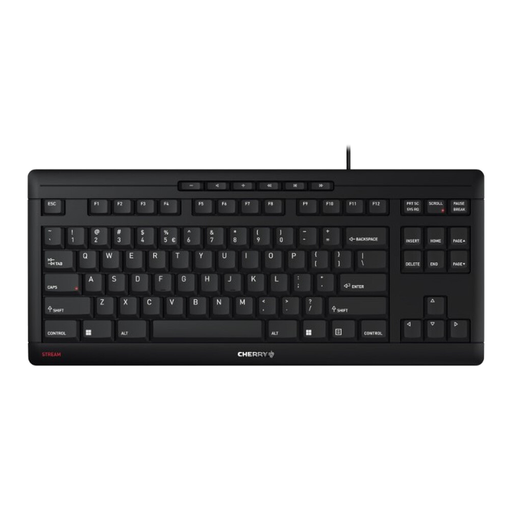
CHERRY STREAM KEYBOARD TKL, wired USB keyboard, US layout
Suitable if you don't often enter numbers and want to make room for your mouse beside the keyboard.
Wired USB connection; TKL layout without a number pad; US layout with Euro symbol; SX scissor keys and six multimedia hotkeys.
View at Joybuy
 No image available
CHERRY MX-LP 2.1, wireless keyboard, 65%, German QWERTZ
A compact option if you're looking for a German QWERTZ layout and multiple connection options.
65% layout; low-profile MX Speed switches; Bluetooth, 2.4 GHz or USB-C. Its compact layout differs from a full-size keyboard.
View at Joybuy
 No image available
Ticktype DP104, mechanical keyboard, full-size with 108 keys, US layout
Worth considering if you prefer a full-size keyboard and the US key layout suits your workflow.
108 keys; Silent Tactile switches; tri-mode connection via 2.4 GHz, Bluetooth or USB-C. Described as a US layout.
View at Joybuy
Frequently asked questions
Do I need a programmable keyboard for nested headings?
No. You create the document structure in your writing software. In Word, numbered headings with multiple levels combine styles with a multilevel list. Programmable keys can make frequently used commands easier to access, but you'll need to set them up and test them in your programme.
How do I move between headings in Word while editing?
In Word for Windows, the Navigation pane displays headings that have heading styles applied; Microsoft Support says you can open it with Ctrl+F. According to Microsoft, the behaviour differs between Word for Windows, Mac and the web.
Are a warranty, statutory rights and returns all the same thing?
No. Statutory rights relate to defects and apply against the seller; a warranty is an additional voluntary promise subject to its terms. For online consumer purchases, you generally have a 14-day right to cancel, although exceptions and the specific contract should be taken into account. The Verbraucherzentrale explains these differences.
Which German rules apply to wireless keyboards or workstations?
When monitoring the market, the Bundesnetzagentur checks matters including CE marking, product identification and manufacturer details; a shop description alone doesn't prove these features for an individual device. For fixed computer workstations used by employees, the Workplace Ordinance sets out requirements for keyboards, including separation from the screen and the ability to tilt. This doesn't create a general personal purchasing obligation for people writing at home.
What should I do with an old keyboard?
Waste electrical equipment should be taken to an authorised collection point, such as a local council recycling centre. Retailer take-back is subject to the conditions set out in the ElektroG; whether you can return equipment without buying a new product depends, among other things, on the retailer's size and the device's dimensions. The Federal Ministry for the Environment explains how to dispose of waste electrical equipment.


