A split editor, as Literature & Latte describes it using Scrivener as an example, is a software view and doesn’t require a physically split keyboard. Choose a keyboard to suit your preferred hand position, typing feel and the keys you actually use with your writing software. A split design can give you more positioning options, while a conventional layout may take less getting used to.
Which keyboard is right for you?
Prolific writers who prioritise posture
If you spend long hours working on a manuscript, you’ll want to position your keyboard and hands to suit your workspace. A split design is one option, but it isn’t automatically the right solution if you’re experiencing discomfort. The Federal Institute for Occupational Safety and Health (BAuA) recommends having enough space to arrange your mouse and keyboard to suit your needs.
Writers who switch between chapters and notes
If you keep a chapter open alongside reference notes, easy-to-reach navigation and function keys can be useful when switching between views and commands. Literature & Latte describes this side-by-side view in the Scrivener editor; the shortcuts available depend on your software.
Writers who prefer a quieter keyboard
If you write in a shared space or prefer a quieter typing experience, check the specific switch type and how the keyboard sounds. Manufacturer claims about noise won’t tell you exactly how it will sound in your own writing environment.
What should you look for when buying?
First, consider which hand position and key layout suit your workspace. Then look at the shortcuts your software requires, the typing feel and how the keyboard connects to your device.
| What matters |
What to check before buying |
Who will find this most important? |
| Hand position during long writing sessions |
Check whether you can position the keyboard and, if applicable, both halves comfortably on your desk. The BAuA highlights the need for enough space to arrange your setup to suit you. |
When I spend a long time working on a manuscript, I want to be able to position my keyboard and hands comfortably on my desk. Around 33% of consumers prioritise hand and arm position. |
| Switching between a manuscript and reference material |
Check the shortcuts for the software and operating system you actually use, and the position of the arrow, function and special keys you need. Literature & Latte documents how Scrivener can display two documents at once. |
When switching between chapter text and notes, I want to reach the commands I need quickly. Around 25% of consumers prioritise navigating between a manuscript and reference material. |
| Typing feel and noise |
If possible, try typing longer passages and check the specific switch type. CHERRY describes the STREAM KEYBOARD’s SX scissor mechanism as quiet, but that doesn’t predict how loud it will seem in your workspace. |
When I write in a shared space, I want a typing experience that suits my surroundings. Around 25% of consumers prioritise typing feel and noise. |
| Key layout and connection |
Check the selected key layout, operating system compatibility, receiver connection and power supply. According to Perixx, the PERIBOARD-624B uses a USB-A wireless receiver and four AAA batteries. |
Before buying, I want to be sure the layout and connection will work with my device. Around 17% of consumers prioritise layout and connection. |
Common buying mistakes
-
Assuming a “split editor” means you need a split keyboard
The split refers to the software view. A physically split keyboard is a separate choice about hand position and workspace setup.
Choose a design based on how you want to position your hands and arms, not on how many editor panes you have open. If you opt for an unfamiliar layout, allow time to get used to it.
-
Buying from a product range without checking the specific key layout
A product range may include different layout options. Choosing the wrong one can make the keyboard harder to get used to.
Check that the version you’ve selected and its key mapping match the layout you actually need.
-
Assuming wireless means Bluetooth-compatible
A wireless keyboard may use a receiver rather than Bluetooth. For the PERIBOARD-624B, Perixx specifies a USB-A receiver and four AAA batteries.
Check the connection method, available port and power supply for the specific version.
Brands and models to consider
Logitech
The ERGO K860 has a fixed split ergonomic layout, while the MX Keys S is a low-profile keyboard with backlit, programmable keys. Each model caters to different writing priorities.
- In its test of the ERGO K860, F.A.Z. Kaufkompass rated the typing feel and wrist rest positively.
- The same test noted that it lacked backlighting and wired operation. Logitech’s claims about posture are manufacturer statements, not evidence of a therapeutic benefit.
CHERRY
The STREAM KEYBOARD is a conventional, low-profile keyboard with an SX scissor mechanism, for writers who aren’t looking for a split design.
- CHERRY says this model has abrasion-resistant key legends and a quiet typing action.
- Manufacturer claims can’t tell you exactly how the keyboard will sound in your workspace.
Keychron
The Q11 Ultra 8K is a mechanical keyboard with halves that can be separated. The manufacturer says a DE-ISO version is available and the layout can be configured.
- Positioning the two halves independently gives you more options for setting up your desk.
- Setup and choosing the right version involve extra steps. A high polling rate isn’t a proven advantage for writing a novel.
Perixx
The PERIBOARD-624B is a wireless split membrane keyboard. Perixx offers a choice of language layouts.
- The technical specifications list a USB-A wireless receiver and four AAA batteries.
- Check the exact layout, connection and power supply instead of relying on the word “wireless” alone.
Joybuy keyboards for longer writing sessions
The following Joybuy options include a range of designs and layouts for longer writing sessions. Pay particular attention to the key layout you need, the connections required and the navigation keys in your writing software.
 No image available
Ticktype DP104, full-size keyboard with 108 keys
For writers looking for a full-size mechanical keyboard; this model has 108 keys and Silent Tactile switches.
The product name specifies a US layout and tri-mode wireless connectivity. Check the key layout if you need a German layout.
View at Joybuy
 No image available
Logitech ERGO K860, QWERTZ
For writers looking for a fixed split key layout and an integrated wrist rest.
The product details specify a QWERTZ layout, Bluetooth and a USB receiver. Customisable Fn keys and shortcuts depend on the software supported.
View at Joybuy
 No image available
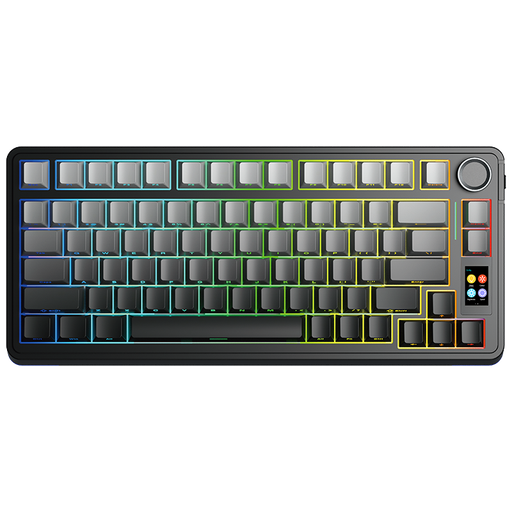
AULA S75 Pro, 75% mechanical keyboard
For writers looking for a more compact mechanical layout with controls built into the keyboard.
The product name specifies an TFT display, a rotary knob, three connection modes and hot-swappable Star Vektor switches. Before choosing, check that the available key layout suits your needs.
View at Joybuy
 No image available
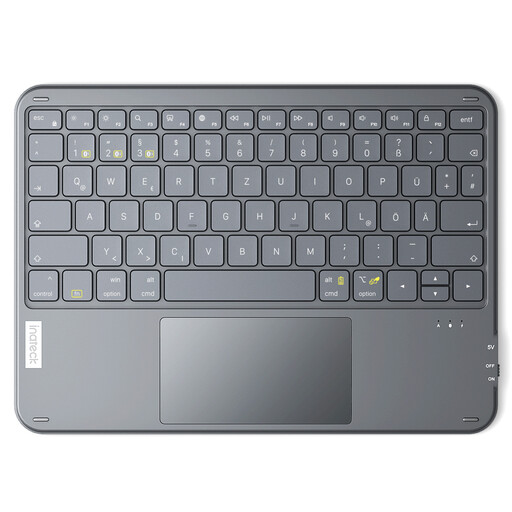
Inateck KB01105 tablet keyboard with touchpad
If you’d like to use a pointer while working on a tablet, the product name specifies an integrated touchpad and shortcut keys.
The product details specify a German QWERTZ layout and wireless connectivity. The description lists compatibility with Windows and iPadOS; check that it works with your specific device.
View at Joybuy
 No image available
AJAZZ AK820 MAX, 75% mechanical keyboard
For writers who want to keep using arrow keys and a function row with a compact layout.
The product details specify a US layout, three connection modes and programmable key mappings. Check that the layout and available navigation keys suit the way you work.
View at Joybuy
Frequently asked questions
Do I need a split keyboard for a split editor?
No. In Literature & Latte’s Scrivener example, “split” refers to two editor panes. The keyboard design is a separate choice based on your preferred hand position.
How do I set up programmable keys for writing?
First, check which shortcuts your writing software and operating system actually support. For supported Keychron keyboards, the manufacturer describes customisation through Launcher; this doesn’t automatically apply to other models or programmes.
How can I tell if a split keyboard will suit my workspace?
The key questions are whether you can position the keyboard and your hands comfortably at your desk, and whether the key layout feels right for you. The BAuA highlights the need for enough space to arrange your mouse and keyboard to suit your needs; the design alone is not evidence of a therapeutic benefit.
What should I check about layout and connection before ordering?
Check that the specific key layout includes the characters you need and that your device supports the connection. A wireless keyboard may use a receiver rather than Bluetooth; for the PERIBOARD-624B, Perixx specifies a USB-A receiver and four AAA batteries.
Are mechanical keyboards always quieter?
You can’t judge noise based on the keyboard type alone. The switches and specific model also matter, so if possible, try the keyboard in conditions similar to your writing environment.


