
Lieferung heute & morgen

Qualitätsgarantie

Willkommens-Angebote freischalten: KOSTENLOSE Lieferung | Bis zu 80 % RABATT | Kostenlose 30-Tage-JoyPlus-Testphase
App herunterladen
A 12V children's electric ride-on car with remote control should give children plenty of driving fun while allowing parents to stay in control. In practice, however, models vary considerably in terms of speed, seat size, battery capacity and features. Marketing details can particularly often lead to disappointing purchases: a vehicle may look large in photos but offer little space; the stated run time may only apply under ideal conditions; or the remote control may not be suitable for every everyday situation.
This buying guide from the Joybuy Product Recommendation Officer examines the key features objectively and shows which children's electric ride-on vehicle may suit different types of family.
A two-seater children's electric ride-on car is not automatically suitable for two children of every size. The actual seat dimensions, maximum load capacity and available interior space are what matter. With a two-seater vehicle, you should also check whether both children have enough room with their seat belts fastened.
The models in this selection differ considerably:
With a battery-powered children's vehicle, operating time depends on factors including total weight, surface, outdoor temperature, driving speed and charge level. Charging time is therefore a more useful point of comparison than a blanket advertising claim about driving duration.
Look out for:
LED lights, music, a USB port and horn make a children's vehicle with LED lights and music versatile. However, they cannot replace easily accessible controls or a controllable speed. For younger children, soft start, reverse gear and parental remote control are usually more important than additional media connections.
A 2.4 GHz remote control can make it easier to control the vehicle when starting, turning and stopping. Multiple speed settings and a separate stop or emergency braking function are particularly useful. Before buying, check whether the remote control is included and which batteries it requires.
Depending on the model, the vehicles in this selection offer three speed settings. The two vehicles with tipping beds are specified as travelling at 3 to 8 km/h, while the Audi model is specified at 3 to 5 km/h. When used on private property, the speed should always be adjusted to the child's age, driving ability and the available space.
A children's vehicle with a seat belt should have an adjustable belt so that it does not sit loosely against the body. Lockable doors can provide additional protection against a child easily slipping out of the seat while the vehicle is moving. Soft start reduces sudden movements when setting off, but it cannot prevent every risk.
The following basic rules also apply:
An electric children's ride-on vehicle intended for outdoor use should be suitable for the surface on which it will be driven. Large, abrasion-resistant wheels and suspension can help provide better handling on asphalt or paved paths. This does not mean, however, that every model is suitable for gravel, wet grass or steep inclines.
If you are looking for a children's ride-on car for ages 3 and over, pay particular attention to a low speed range, an easily accessible stop function and a suitable seating position. An electric children's digger with a tipping bed or shovel is especially suitable for families who also want to use the vehicle for imaginative play.
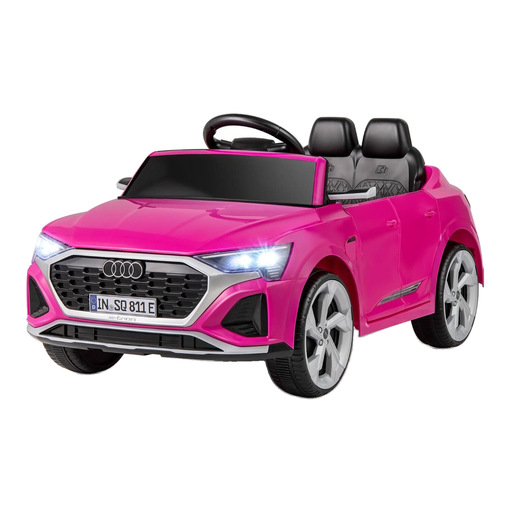
Why this product suits the profile: The compact Audi SQ8 children's electric ride-on car is specified for children aged 3 and over and combines manual controls with parental remote control.
The product data specifies a clear speed of 3–5 km/h, a charging time of 4–6 hours and a load capacity of 30 kg.
12 V battery, two driving modes, soft start, LED headlights, music, horn and lockable doors.
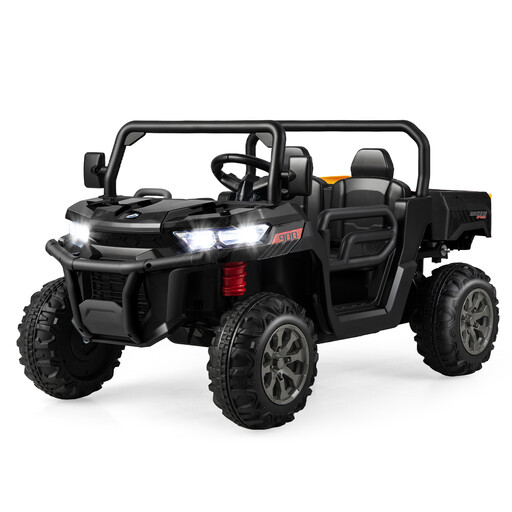
Why this product suits the profile: Two seats, a metal and PP construction, plus suspension make this vehicle appealing to families looking for a versatile option for two children.
The specifications state a maximum load capacity of 50 kg, a 12 V, 7 Ah battery and a charging time of 8–12 hours.
Two motors, seat belt, lockable doors, soft start, remote control with three speed settings and emergency brake button.
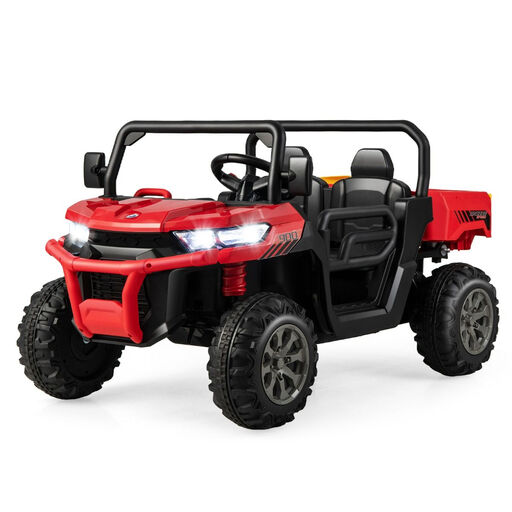
Why this product suits the profile: The tipping bed and removable shovel turn this model into an electric children's digger-style ride-on toy for imaginative outdoor play.
The product description lists specific dimensions of 119 × 68 × 65 cm, a load capacity of 50 kg and a charging time of 8–12 hours.
Automatic tipping bed, tailgate, shovel, LED lighting, music, USB, AUX and wireless connectivity.
We have put together a complete, regularly updated list of products that fully meet these strict selection criteria and the safety regulations applicable in the EU.
A 12V children's ride-on car does not need fuel, but it does incur electricity costs and occasional maintenance. The cost per charge depends on the battery capacity and electricity tariff. For a rough estimate, use: Kilowatt-hour consumption × electricity price. Actual energy consumption may be slightly higher due to charging losses.
For a longer service life:
This depends on the model. The selection featured here specifies charging times of 4–6 hours and 8–12 hours, respectively. Before using the vehicle for the first time, always follow the specific instruction manual.
Depending on the version, the models presented are specified for children aged 3 and over. However, height, weight, coordination and the surroundings remain decisive factors. The remote control provides an additional way to maintain control and does not replace adult supervision.
Depending on the model, paved, level surfaces such as asphalt or concrete may be suitable. Wet conditions, steep inclines, stairs and public roads should be avoided. Information about the wheels and suspension can provide guidance, but does not mean that the vehicle is approved for every type of surface.