
Lieferung heute & morgen

Qualitätsgarantie

Willkommens-Angebote freischalten: KOSTENLOSE Lieferung | Bis zu 80 % RABATT | Kostenlose 30-Tage-JoyPlus-Testphase
App herunterladen
A dedicated table in a child's room is more than just a piece of furniture—it's a space for creativity, play, and their first learning experiences. But choosing the right activity table for kids can quickly become overwhelming. Many models promise multifunctionality but prove impractical in daily use. This guide will show you what to look for to make an informed decision and steer clear of common purchasing traps.
Before diving into the benefits, it's helpful to know the problems that often arise with low-quality products. These three issues frequently lead to disappointment and unnecessary expense.
To avoid the problems mentioned above, you should pay attention to a few core features during your selection. These define the quality, safety, and durability of a children's furniture set.
The material is fundamental. A wooden play table or one made from high-quality engineered wood like MDF is often a good choice, provided the workmanship is right. Pay attention to the following points:
A good kids' activity table adapts to their changing needs. A reversible tabletop, offering one side as a classic table and the other as a kids' drawing table with a chalkboard or whiteboard surface, doubles its utility. This way, a table for eating or puzzles can instantly become a kids' craft table that fosters creativity. This flexibility ensures the piece of furniture remains engaging for several years.
A kids' table and chair set with storage should not only offer space for toys but also be ergonomically designed.
Based on the criteria above, we have identified some models that are suitable for different needs and living situations.
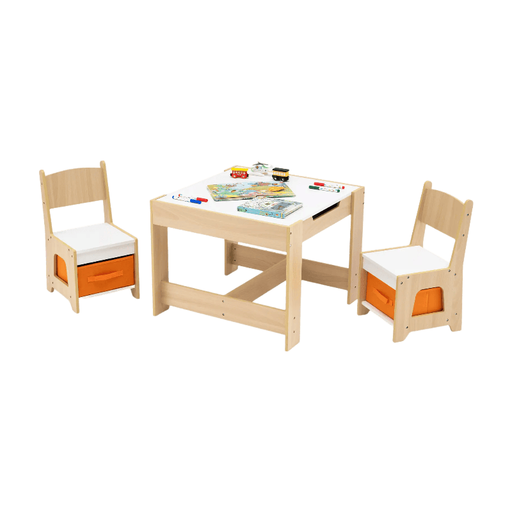
Why This Fits Their Persona: Ideal for children who love to paint, draw, and craft. The reversible tabletop offers a whiteboard and a chalkboard side, allowing for maximum creative freedom and making the table usable for various activities.
The dual-sided top solves the problem of quickly wearing surfaces by offering two durable sides, each optimized for its specific purpose.
Reversible tabletop (whiteboard/chalkboard) and a hidden storage compartment under the top for a tidy play area.

Why This Fits Their Persona: Perfect for parents who value a tidy kids' room. The set includes three separate fabric bins, helping children sort toys and craft supplies and develop good organizational habits.
This set bypasses the impractical storage trap with a thoughtful system of three different-sized bins that encourages clear organization.
Three separate fabric bins for easy organization. According to the manufacturer, it uses wood from FSC-certified forests.
Why This Fits Their Persona: For families with limited space. The chairs can be pushed completely under the table when not in use. With its compact dimensions of approx. 62 x 62 cm, the set also fits into smaller children's rooms or a play corner in the living room.
It avoids the trap of bulky children's furniture that clutters the room. The thoughtful design maximizes the play area without wasting valuable space.
Space-saving design where the chairs fit under the table. The square shape is ideal for placement in corners.
We've compiled a full, up-to-date list of products that fully meet these strict selection criteria and UK/EU safety regulations.
Most manufacturers recommend their models for children aged 3 and up. From this age, children can usually sit stably on a chair and begin to show interest in painting, crafting, and building. Pay attention to the manufacturer's recommended age and check if the seat and table height match your child's size to ensure an ergonomic posture.
For the whiteboard side, only use dry-erase whiteboard markers. Cleaning is best done with a dry cloth or a special whiteboard eraser. Stubborn stains can be carefully removed with a slightly damp cloth. For the chalkboard side, standard chalk is suitable. A damp sponge is sufficient for cleaning. Avoid aggressive or abrasive cleaning agents, as they can damage the surfaces.
MDF (medium-density fibreboard) is a widely used material in furniture construction. For safety in a child's room, it is crucial that the products comply with European standards. Look for the E1 class designation, which ensures that formaldehyde emissions are below the legal limits. Additionally, all surfaces and edges should be smoothly finished and sealed with non-toxic, child-safe lacquers.