
Lieferung heute & morgen

Qualitätsgarantie

Willkommens-Angebote freischalten: KOSTENLOSE Lieferung | Bis zu 80 % RABATT | Kostenlose 30-Tage-JoyPlus-Testphase
App herunterladen
A child's room is a bedroom, study, and playroom all in one. Furnishing it can be a challenge, especially in smaller spaces. A kids' bed with a desk and storage promises to combine these three functions into a space-saving solution. However, the market is flooded with models of widely varying quality. Before you make a decision, it's crucial to understand the common weaknesses that can quickly turn a clever idea into a poor purchase.
Many parents invest in a multifunctional bed only to find that the structure wobbles, the drawers jam, or the desk is unusable for homework after just a few months. We'll show you the three main pitfalls to watch out for and how to choose a durable, functional piece of furniture for your child.
To avoid these issues, you should carefully examine three core aspects before buying. These will determine whether a space-saving kids' bed will reliably serve its purpose for years to come.
A bed's durability is directly linked to its material. A solid wood bed for kids, made from pine or beech for example, offers significantly more stability and load-bearing capacity than models made from simple particle board (MDF). Pay attention to the following:
A youth bed with a desk needs to do more than just look good. Its functionality determines its daily usefulness.
The most common size for kids' and youth beds is 90x200 cm. This standard dimension makes it easier to find suitable mattresses and bedding later on. A 90x200 cm multifunctional bed is a future-proof choice. Before buying, measure the room carefully, considering not only the footprint of the bed itself but also the space needed to pull out drawers and for a chair at the desk.
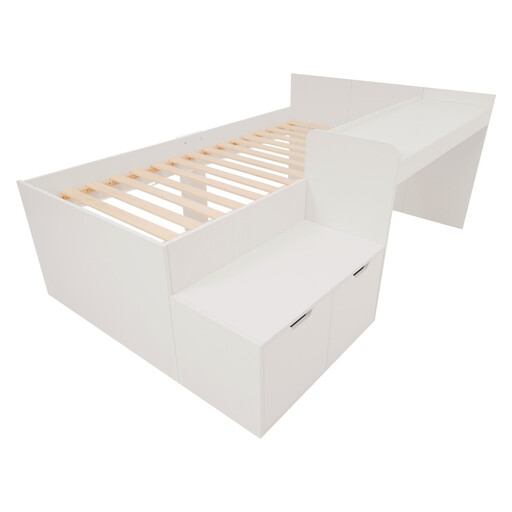
Why it's a good fit: Ideal for school-aged children who need a dedicated space for homework. It combines sleeping, studying, and storage in a minimal footprint, creating a structured environment in the child's room.
The construction of solid pine wood and MDF provides the necessary stability. The two large drawers offer real, usable storage space. Rounded edges and transparent corner guards directly address the safety aspect.
Fully integrated desk and storage in one compact unit. The bed frame's load capacity is 120 kg, according to the manufacturer.
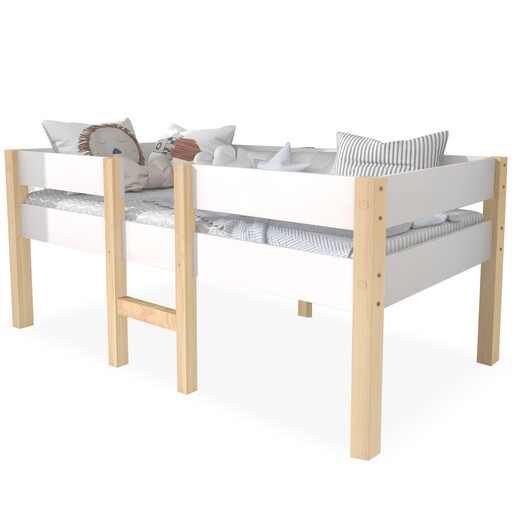
Why it's a good fit: A great choice for younger children or when safety is the top priority. The mid-sleeper design with a full-length guard rail creates a secure sleeping den. The space under the bed can be customised.
The construction of solid pine wood ensures stability. The full-length guard rail minimises safety risks. The open space under the bed (44 cm high) avoids the pitfall of impractical, fixed drawers and can be flexibly filled with storage boxes.
High level of safety thanks to the wrap-around guard rail and flexible use of the storage space under the sleeping area.
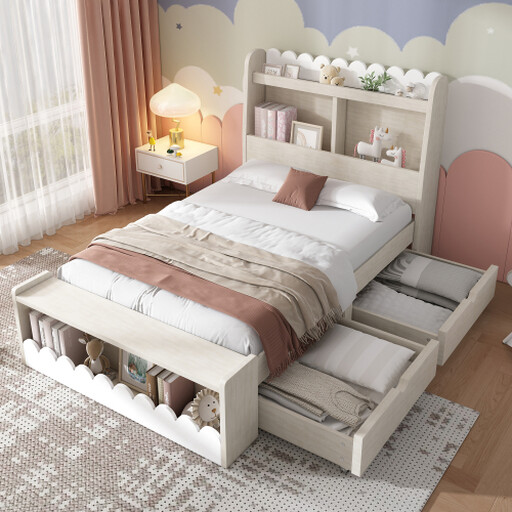
Why it's a good fit: For anyone who wants to maximise available space for organisation. With drawers, shelves at the head and foot, and a storage bench, this bed offers a comprehensive solution.
This model tackles the "impractical storage" pitfall with a variety of options: deep drawers on castors, 13 cm deep shelves with stoppers, and an additional bench. The construction of solid wood and MDF ensures stability.
An exceptional number of integrated storage options that help keep the child's room permanently tidy.
We have compiled a complete, up-to-date list of products that fully meet these strict selection criteria and German safety regulations.
For high stability and durability, solid wood like pine or beech is the top choice, especially for the load-bearing parts and the desk attachment. High-quality MDF boards can be an alternative, but pay close attention to a solid thickness and stable screw connections to prevent the structure from wobbling.
Plan for more than just the bed's dimensions (e.g., 90 x 200 cm). You will need at least 60–80 cm of free space in front of the desk for a chair and freedom of movement. If the bed has side drawers, factor in their extension depth (approx. 50 cm) as well.
Yes, as long as they meet key criteria. Look for a stable overall construction, rounded edges, and, for mid-sleeper or loft beds, a standard-compliant guard rail. Another important point is the use of non-toxic paints and materials, often indicated by quality seals like the EN 71-3 standard.