
Lieferung heute & morgen

Qualitätsgarantie

Willkommens-Angebote freischalten: KOSTENLOSE Lieferung | Bis zu 80 % RABATT | Kostenlose 30-Tage-JoyPlus-Testphase
App herunterladen
Selecting a child's bed is a decision that should be guided by objective criteria, including material quality, safety features, and functional design. A wooden child's bed provides a solid foundation for any kid's room, but the differences in construction and features can be significant. This article analyses the technical aspects relevant when choosing a bed for children aged approximately 2 to 10 and presents a selection of models with various specialisations.
When evaluating a child's bed, three main areas should be considered: the material, the safety design, and the functionality.
The term "wooden bed" encompasses various materials, each with specific properties.
The choice of material directly impacts the bed's robustness, weight, and maintenance requirements.
The safety of a child's bed is defined by its construction. The following points should be checked:
A modern child's bed is often more than just a place to sleep.
The following models have been selected based on their specific technical features and practical benefits.
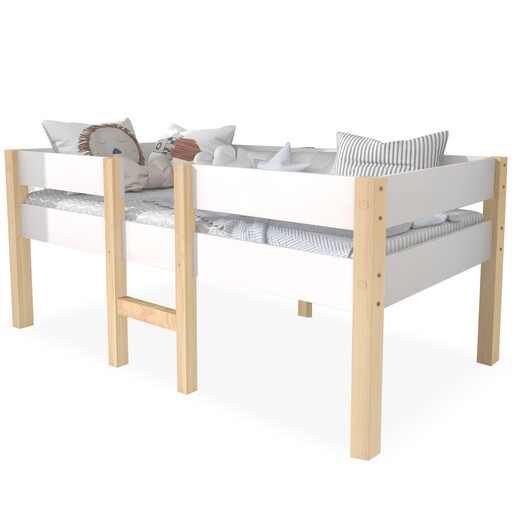
Product Feature Analysis: This mid-sleeper bed combines a solid pine wood construction with a thoughtful safety design. The wrap-around guard rail, featuring a narrow 35 cm opening for entry, offers enhanced security for restless sleepers. The sleeping surface is elevated, creating 44 cm of clearance underneath for storage. The solid wood corner posts ensure high stability, rated by the manufacturer for a maximum user load of 120 kg.
Advantages:
Who It's For: This model is designed for parents seeking an exceptionally safe and stable bed for the transition from a cot. The additional storage space underneath is a practical advantage for smaller children's rooms.
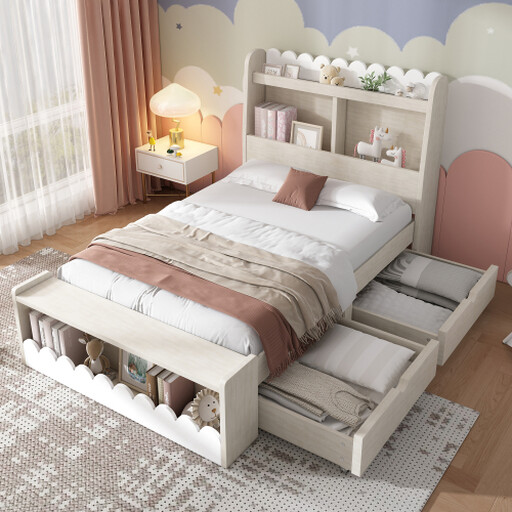
Product Feature Analysis: This storage bed is engineered for maximum space efficiency. It integrates two 50 cm deep drawers that can be flexibly mounted on either the left or right side. Additionally, 13 cm deep shelves at the head and foot of the bed provide space for books or an alarm clock. A bench at the foot of the bed expands its functionality. The bed frame is designed with a recessed base to hold the mattress securely in place and prevent slipping. The maximum weight capacity is stated as 120 kg.
Advantages:
Who It's For: This bed is aimed at parents who need to make the most of the space in a child's room. It is particularly suitable for school-aged children who require more storage for books, toys, and personal belongings.
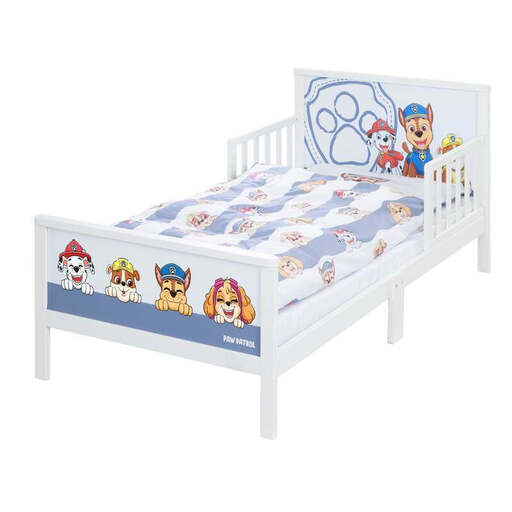
Product Feature Analysis: This 70x140 cm toddler bed is designed as an all-in-one package. It is based on the Montessori principle, with a low entry height of 18 cm (plus mattress height) that allows children to get in and out of bed independently. The delivery includes the slatted frame and matching bedding. Two side guard rails at the head of the bed serve as fall protection. According to the manufacturer, the bed is constructed in compliance with safety standard EN 716-1/-2:2008 + A1:2013 and is designed for a weight of up to 35 kg.
Advantages:
Who It's For: This model is ideal for parents of toddlers aged 2 to 5 who are looking for a themed and safe first bed after the cot. The all-in-one approach simplifies the purchasing process.
The selection presented here represents specific solutions for different needs. The market offers a wide variety of other models that differ in design, colour, and material. For a broader overview, especially for models with a specific colour scheme, you can explore our category for white child's beds.
1. From what age is a wooden child's bed without bars appropriate? Transitioning from a cot to an open child's bed is often recommended between the ages of 2 and 3.5. The child's individual development is the deciding factor. If a child starts to climb out of their cot independently, an open bed with a guard rail can be a safer alternative.
2. What is the difference between a junior bed and a standard single bed? A junior bed often measures 70x140 cm or 70x160 cm and is designed as a transitional solution for toddlers. It is lower to the ground and frequently equipped with an integrated guard rail. A standard single bed, such as the common 90x200 cm size, is taller and suitable for school-aged children, teenagers, and adults, offering a longer period of use.