
Lieferung heute & morgen

Qualitätsgarantie

Willkommens-Angebote freischalten: KOSTENLOSE Lieferung | Bis zu 80 % RABATT | Kostenlose 30-Tage-JoyPlus-Testphase
App herunterladen
Choosing the first real bicycle is an exciting milestone for any child. For parents, however, the search can quickly become overwhelming. Between different sizes, safety features, and designs, there are several pitfalls that can lead to a poor purchasing decision. As your Joybuy Product Recommendation Officer, I'll help you understand the key criteria and make an informed choice that meets both your child's needs and your standards for safety and durability.
Before we dive into the details, let's look at three typical problems that often lead to disappointment:
To avoid these mistakes, you should focus on a few crucial technical parameters. These will help you separate marketing promises from actual product features.
The size of a kids' bike is given in inches (″) and refers to the diameter of the wheels. The most common sizes for ages 2 to 7 are:
Pro Tip: Measure your child's inseam length (the inside of the leg from the floor to the crotch). With the saddle at its lowest setting, the child should be able to stand with both feet flat on the ground. This provides the necessary security when stopping and mounting.
For new riders, a dual braking system is a sensible feature. The combination of a hand brake (usually a V-brake on the front wheel) and a bike with a coaster brake on the rear wheel offers two advantages: children learn how a hand brake works, but in moments of panic, they can intuitively brake by pedalling backwards.
A kids' bike with training wheels is the classic introduction to the world of cycling for many children. They provide stability and self-confidence until the sense of balance is sufficiently developed. Make sure the training wheels are sturdy and can be easily removed when needed. A fully enclosed chain guard is also an important feature to protect clothing and fingers from the chain.
Based on these objective criteria, we have identified a few models that are suitable for different needs.
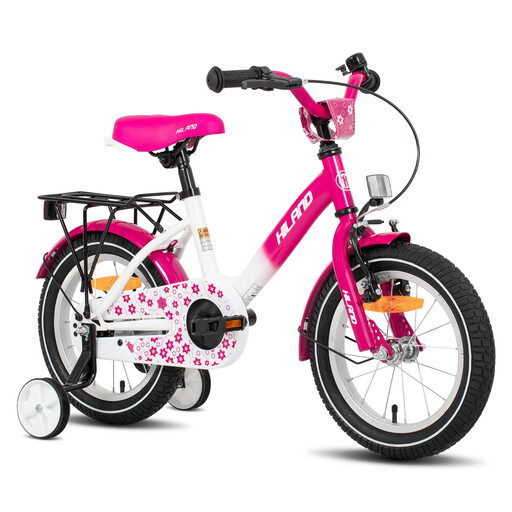
Why this model is a great fit: With its 12-inch size and included training wheels, this HILAND kids' bike is tailored to the needs of beginners aged 2 to 4 (80–105 cm). The low step-through frame makes it easy to get on and off.
The clear size recommendation prevents a poor purchase. The dual braking system and enclosed chain guard meet key safety requirements from the start.
Combination of a V-brake and a coaster brake for intuitive operation. Training wheels are included in the box.
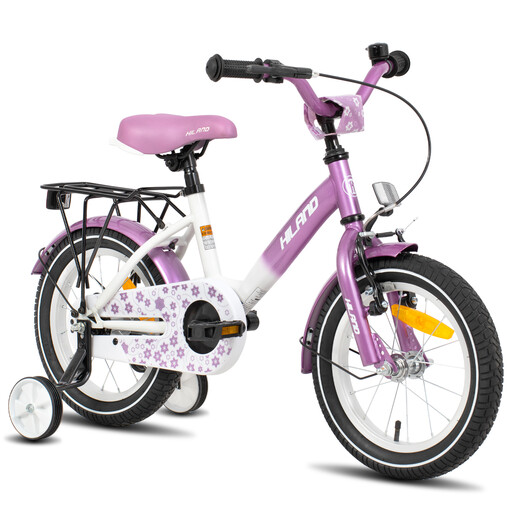
Why this model is a great fit: Designed as a bike for girls and boys, the 14-inch version offers a great fit for children from 3 to 6 years old (90–125 cm). It's the logical next step when the 12-inch bike becomes too small, while still offering the security of training wheels.
This model bridges the gap for growing children, preventing them from having to ride a bike that is too small. The safety features remain at the same high level as the smaller models.
The robust Hi-ten steel frame is durable, and the wide 1.95-inch tyres provide extra stability on various surfaces.
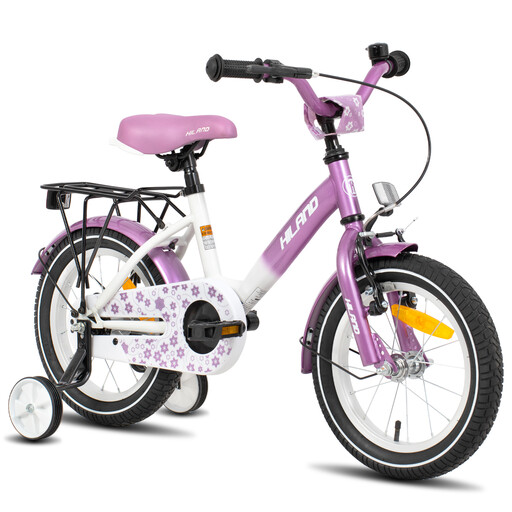
Why this model is a great fit: The 16-inch kids' bike is designed for children aged 4 to 7 (105–135 cm) who are already riding confidently or are about to. This model comes with a kickstand instead of training wheels, which encourages the transition to riding without assistance.
It offers a suitable size for preschoolers and prevents them from riding a bike that's too small. The sturdy construction is designed for long-term use.
The dual braking system is retained, while the included kickstand gets the child used to parking the bike independently.
We've compiled a full list of products that meet our selection criteria.
1. How do I find the right kids' bike size? The most reliable way is to measure your child's inseam length. Have your child stand with their back against a wall (without shoes) and place a book vertically between their legs, high up. Measure the distance from the floor to the top edge of the book. This value should be greater than the bike's minimum seat height, ensuring your child can safely reach the ground with their feet.
2. Is a coaster brake useful for a kids' bike? Yes, for many children, a coaster brake is very intuitive. In stressful situations, they tend to stop pedalling or move the pedals backwards. A coaster brake responds to exactly this impulse and initiates braking. It's a great supplement to the hand brake, which prepares the child for future, larger bikes.
3. How long does it take to assemble a kids' bike? For the models presented here, which are delivered 90% pre-assembled, final assembly usually takes about 20 to 30 minutes. Typically, the handlebars, saddle, pedals, and, if applicable, the training wheels or front wheel need to be mounted. The necessary tools are often included. It is recommended to check all screws and brakes before the first ride.