
Lieferung heute & morgen

Qualitätsgarantie

Willkommens-Angebote freischalten: KOSTENLOSE Lieferung | Bis zu 80 % RABATT | Kostenlose 30-Tage-JoyPlus-Testphase
App herunterladen
A clutter-free kid's room—it's the dream of many parents. A well-chosen kids' shelf is often the first step towards better organisation. It should not only provide storage for books and toys but also be safe and practical for children. However, the market is overwhelming, and many products don't live up to their promises.
As a Joybuy Product Recommendation Officer, I analyse product information daily to help you distinguish functional, durable furniture from short-lived marketing trends. Before you make a decision, you should be aware of the three most common pitfalls that lead to disappointment and unnecessary expense.
To avoid these pitfalls, you should check three core parameters before buying. These objective criteria will help you find a safe and practical storage shelf for your child's room.
Safety is the top priority. A crucial feature is the included anti-tip kit. This device is used to securely fasten the shelf to the wall and prevent it from tipping over. Ensure it is included with the product and that the assembly instructions provide clear guidance on how to attach it. Rounded corners and edges are equally important. They minimise the risk of injury from bumps and falls, which is especially significant in an active play environment. A wall-mounted shelf in a child's room can be a space-saving alternative, but it must also be installed correctly and securely.
Many pieces of children's furniture are made from MDF (Medium-Density Fibreboard) panels. The material itself is not a problem, as long as it meets a certified emission class. Look for the MDF (E1) designation. This standard ensures that the board's formaldehyde emissions are very low and comply with legal limits for indoor use. A kids' shelf made of wood, meaning solid wood, is an alternative but often comes at a higher price point. Regardless of the material, a low-emission finish is essential for the indoor air quality in a child's room.
A good kids' bookshelf or toy shelf is designed so that children can use it independently. The Montessori shelf is a prime example of this: it is low to the ground, and its compartments are open and easily accessible. Books are often displayed with their covers facing forward, which visually appeals to children and encourages them to read. The ideal height of the shelf depends on the child's age. For toddlers, everything should be reachable at eye level to foster their autonomy and sense of order.
Based on these objective criteria, we have selected a few models from our range that are suitable for different needs and living situations.
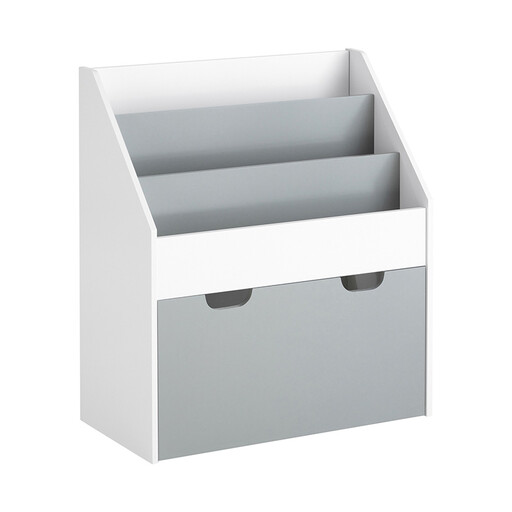
Why This Fits Their Persona: Ideal for parents looking for an initial, functional, and compact solution for book and toy storage. The combination of open shelves and a rolling bin provides a clear structure for their first attempts at tidying up.
Its low 70 cm height and softened edges directly address the ergonomics and safety traps. The material is specified as MDF (E1), and an anti-tip kit is included according to the manufacturer.
Combines book and toy storage; removable toy box with castors for easy handling.
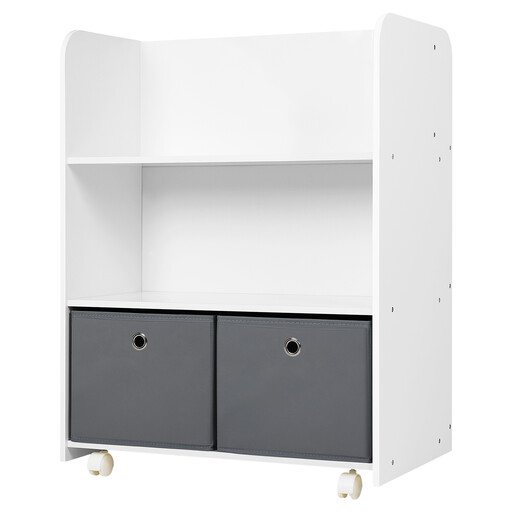
Why This Fits Their Persona: Perfect for families who value flexibility. This mobile kids' shelf with bins can be easily moved around the room and serves as a practical room divider in the playroom, thanks to its two-sided design.
The design is highly practical and versatile, ensuring it won't quickly fall into disuse. The product description explicitly highlights the need for wall anchoring to bypass the stability trap, even with its castors.
Two-sided storage (book and toy sides); mobile thanks to castors; includes practical fabric bins.
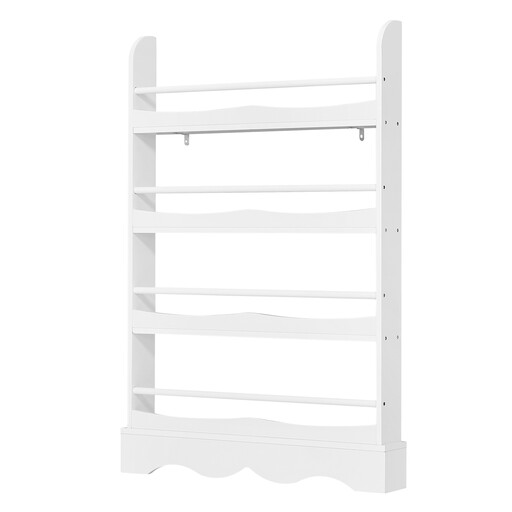
Why This Fits Their Persona: For parents who specifically want to encourage a love of reading. This white kids' bookshelf displays books with their covers facing forward, which is proven to encourage children to grab and browse.
The design is maximally child-friendly, avoiding the pitfall of inaccessibility. The product information mentions an anti-tip kit, rounded corners, and P2-grade MDF, covering the safety and material aspects.
Actively promotes an interest in reading; very space-efficient due to its slim profile; secure design with retaining rods.
We've compiled a complete, up-to-date list of products that fully meet these strict selection criteria and European safety regulations.
Every freestanding shelf for a child's room should be secured to the wall using the provided anti-tip kit. Assemble the shelf according to the instructions. Mark the drilling spot for the wall bracket, drill a hole, and insert a wall anchor suitable for your wall type (e.g., for drywall or masonry). Then, firmly screw the bracket to both the wall and the shelf. Check for a secure fit by gently wiggling the unit.
The main advantage of a Montessori shelf is that it promotes independence. Thanks to its low height and the forward-facing display of books, children can choose their own reading material and put it away themselves. This builds their self-confidence and sense of order. A conventional bookshelf with only the spines showing is often confusing and difficult for young children to manage.
Look for clear and transparent material specifications from the manufacturer. For furniture made from engineered wood like MDF or particleboard, the E1 label is a reliable indicator. It confirms that the product complies with legal European limits for formaldehyde emissions and is suitable for use in living spaces, especially in a child's room.