
Lieferung heute & morgen

Qualitätsgarantie

Willkommens-Angebote freischalten: KOSTENLOSE Lieferung | Bis zu 80 % RABATT | Kostenlose 30-Tage-JoyPlus-Testphase
App herunterladen
A well-chosen kids' bookshelf not only creates order but can also foster your child's love of reading and independence. However, the market is flooded with models whose weaknesses often only become apparent after purchase. As a Joybuy Product Recommendation Officer, I'll help you identify the crucial features and avoid common purchasing pitfalls, so you can make a durable and safe choice for your bookshelf in the kids' room.
Many shelves look appealing in product photos but prove to be impractical or even unsafe in daily use. Pay special attention to these three weak points:
To avoid a bad purchase, you should base your decision on objective criteria. The following three points are essential for storage in the kids' room.
Safety is the top priority. A stable shelf must have either a very wide, heavy base or a fixture for wall mounting.
A good kids' bookshelf is tailored to the child's size and motor skills.
The choice of material affects not only stability but also longevity and the indoor climate.
Here are three recommendations tailored to different needs and room situations, all of which meet the quality criteria mentioned above.
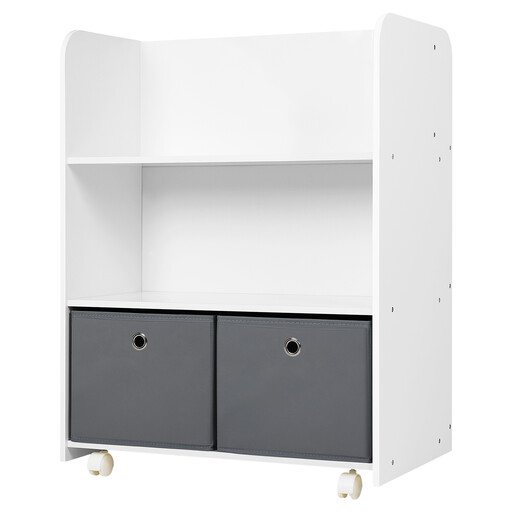
Why it's a great fit: Ideal for parents looking for a flexible, all-in-one solution for books and toys. Thanks to its castors, the shelf can be easily moved, and the double-sided design allows access from both sides—perfect for the centre of a playroom.
It combines a bookshelf with a toy shelf, including fabric bins, thus avoiding the "design dead-end" of an impractical, one-size-fits-all shelf. The construction of MDF and solid wood is a solid choice.
Double-sided access and high mobility thanks to lockable castors. It offers a clear separation between books and toys.
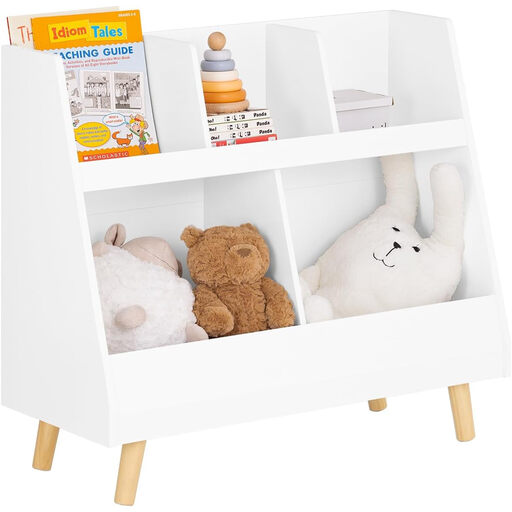
Why it's a great fit: This shelf is consistently designed to meet the needs of young children. Its low height, open compartments, and stable trapezoidal shape make it a great choice for parents who follow the Montessori approach and want to foster their child's independence.
The child-friendly design avoids the trap of compartments that are too high and deep. The wide base and solid pine wood legs actively counteract the stability trap. All edges are rounded.
The low-profile design and open compartments allow even toddlers to independently access their books and toys.
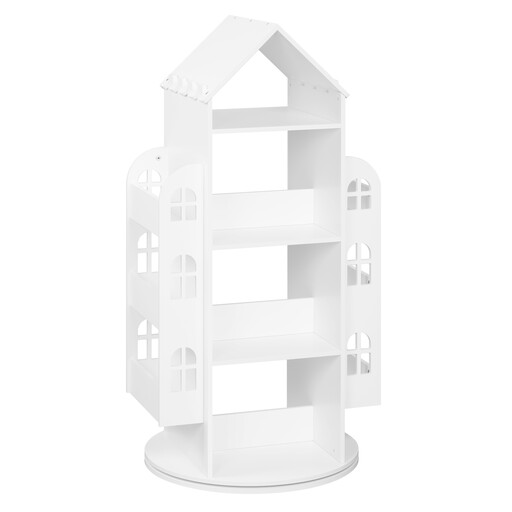
Why it's a great fit: For families with lots of books but limited space. The vertical, 360° rotating design makes optimal use of the room's height, offering a remarkable amount of storage on a very small footprint. The playful house design is an added eye-catcher.
The rotating function makes all compartments easily accessible, solving the problem of hard-to-reach corners. The wide, stable base and high dead weight of approx. 25.9 kg ensure good stability.
The 360° rotating function provides easy access to 7 main and 6 side compartments, maximising storage on a minimal footprint.
We have compiled a complete, up-to-date list of products that fully meet these strict selection criteria and rigorous safety standards.
Most shelves intended for children's rooms come with an anti-tip kit. This is usually a sturdy strap or a metal bracket. To install it, drill a hole in the wall, insert a wall anchor suitable for your wall type (e.g., drywall, brick), and screw the anchor firmly to both the wall and the shelf. Always follow the manufacturer's assembly instructions.
A Montessori shelf is useful as soon as a child begins to crawl or walk and shows an active interest in their surroundings, typically around 12 to 18 months of age. The low, open design allows the child to independently select and put away toys or books, which fosters autonomy and decision-making skills from an early age.
Solid wood is generally considered the most robust and long-lasting material for children's furniture. It is resilient and can be sanded down and refinished if needed. A very good and common alternative is high-quality MDF board (E1-class) with a durable surface treatment like melamine veneer or a water-based lacquer. This material offers excellent stability and durability at a often more affordable price.