
Lieferung heute & morgen

Qualitätsgarantie
App herunterladen
Kategorien
A structured environment can foster a child's independence. A purposefully designed children's bookshelf is a key element that not only keeps things tidy but also makes books and toys easily accessible. The choice of a suitable model depends on criteria like material, safety, and ergonomic suitability for the child's height. This guide analyses the technical aspects relevant to choosing a kids' storage shelf.
The decision for a kids' room shelf should be based on an analysis of objective features. The following points are crucial for making an informed choice.
The choice of material directly impacts the furniture's durability and safety.
The design determines how well a child can use the shelf independently.
A thorough needs assessment is required before purchasing.
Based on the criteria mentioned, we present three models that stand out for their specific design features and applications.
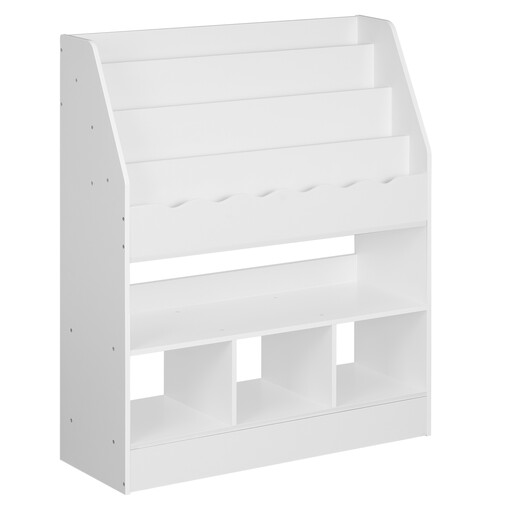
Why we recommend this product: This model combines a sturdy construction with a thoughtful design. The stepped arrangement of the compartments provides a clear overview and easy access for children of different heights. Made from E1 MDF boards and equipped with anti-tip hardware, it meets essential safety requirements. Its 100 cm height is a good compromise for use over several years.
Pros:
Best for: Parents looking for a durable and safe storage solution for books and toys that can be used in a child's room as well as in playgroups or nurseries.
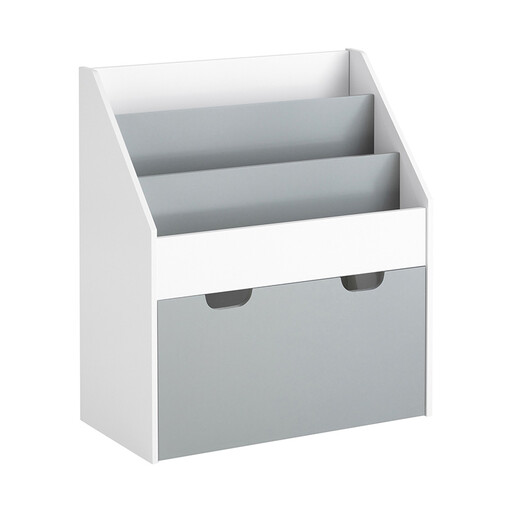
Why we recommend this product: This shelf's strength lies in its multifunctionality. It combines three open shelves for front-facing book display with a large toy box on wheels. With a total height of just 70 cm, it is specifically designed for the needs of toddlers. The rounded edges and sturdy E1-grade MDF construction underscore its focus on safety.
Pros:
Best for: Families with toddlers who need a space-saving, all-in-one solution for toy storage and their first books.
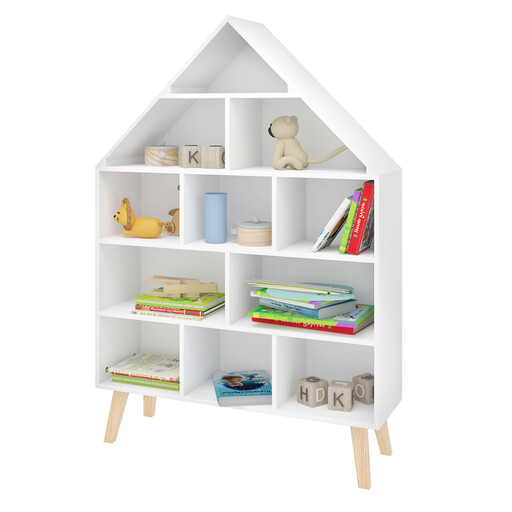
Why we recommend this product: This model combines high functionality with an appealing design. The house shape can playfully motivate children to tidy up. With 11 compartments across 5 tiers, it offers a very large storage capacity for books, toys, and craft supplies. The solid pine wood legs ensure a stable base, while the body is made from E1-grade MDF boards.
Pros:
Best for: Parents looking for a kids' storage shelf with maximum capacity that also acts as a design highlight in the child's room.
The models presented here cover specific use cases. Depending on room size, interior design style, and your child's individual needs, other solutions such as narrow wall shelves, modular shelving systems, or closed cabinets may also be suitable. For a broader overview of different designs and sizes, you can find more models in our Storage Shelves category.
1. How high should a kids' bookshelf be? The ideal height depends on the child's age. For toddlers (2-4 years), shelves up to 75 cm high are optimal, as they can reach all compartments independently. For preschool and primary school children (5-8 years), models up to 120 cm are suitable. Regardless of the height, securely anchoring the unit to the wall with anti-tip hardware is essential for safety.
2. What is a Montessori shelf? A Montessori shelf is a low, open shelving unit that gives children independent access to their toys and books. A characteristic feature is often the front-facing display of books, allowing the child to see the covers and choose their reading material on their own. The principle behind this is to foster autonomy and a sense of order.
3. How do I securely attach a kids' bookshelf to the wall? Most kids' bookshelves come with anti-tip hardware. This typically consists of one or two brackets or straps, screws, and wall anchors. Attach one part to the shelf (at the designated spot) and the other part securely to the wall. Use wall anchors that are appropriate for your wall type (e.g., concrete, drywall). Ensure the connection is taut and that the shelf cannot tip forward when pulled. The manufacturer's assembly instructions must be strictly followed.