
Lieferung heute & morgen

Qualitätsgarantie

Willkommens-Angebote freischalten: KOSTENLOSE Lieferung | Bis zu 80 % RABATT | Kostenlose 30-Tage-JoyPlus-Testphase
App herunterladen
A two-seater electric car for kids promises double the driving fun and is often the ultimate gift. However, the market is vast, and not every model lives up to its promises. Before you make a decision that could lead to disappointment, it's crucial to understand the common pitfalls and focus on the features that truly matter. As your Joybuy Product Recommendation Officer, I'm here to help you separate the best from the rest.
Many offers sound tempting, but they often hide compromises that significantly limit play value and safety. Pay special attention to these three points:
To make an informed decision, focus on the technical specifications that are critical for safety, durability, and genuine fun.
For a 2-seater kids' electric car, a true 12V system with a capacity of at least 7 Ampere-hours (Ah) is the recommended baseline. This ensures that the runtime doesn't end after just a few minutes, even at full capacity and on uneven terrain. Models with two drive motors (Dual Motor), usually on the rear wheels, offer significantly better traction and power distribution than vehicles with only one motor.
A realistic 50 kg weight capacity is a good benchmark for a true two-seater. This provides plenty of leeway for two children aged 3 to 6, as well as for small "cargo." In addition to the weight capacity, pay attention to the specified width of the seat. This is the only way to ensure that there is enough space in practice for two small passengers.
The most important safety feature for parents is a reliable ride-on car with a remote control. Look for 2.4 GHz radio technology. Unlike old infrared systems, this is interference-free and includes an emergency stop function, allowing you to intervene at any time. Equally important is the soft-start function. It prevents jerky starts, protects children's necks, and ensures a controlled and safe driving experience from the very first second.
Instead of presenting an overwhelming list, we have matched models based on typical user profiles.
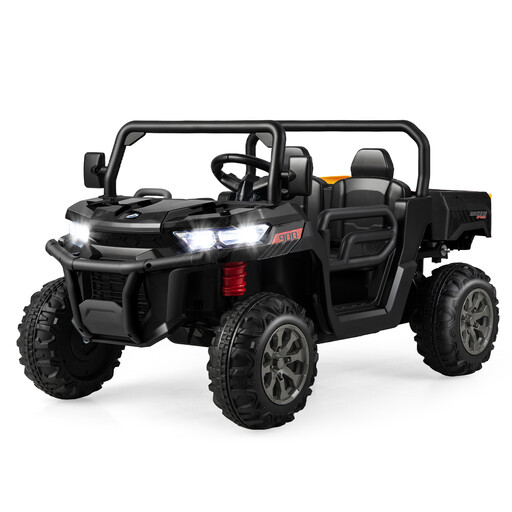
Why this model fits: Ideal for children who love role-playing. The combination of two seats and a functional, electric tilting bed makes this vehicle the centerpiece of any small "construction site" in the garden. It encourages cooperative play, with one child driving and the other operating the cargo bed.
With a weight capacity of 50 kg and two full-sized seats, it's a genuine two-seater. The 12V 7Ah battery reliably powers the two motors for extended playtime.
The automatic tilting bed is the clear standout feature, offering high, long-lasting play value that goes beyond just driving.
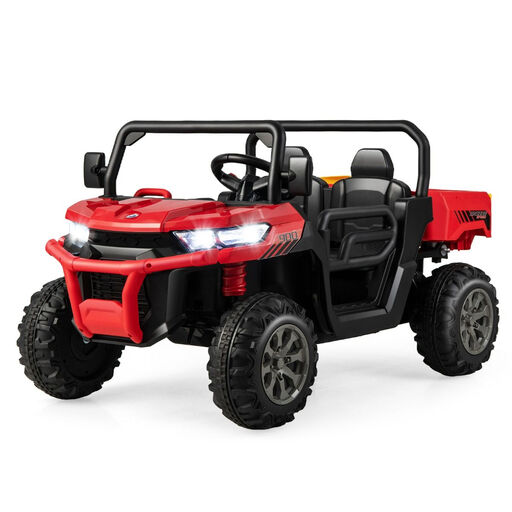
Why this model fits: This model is the ideal choice for parents and grandparents looking for an exciting gift for kids without compromising on safety. The comprehensive safety features give you full control and peace of mind.
It bypasses the safety trap with a 2.4 GHz remote control with emergency stop, adjustable seat belts, lockable doors, and a soft-start function that prevents sudden acceleration.
The combination of two driving modes (child controls or parent remote control) offers flexibility for different ages and developmental stages and enhances interaction.
We have compiled a complete, up-to-date list of products that fully meet these strict selection criteria and safety requirements.
The actual runtime depends on several factors: the battery capacity (in Ah), the total weight of the children, and the driving surface. A model with a 12V 7Ah battery typically offers a continuous runtime of about 60 to 90 minutes. The charging time for a fully depleted battery is usually 8 to 12 hours.
A weight capacity of 50 kg is a solid foundation for use by two children. It is generally sufficient for two children between the ages of 3 and 5. For two older children (e.g., 6 or 7 years old), it might get tight not just in terms of weight, but also the physical seat width. Therefore, in addition to the weight capacity, check the dimensions of the seat to ensure there is enough room for a comfortable shared ride.
No, absolutely not. These vehicles are legally considered toys and are not approved for road traffic. They are to be used exclusively on private property (e.g., in the garden, on the driveway) and away from public traffic. The safety of the children is the top priority here.