
Lieferung heute & morgen

Qualitätsgarantie

Willkommens-Angebote freischalten: KOSTENLOSE Lieferung | Bis zu 80 % RABATT | Kostenlose 30-Tage-JoyPlus-Testphase
App herunterladen
Depending on the design, a kids’ electric motorcycle can be a slow ride-on toy for the garden or a more powerful electric dirt bike for private off-road areas. For parents and grandparents, price is therefore only one consideration. Motor power, seat height, speed modes, brakes and battery must all match the child and the intended use.
A high top speed may look attractive on a specification sheet, but it is not automatically practical for beginners. An electric kids’ motorcycle with multiple speed modes can be adjusted gradually. For younger children, low modes of around 8 to 15 km/h are often easier to control than a vehicle that immediately reaches 25 or 35 km/h.
Important: The stated top speed depends, among other things, on rider weight, surface conditions, battery charge and gradient. It is not a reliable value for every riding situation.
A 12-inch electric motorcycle may be more suitable for smaller children than a larger 14-inch or 18-inch electric motocross model. The key question is whether the child can place both feet securely on the ground while stationary and control the handlebars confidently. A machine that is too large makes starting, turning and dismounting more difficult.
The manufacturer’s age recommendation is intended only as a guide. The child’s height, inseam, weight and riding experience should also be taken into account. With a 20-inch electric motorcycle, the higher motor output must also be considered.
Manufacturers’ range figures generally refer to specific test conditions. Actual riding time decreases at higher speeds, on soft surfaces or with frequent acceleration. A kids’ motorcycle with a battery should be charged according to the instructions after every use and stored in a dry place. Also check whether the battery is removable and whether a replacement battery is available.
For beginners, models with several riding modes and an adjustable speed limit are a sensible choice. A 36V kids’ electric motorcycle can deliver significantly more power than a basic 12V vehicle with training wheels. However, voltage alone does not describe the complete riding performance. Rated power, peak power, torque and controller settings are also relevant.
Look for:
For a kids’ off-road motorcycle, tread tyres, ground clearance and suspension are practical selection criteria. A front fork and rear shock absorber can help absorb uneven ground, but they do not replace an appropriate riding speed or a level practice area.
For controlled riding, mechanical or hydraulic disc brakes, non-slip grips and a sturdy frame are also important. Descriptions such as “All-Terrain” should not be interpreted as approval for every weather condition. Check the specific water resistance of each component.
Compare battery voltage, capacity in Ah or Wh, charging time and charge cycles. A 36V 5Ah battery corresponds to approximately 180 Wh. This makes it easier to compare different offers. Range figures or claims of 80 minutes of riding time are manufacturer estimates and may differ in everyday family use.
Only charge the battery with the supplied charger, on a non-combustible and well-ventilated surface. After off-road riding, inspect the tyres, brakes, chain or drive system and screw connections. For Germany, you should also check the operating instructions, manufacturer or importer information and a traceable CE marking before buying.
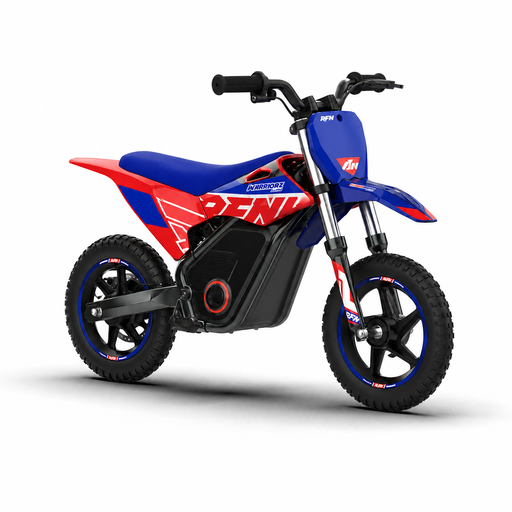
Why it fits: According to the product listing, it is designed for children aged approximately 3 to 6, with three riding modes and 12-inch wheels for private practice areas.
The 8, 12 and 25 km/h modes avoid a single permanently high speed. The seat height is 460 mm.
36V 250W motor, 36V 5.2Ah lithium battery, stated range of 18 km, front suspension and rear disc brake.
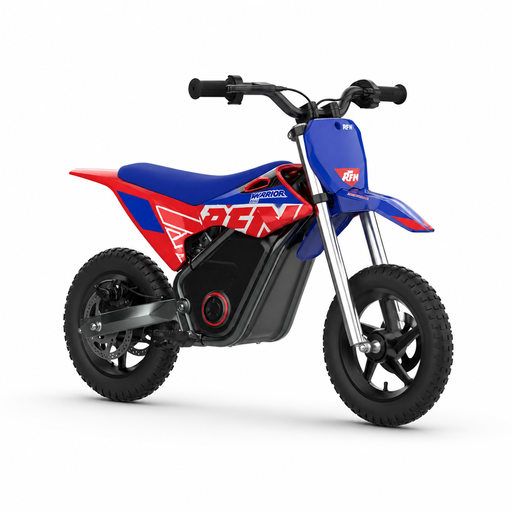
Why it fits: The product listing specifies an age range of 4 to 8 years, 14-inch off-road tyres and a seat height of 490 mm. This makes the model suitable for taller children with some initial riding experience.
Three modes at 15, 22 and 30 km/h, together with a stated lockout to prevent accidental mode changes, make it easier to adjust the riding experience.
36V 5Ah battery, front and rear suspension, 140mm disc brakes and 14×2.4-inch tyres according to the product specifications.
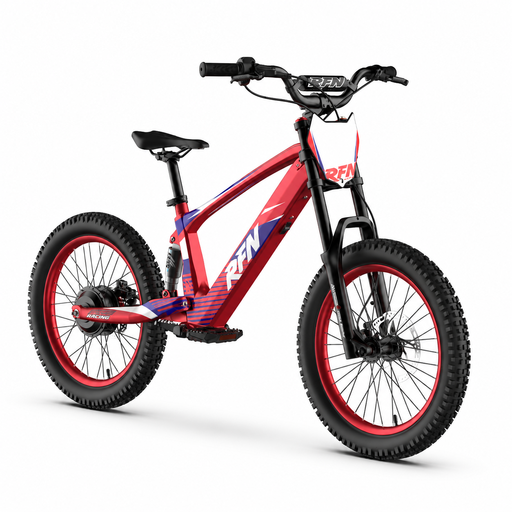
Why it fits: The 20-inch electric motorcycle is designed for taller children and private off-road areas, provided that the child’s height, weight and riding ability are appropriate.
Three levels at 15, 25 and 35 km/h allow for a progressive riding experience. The higher power output calls for especially careful selection and supervision.
36V 750W motor, 20-inch mountain tyres, hydraulic brakes, 7.5Ah battery and stated maximum load of 75 kg.
The complete category includes additional kids’ electric motorcycles for different age groups, wheel sizes and intended uses. Always check the current product specifications and safety information before buying.
As a general rule, a kids’ electric motorcycle should be used on suitable private property, provided the owner permits it. Public roads, pavements and cycle paths are not automatically permitted. Before riding, also check whether a particular off-road track allows children’s vehicles.
Essential equipment includes a properly fitting helmet, sturdy footwear, long clothing, knee protection and elbow protection. The child should begin practising on a level, clearly visible surface. With a model featuring training wheels, such as a 12V electric motorcycle in an Aprilia-inspired design, low speed and easy handling take priority over off-road performance.
That depends on the model, seat height, child’s height and riding experience. Basic 12V models with training wheels are often intended for younger children. More powerful 12-inch or 14-inch kids’ electric dirt bikes may, according to the manufacturer, be suitable from around 3 or 4 years of age. Before buying, compare these recommendations with the child’s actual measurements.
Runtime depends on battery capacity, speed, rider weight, surface conditions and temperature. Manufacturer figures such as an 18 km range or up to 80 minutes of riding time are guidelines. For longer outings, a model with a removable or swappable battery can be practical. Lithium batteries should be charged according to the instructions and should not be stored fully discharged.
The electricity cost per charge is usually lower than the purchase price. For a rough calculation, multiply the battery capacity in kWh by your electricity tariff. A 36V 5Ah battery has a calculated capacity of approximately 0.18 kWh; charging losses must be added. Parents should also factor wear parts such as brake pads, tyres and, where applicable, a replacement battery into the ongoing running costs.