
Lieferung heute & morgen

Qualitätsgarantie
App herunterladen
Kategorien
A children's picnic table set is a functional and space-saving solution for giving kids their own dedicated area outdoors to sit, eat, or play. Whether in the garden, on the balcony, or at family gatherings, choosing the right model depends on criteria like material quality, safety features, and practicality. This article analyses the technical aspects that are crucial when deciding on a kids' garden seating set.
The decision to purchase a kids' outdoor seating set should be based on an objective evaluation of product features. The following parameters are essential for making an informed choice.
Most children's picnic table sets consist of a combination of wood for the tabletop and seating surfaces and metal for the frame.
For products used by children, safety is the highest priority.
The practical aspects determine the everyday usability of the kids' garden set.
Based on the criteria above, we present two models that stand out for their construction and intended use.
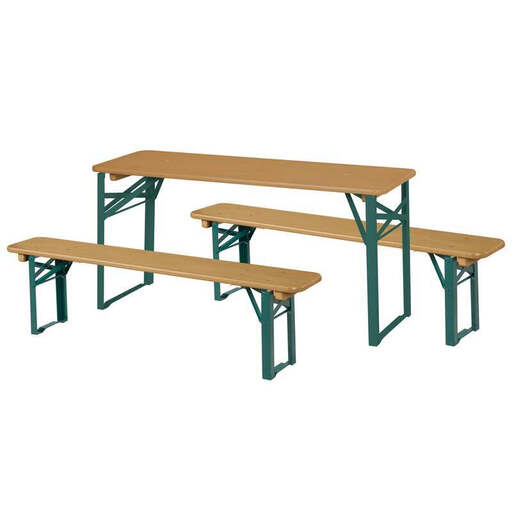
Why We Recommend This Product This set is distinguished by its classic, space-saving design. The combination of solid wood for the surfaces and a rust-proof metal frame offers a high weight capacity. According to the manufacturer, the maximum load per bench is 100 kg. The practical folding function allows for quick assembly, disassembly, and compact storage. With a seat height of 34 cm, this kids' picnic table is designed for children aged 24 months and up.
Pros
Who It's For This model is suitable for families looking for a flexible and sturdy seating set for children from around 24 months. It is an excellent choice if the set will be frequently assembled and disassembled or needs to be stored compactly.
Technical Specifications
| Feature | Specification | | :--- | :--- | | Table Dimensions (H x W x D) | 52 x 109 x 40 cm | | Bench Dimensions (H x W x D) | 34 x 108 x 20 cm | | Seat Height | 34 cm | | Material | Solid wood (surfaces), rust-proof metal (frame) | | Maximum Weight Capacity | 100 kg per bench | | Age Range | 24 months and up | | Special Feature | Foldable |
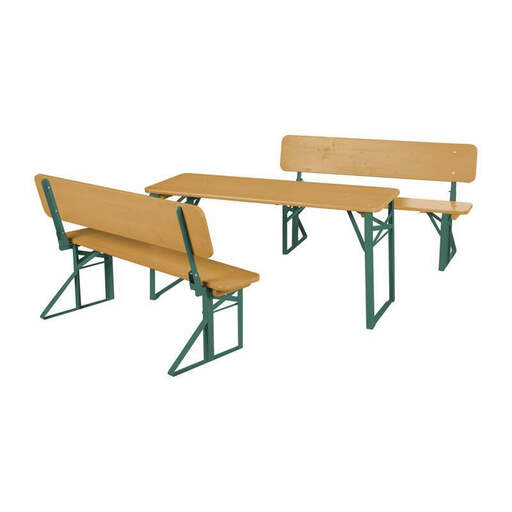
Why We Recommend This Product The addition of 32 cm high backrests on this model enhances seating comfort and safety, particularly for younger children. The backrests provide stable support and reduce the risk of a child tipping backward off the bench. The construction of solid wood and painted metal is also designed for durability and weather resistance. This kids' table with benches also features a folding function, making it versatile despite the added backrests.
Pros
Who It's For This set is ideal for parents and grandparents who prefer an especially safe seating option with backrests for children aged 2 to 4. The backrests offer significant added value in terms of safety during moments when a child might be briefly unsupervised.
Technical Specifications
| Feature | Specification | | :--- | :--- | | Table Dimensions (H x W x D) | 52 x 109 x 40 cm | | Bench Dimensions (H x W x D) | 60 x 108 x 40 cm | | Seat Height | 34 cm | | Backrest Height | 32 cm | | Material | Solid wood, painted metal | | Maximum Weight Capacity | 100 kg per bench | | Age Range | 24 months and up | | Special Feature | Foldable, with backrests |
If the featured models don't perfectly match your requirements, or if you are looking for specific designs and color schemes, you can find a wider selection of outdoor seating in our Green Wooden Furniture category.
1. From what age is a children's picnic table set suitable? Most manufacturers recommend their models for children aged 24 months and older. The key factor is that the child can sit stably and get on and off the bench independently. The seat height, typically around 34 cm, is designed for this age group. Use should always be under adult supervision.
2. How do you maintain a wooden kids' seating set for the garden? Cleaning is best done with a slightly damp cloth. Harsh cleaning agents should be avoided as they can damage the varnish or the wood. To maximise the lifespan of the wooden kids' seating set, it is recommended to store it in a dry, protected place during long periods of non-use or over the winter.