
Lieferung heute & morgen

Qualitätsgarantie

Willkommens-Angebote freischalten: KOSTENLOSE Lieferung | Bis zu 80 % RABATT | Kostenlose 30-Tage-JoyPlus-Testphase
App herunterladen
A tidy kid's room where every book and toy has its place is the dream of many parents. The right kid's room shelf is the foundation for making this happen. However, the selection is vast, and not every model that looks good at first glance proves to be practical and safe in daily life. Hasty purchases often lead to frustration and unnecessary expenses.
As a Joybuy Product Recommendation Officer, I analyse product information daily to help you distinguish functional, long-lasting solutions from short-lived marketing trends. In this guide, I'll show you the three most common pitfalls when buying a children's shelf and what you need to look for to make a safe and smart choice for your family.
Many shelves look appealing in the online shop but turn out to be impractical or even a safety hazard after just a few months. These three problems are especially common:
To avoid these pitfalls, you should check three crucial features before buying. These determine whether a storage shelf in a kid's room will serve its purpose in the long run.
Safety is an absolute must for any piece of furniture in a child's room. Pay attention to two essential features:
Most children's shelves are made of MDF (Medium-Density Fibreboard). The material is robust and easy to clean. The key factor here is the emissions standard.
A good toy shelf grows with your child's needs.
Based on these criteria, we have identified several models that are well-suited for different requirements and living situations.
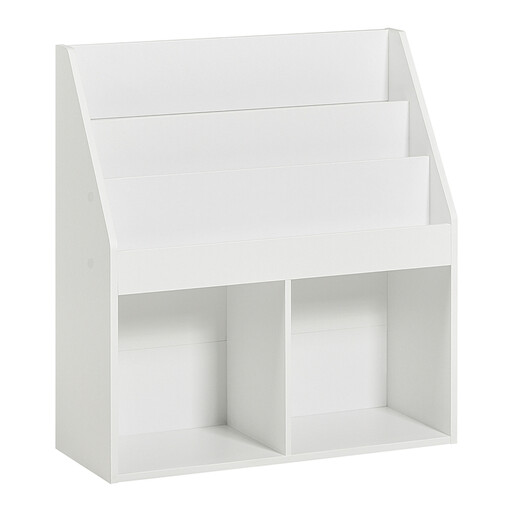
Why it's a great fit: Perfect for parents following the Montessori approach. The child-friendly height and forward-facing book slings encourage toddlers to independently select and tidy up their books.
The low, wide design is inherently stable. The combination of narrow book slings and large, open compartments at the bottom solves the problem of impractical layouts.
Actively promotes independence and a love for reading through easy access to books and toys.
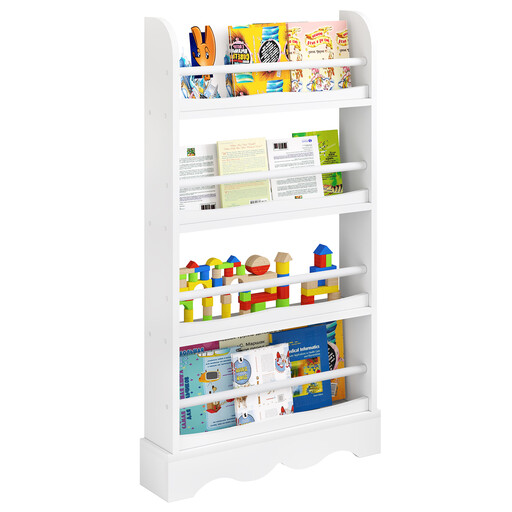
Why it's a great fit: With a depth of only 12 cm, this shelf is an excellent solution for small rooms or narrow hallways. It makes optimal use of vertical space without taking up valuable floor area.
The included anti-tip kit is essential for this tall, narrow model and directly addresses the stability issue. The open shelves are suitable for books of various sizes.
Extremely space-saving design that fits snugly against walls and doesn't visually overwhelm the room.
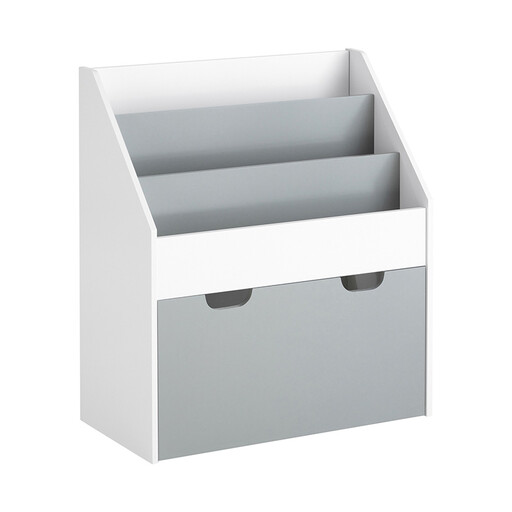
Why it's a great fit: This solution is an all-rounder. It combines a classic bookshelf with a large, mobile toy box on wheels. Perfect for organising both books and bulky toys like building blocks or dolls.
The large, removable box completely solves the problem of impractical compartment sizes. The sturdy MDF construction and low height of 70 cm ensure high stability.
Combines a fixed bookshelf with a mobile toy box for maximum organisational flexibility.
We've compiled a full, up-to-date list of products that fully meet these strict selection criteria and German safety regulations.
1. At what age is a kid's room shelf useful? A low, easily accessible shelf is useful as soon as your child starts to show interest in books and toys, typically around 1 to 2 years of age. A Montessori-style shelf is ideal here, as it supports independence from the very beginning.
2. How do I securely attach a kid's shelf to the wall? Always use the provided anti-tip kit. For drywall, you should anchor the screws into a stud (the wooden beams in the wall). For solid walls (e.g., brick), use appropriate wall anchors. Securing the shelf to the wall is the most important step to prevent it from tipping over and to ensure your child's safety.
3. What does the material specification "MDF (E1)" mean? MDF stands for "Medium-Density Fibreboard," a common engineered wood product used in furniture. The "E1" designation refers to European Emission Class 1. It guarantees that the off-gassing of formaldehyde from the board does not exceed a very low limit. Materials with this standard are considered safe for health and are suitable for use in children's furniture.