
Lieferung heute & morgen

Qualitätsgarantie

Willkommens-Angebote freischalten: KOSTENLOSE Lieferung | Bis zu 80 % RABATT | Kostenlose 30-Tage-JoyPlus-Testphase
App herunterladen
As a Joybuy Product Recommendation Officer, I see parents every day searching for the perfect solution to manage the growing chaos of books and toys. A good kids' room shelf not only creates order but also fosters your child's independence. However, the market is flooded with products that look great at first glance but quickly prove to be a poor investment. Before you make a decision, it's crucial to know the most common pitfalls.
Many shelves for children's rooms look appealing, but they hide flaws that only become apparent with daily use. These three issues most often lead to disappointment:
To avoid these traps, you should base your choice on three objective criteria. These define a safe and functional storage shelf for a child's room.
Your child's safety is the top priority. Therefore, pay close attention to two essential features:
A good toy shelf is designed so that children can use it without assistance.
Storage needs change as a child grows. Flexible solutions are therefore a wise investment.
Based on these criteria, we have identified a few models suitable for different needs and living situations.
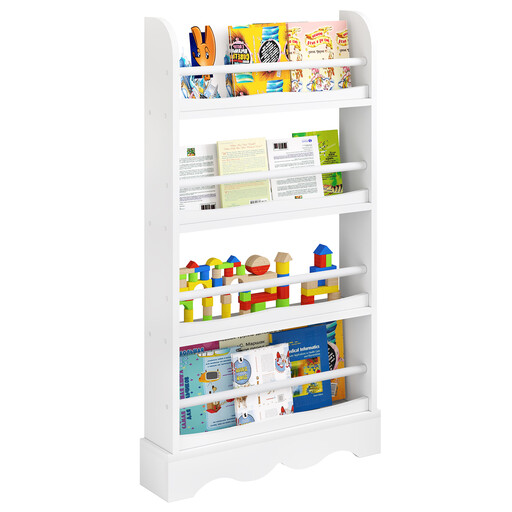
Why This Fits Their Persona: A great choice for families looking for a space-saving and streamlined solution for book storage without a large budget.
The shelf comes with an anti-tip kit and is made of P2-grade MDF. The rounded corners and child-friendly height directly address safety and ergonomic concerns.
At only 12 cm deep, it's extremely space-saving and ideal for small rooms or narrow walls. The four tiers provide a clear overview of the books.
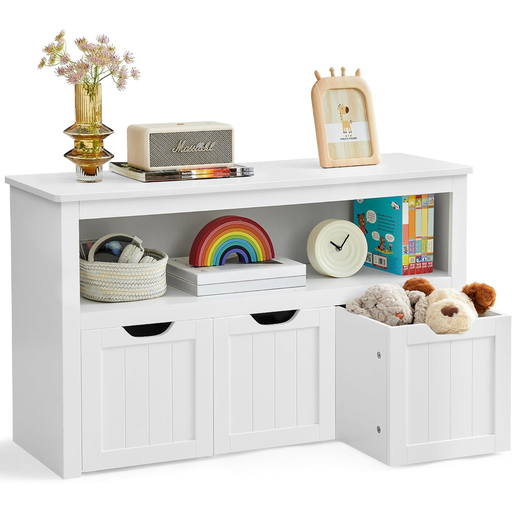
Why This Fits Their Persona: Perfect for parents who need an all-in-one solution for books and bulky toys. The mobile bins make tidying up after playtime significantly easier.
The removable bins on casters solve the problem of inaccessible compartments. At 60 cm high, the shelf is suitably low for children, and the rounded cut-outs are designed to help prevent fingers from getting trapped.
The combination of a top shelf, an open compartment, and three mobile storage bins offers extremely flexible toy storage.
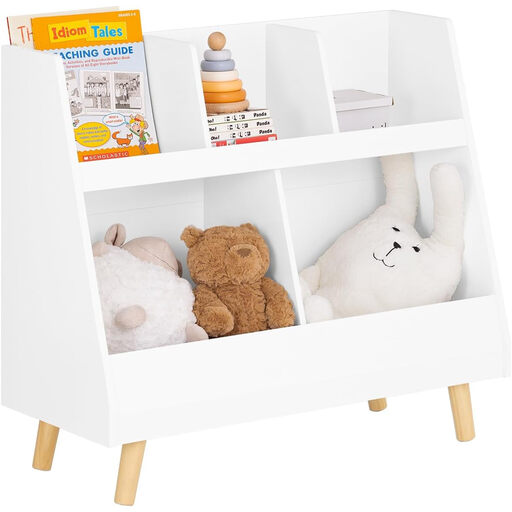
Why This Fits Their Persona: This shelf is specifically designed to promote independence. Children can see the book covers and reach their favourite stories and toys without help.
The child-friendly height (78 cm) and open compartments are key design elements. Its trapezoidal construction with solid pine wood legs ensures high stability and counteracts the risk of tipping.
Actively promotes independence and organisational skills. The combination of book and toy compartments makes it a versatile Montessori shelf.
We have compiled a complete, real-time list of products that fully satisfy these strict selection criteria and UK safety regulations.
Most freestanding shelves come with an anti-tip kit, which consists of a bracket, a screw, and a wall plug. Attach the bracket to the top of the shelf and to the wall. Use the appropriate wall plug for your wall type (e.g., hollow-wall anchors for plasterboard, expansion plugs for solid walls). Ensure the connection is firm and the shelf can no longer tip forward.
A low, open toy shelf is useful for toddlers from around 1.5 to 2 years old. As soon as a child can stand and grasp objects securely, they can learn to take toys from an easily accessible shelf and (with a little help) put them back. This lays an early foundation for tidiness and independence.
MDF (E1 standard) panels are a common and excellent choice. They are dimensionally stable, robust, and have a smooth surface that is easy to clean. Solid wood is more durable and often of higher quality, but it is also more expensive and requires more maintenance. For both materials, ensure that the surfaces have been treated with non-toxic paints or oils suitable for children's toys.