
Lieferung heute & morgen

Qualitätsgarantie

Willkommens-Angebote freischalten: KOSTENLOSE Lieferung | Bis zu 80 % RABATT | Kostenlose 30-Tage-JoyPlus-Testphase
App herunterladen
A science kit for kids promises to spark curiosity and teach concepts through play. But the selection is vast, and not every kit delivers on the promises made by its colourful packaging. As a Joybuy Product Recommendation Officer, I often see well-intentioned gifts go unused after just a short time. To prevent that from happening to you, I'll show you which pitfalls to watch out for and how to find the perfect discovery set for a curious child.
Before you make a decision, it helps to know the typical problems that can quickly put an end to the fun.
To avoid these traps, you should check three key aspects before buying. These will help you identify a durable and motivating educational toy for ages 8 and up.
The "ages 8 and up" recommendation is only a rough guideline. The crucial factor is how the set presents its content. A good discovery set for kids in this age group features clearly structured, richly illustrated instructions. The experiments should be broken down into small, understandable steps that the child can perform as independently as possible. Check whether the explanations are child-friendly and not just dry, technical text.
Children's interests are diverse. A set that doesn't match the child's area of interest will hardly spark any enthusiasm. Consider what fascinates the child:
A targeted STEM toy (Science, Technology, Engineering, Mathematics) not only promotes knowledge but also logical thinking and problem-solving skills.
Pay attention to the contents. A high-quality science kit provides material for multiple experiments or projects. Ideally, the experiments can be varied or the results can be used further. A self-built robot that can be played with afterwards, or a microscope that is used again and again for new discoveries, offers significantly higher and more sustainable play value than a single, quickly completed experiment.
Based on the criteria above, we have identified some products that are suitable for different interests and requirements.

Why this kit is a great fit: Ideal for children interested in animals and nature. It's not about a single experiment, but about raising and observing living creatures over a longer period. This fosters patience and a sense of responsibility.
This set escapes the "one-and-done" effect because caring for the Triops is an ongoing task. The instructions from Kosmos are known to be detailed and tailored to the market.
The set includes an extra-large tank with a separate breeding area, which allows for good observation. According to the manufacturer, the eggs come from a controlled laboratory breeding programme.

Why this kit is a great fit: Perfect for kids who love to be creative and make something of their own. It combines basic chemistry with a practical, usable result—their own perfume or scented bath salts.
The set provides instructions for various creations (perfume, potpourri, bath salts), which increases its reusability. The result is a personalised product that can be proudly used or given as a gift.
It includes a complete lab with essences, ingredients, and tools. According to the manufacturer, the illustrated manual introduces children to authentic perfume-making techniques.
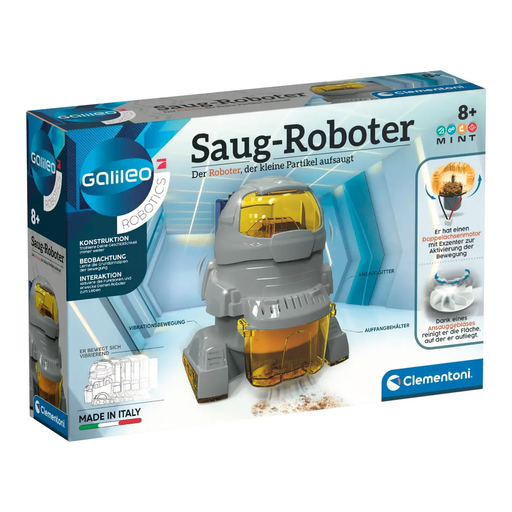
Why this kit is a great fit: This **robotics kit** is an excellent introduction to the world of robotics and mechanics. Children don't just build a model, but a functioning suction robot, which makes the connection between construction and function tangible.
The building process is the main activity, and the finished product is a toy. This ensures long-lasting motivation. The illustrated manual is designed to convey technical concepts in an understandable way.
The set teaches practical STEM concepts like mechanics and vibration. After assembly, the robot can suck up small particles like dust or crumbs, making its success immediately visible.
We have compiled a complete, up-to-date list of products that fully meet these strict selection criteria and UK/EU safety regulations.
Yes, many sets require additional, common household items like water, oil, empty jars, or batteries. A hallmark of a good product is that these required materials are listed clearly and prominently on the packaging or in the product description. This way, you won't face any unpleasant surprises after unpacking.
Both brands offer high-quality sets, but they often have different focuses. Kosmos science kits, from a traditional German company, are often heavily focused on curriculum-oriented educational value and detailed scientific explanations. Clementoni Galileo Lab sets, originating from Italy, often combine scientific principles with a strong creative and design component, such as in the creation of cosmetics or jewellery.
This depends heavily on the complexity of the kit. Simple models for children ages 8 and up are designed to be assembled with illustrated step-by-step instructions and without soldering. They are excellent for understanding basic mechanical and electronic principles. For older or more experienced children, there are more complex kits that also require programming skills.