
Lieferung heute & morgen

Qualitätsgarantie

Willkommens-Angebote freischalten: KOSTENLOSE Lieferung | Bis zu 80 % RABATT | Kostenlose 30-Tage-JoyPlus-Testphase
App herunterladen
A children’s scooter should suit the child’s age, physical dimensions and intended environment. In practice, however, three common buying mistakes often lead to the wrong choice: eye-catching LED lighting is mistaken for safety equipment, a broad age recommendation is accepted without considering height and maximum load, and a folding model is bought even though the folding mechanism is not actually needed in everyday life.
The term “for children” also says little about a product’s actual suitability. A 3-wheel children’s scooter with lean-to-steer control is designed for different users than a two-wheeled stunt scooter for children. Before buying, parents should therefore consider the technical specifications, safety warnings and intended use together.
Children’s scooters with LED wheels are highly visible in low light and can make riding more enjoyable. However, the lighting is no substitute for a suitable helmet, closed shoes and, where appropriate, knee, elbow and wrist protection. For battery-powered lights, parents should also check whether batteries are included and whether small parts could be accessible to younger children.
A scooter for children aged 3 and over can have different handlebar heights and maximum load limits depending on the model. Height is therefore important, as are the deck height and the ability to adjust the handlebar correctly. An adjustable children’s scooter can be used for longer, provided that its construction and maximum load are suitable for the child.
A folding children’s scooter is easier to transport and takes up less storage space. Before every ride, however, the folding mechanism should be fully locked into place. Joints, catches and screws are components that need to be checked regularly. For a model that is kept permanently in a cellar or hallway, the folding function is not necessarily a decisive feature.
For toddlers, a balance bike for toddlers or a sturdy 3-wheel scooter may be suitable. A balance bike has no pedals and helps children practise balance and pushing off, while a children’s scooter requires a different sequence of movements. With a scooter for children aged 3 and over, parents should look for a low, sufficiently wide deck and a brake that is easy to reach.
For children aged around 4 to 7, a children’s bike with stabilisers may also be an alternative. According to the product specifications, the Hiland Starry features a 16-inch wheel, a recommended height of 105 to 135 cm, a front V-brake and a coaster brake. It is a bicycle rather than a replacement for a scooter, but it can be considered when choosing an age-appropriate vehicle.
A 3-wheel children’s scooter has a different stance on the riding surface by design than a two-wheeled scooter. With a lean-to-steer children’s scooter, direction is controlled by shifting the rider’s weight. This principle may be easier for younger children to understand than directly turning the handlebar, although it does require a short adjustment period.
Two-wheeled models are generally designed for more active balance control. A stunt scooter often has a fixed handlebar, a rigid deck and smaller wheels. These models should only be chosen once the child can set off, brake and maintain their balance safely.
An anti-slip deck should be wide enough for the front and back foot to be positioned securely. Solid polyurethane wheels do not need inflating and are less susceptible to punctures, but they transmit more vibration on uneven surfaces.
A children’s scooter brake is often positioned over the rear wheel and operated with the foot. It should be easy to reach and must not be affected by dirt or wear. Before every use, it is advisable to carry out a quick check of the brake, wheels, handlebar attachment and visible screws.
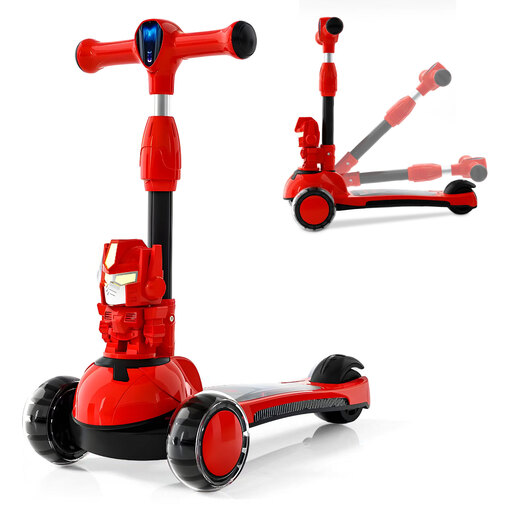
Why this product suits this profile: The design is intended for children aged 3 to 10 and combines three wheels with lean-to-steer control, an adjustable handlebar and a wide deck.
The age recommendation is supported by specific information about handlebar adjustment and deck design. LED wheels are not presented as the only safety equipment.
Three-wheel platform, anti-slip deck, lean-to-steer system and adjustable handlebar.

Why this product suits this profile: This model combines adjustable handlebar heights, a folding function, a wide deck and a rear brake for children aged 3 and over.
The product specifications state a maximum load of 110 lb, three handlebar heights and specific battery information for the deck lighting.
Folding design, battery-free LED wheels and additional battery-powered deck lighting.
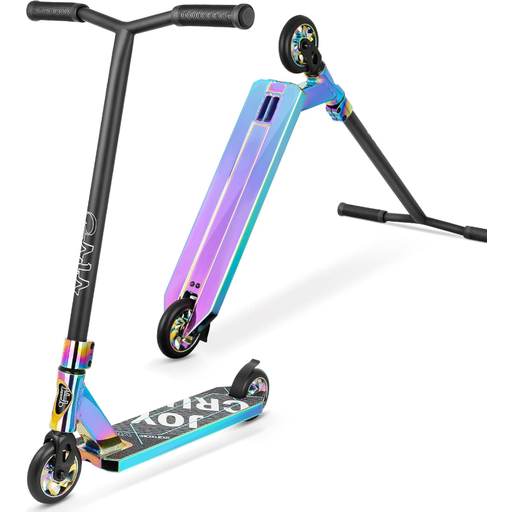
Why this product suits this profile: According to the product specifications, this two-wheeled stunt scooter is intended for users aged 8 and over and is suitable for everyday riding as well as basic freestyle use.
The maximum user weight is stated as 100 kg. The fixed handlebar, rigid chassis and foot brake are clearly described and should not be confused with adjustable steering for toddlers.
Steel and aluminium frame, solid polyurethane wheels, anti-slip deck and easy assembly.

Why this product suits this profile: For families looking for a bike with stabilisers alongside a children’s scooter, this 16-inch model provides clearly defined age and height recommendations.
Suitability is not described by age alone; a height of 105 to 135 cm is also specified. Two different braking systems are listed.
Front V-brake, coaster brake, enclosed chain, luggage rack and adjustable saddle.
We have put together a complete, regularly updated list of products that fully meet these strict selection criteria and the safety regulations applicable in the EU.
Before every ride, parents should check the handlebar clamp, folding catch, wheels and brake. A damp cloth is usually sufficient for cleaning; harsh cleaning products can damage surfaces and plastic parts. Scooters should be stored in a dry place, especially if they have LED lights or battery compartments.
The actual service life depends on weight, surface, weather and use. Steps, kerbs and skateparks put more strain on components than flat paths. If there are visible cracks, loose connections, heavily worn wheels or a brake that responds slowly, the vehicle should not be used again until the cause has been checked and fixed.
This depends on the design and the child’s stage of development. Many 3-wheel models are recommended from around the age of 3. Height, a secure standing position, handlebar height and the ability to brake in a controlled manner remain the key considerations. For younger children, a balance bike may be more suitable to begin with.
The handlebar should be adjusted so that the child stands upright with their arms slightly bent. The specific adjustment range of the model in question should be taken into account. A handlebar set too low can cause a hunched posture, while one set too high may make the scooter more difficult to control.
For scooters without batteries, everyday costs are generally limited to wear-and-tear parts such as wheels or grips. LED wheels with dynamic lighting often use movement as their energy source. Additional deck lighting may require batteries. Parents should therefore check before buying which lighting functions are included and whether batteries need to be purchased separately.