
Lieferung heute & morgen

Qualitätsgarantie

Willkommens-Angebote freischalten: KOSTENLOSE Lieferung | Bis zu 80 % RABATT | Kostenlose 30-Tage-JoyPlus-Testphase
App herunterladen
A height-adjustable shower stool can make showering easier if standing for long periods is difficult or you need extra support getting in and out. For older people, those with limited mobility, people recovering from an operation and pregnant women, the lowest price isn’t the only thing that matters. The right dimensions, a stable base and a design that suits your shower or bath are all essential.
Non-slip rubber feet and suction cups don’t work equally well on every surface. They can provide a good grip on smooth, clean tiles. However, textured or uneven floors, or floors with wide grout lines, reduce the area in contact with the surface. Always use a non-slip shower stool with all its feet resting fully on the floor. Before you buy, check that the floor is level and that the feet are suitable for its surface.
A maximum weight capacity of, for example, 136 or 150 kg is a manufacturer’s specification, not a substitute for an individual safety assessment. Your body weight, the movement involved in sitting down and standing up, and the stability of the floor also matter. There should be a sufficient margin between your body weight and the stated maximum capacity. Always follow the information in the product description and assembly instructions.
Even an adjustable shower seat can be impractical if your feet don’t rest flat on the floor, or your knees sit too high or too low. Before you buy, measure the distance from the floor to the crease behind your knee while seated. For a bath seat, the height of the bath rim is also important. Some models are suitable for showers but won’t fit over every bath.
A height-adjustable shower chair should cover a range that suits your height and the space where it will be used. Common models can often be adjusted from around 35,5 to 51 cm or 41 to 53,5 cm. The number of height settings isn’t the only thing that matters; you should also be able to set every leg to exactly the same height.
Check the seat’s width and depth, too. A larger seat can give you more room to move, but it also takes up more space in a small shower. A shower seat with a hygiene cut-out can make personal care easier, while drainage holes can help water run away and simplify cleaning.
Check whether the model has rubber feet, suction cups or a wall fixing. Suction cups need a smooth, clean surface and shouldn’t be treated as a guarantee of a secure grip on their own. For a wall-mounted model, check the wall material, fixing points and load-bearing capacity before installation. Fixing the seat to a suitable concrete or brick wall is different from attaching it to a lightweight partition wall.
A shower stool with armrests can give you extra places to grip when sitting down and standing up in a controlled way. A backrest can support your upper body while you’re seated. However, these features take up more space and may restrict access in a small shower.
A swivel shower stool can make repositioning easier if the seat has a defined stop position. Use the swivel function slowly and with control. It doesn’t replace suitable grab points or a professional assessment if you have significant balance problems.
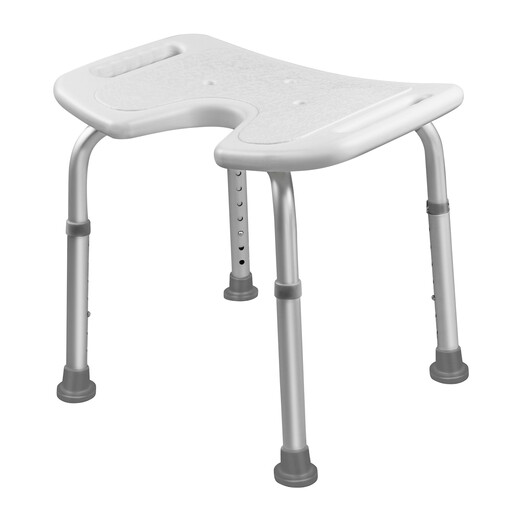
Why it suits this need: This compact shower stool has seven height settings, a U-shaped seat and weighs around 2.5 kg. It’s a good option if you’re looking for a simple seat without a backrest or armrests.
The 37 to 51 cm height range can be adjusted to suit different seated positions. Drainage holes help water run away.
Aluminium frame, seven height settings, non-slip feet and a stated weight capacity of up to 136 kg.
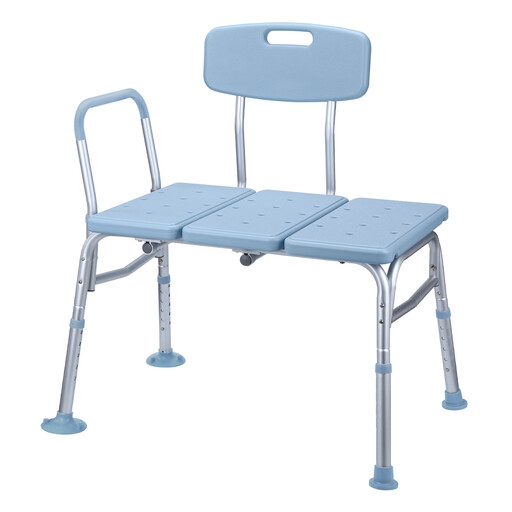
Why it suits this need: This seat combines a removable backrest, padded armrests and ten height settings from 47 to 58.5 cm. It’s also designed to fit suitable baths.
The product details specify that it’s suitable for bath rims up to 47 cm high. Check this measurement before you buy.
Corrosion-resistant aluminium frame, drainage holes, armrests and a stated weight capacity of up to 150 kg.
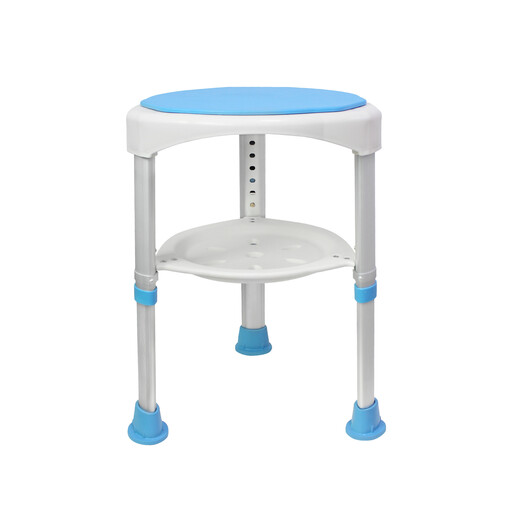
Why it suits this need: The swivel seat, with a stop function, can be useful when space is tight, for example when moving between sitting, washing and standing up.
The stop function limits how freely the seat can turn. Check that there’s enough room for the swivel range in your shower, too.
Continuously adjustable height from 45 to 57 cm, four feet with rubber caps and suction-cup elements, and a stated weight capacity of up to 200 kg.
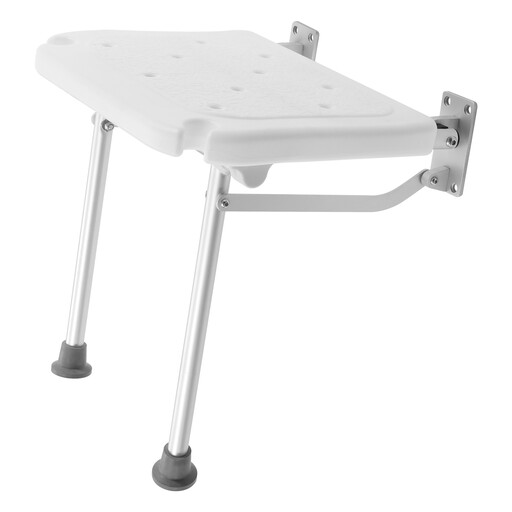
Why it suits this need: This folding shower seat folds up by 90 degrees, freeing up more floor space when not in use. It could be a good choice for a small shower or a shared bathroom.
The fixed wall mounting prevents the whole stool from slipping. It must be attached securely to a suitable supporting wall.
90-degree fold-up design, drainage holes and a 40 × 32 cm seat; stated weight capacity of up to 100 kg.
We’ve put together a complete, regularly updated list of products that meet these strict selection criteria and fully comply with the safety regulations in force in the EU.
Before using the stool for the first time, check all screws, locking pins and height adjustments. Make sure every leg is set to the same height and all the feet rest fully on the floor. Clean soap residue and limescale from the seat and feet regularly. Damaged rubber feet, loose connections or cracks in the seat are reasons to stop using the shower stool until the problem has been checked.
When seated, both feet should rest as flat on the floor as possible. Ideally, your knees should be roughly level with your hips. As people’s height and mobility vary, as do shower floors, an adjustable height range is more practical than a fixed seat height.
Its lifespan depends on the materials, how often it’s used, moisture, cleaning and installation. Aluminium and plastic are suitable for damp rooms, but you should still check the fixings and rubber feet regularly. It isn’t possible to give a reliable, one-size-fits-all estimate of how long every model will last.
A shower chair may be suitable as a shower aid during pregnancy if its height, seat and stability suit the person using it. For older people, those recovering from an operation or anyone at increased risk of falling, the choice should also take account of their individual movements. If you’re unsure, you can ask family members, carers or a healthcare professional for advice.