
Lieferung heute & morgen

Qualitätsgarantie

Willkommens-Angebote freischalten: KOSTENLOSE Lieferung | Bis zu 80 % RABATT | Kostenlose 30-Tage-JoyPlus-Testphase
App herunterladen
A children’s jigsaw should suit your child’s age, fine motor skills and patience. In practice, unclear age guidance, pieces that are too small or flimsy materials can quickly lead to frustration. And an appealing picture alone doesn’t tell you whether a jigsaw will really work for everyday family life.
This buying guide explains what parents, grandparents and other family members should look out for when choosing a jigsaw. You’ll also find tips for teenagers and adults looking for more challenging 3D wooden puzzles.
A 100-piece jigsaw sounds more challenging than a 48-piece one. But piece size, the layout of the picture, colour contrast and the recommended age all matter too. A jigsaw with large areas of a single colour can be harder than a smaller one with clearly defined pictures.
For children aged 3 and over, a jigsaw with a small number of larger pieces or a tray puzzle is often a good choice. For children aged 4 and over, 26 to 48 pieces may be suitable if they already have some experience. The age guidance is just a guide and doesn’t replace an assessment of your child’s individual abilities.
Descriptions such as ‘educational jigsaw’ or ‘premium quality’ should be checked against specific features. These might include material thickness, clean-cut pieces, surface finish, piece size and storage. For a children’s jigsaw, it’s also important to check whether the manufacturer flags any small parts and what safety information is given on the packaging.
A vehicle jigsaw may be a good fit for children who are interested in cars, trains or construction vehicles. A dinosaur jigsaw will appeal to a different set of interests. For fans of the series, a Bibi & Tina jigsaw could be more motivating. But if you choose a theme based only on how the box looks, the jigsaw may soon be left unused.
Check the age range given by the manufacturer. Products with small parts can pose a choking risk for younger children, so a jigsaw shouldn’t be given to children below the stated minimum age. For younger children, jigsaws with large pieces, tray puzzles or pictures with clear blocks of colour are good options.
A jigsaw for children aged 3 and over often has fewer, larger pieces. For children aged 4 and over, the piece count may be higher. Jigsaws with 100 to 150 pieces may suit school-age children, as long as the picture and your child’s patience are up to the challenge.
Cardboard pieces should be sturdy enough not to bend easily as your child puts the jigsaw together. A precise cut makes the pieces easier to fit together, while a matt or linen-textured finish can help reduce glare. These features don’t guarantee a particular lifespan, but they do help you assess the product more objectively.
For wooden jigsaws, buyers should also check the material details, how the edges are finished and the recommended age range. 3D wooden puzzles for adults aren’t automatically suitable for children. Moving mechanisms, thin components and a high piece count often call for patience and careful assembly.
A picture featuring vehicles, dinosaurs or characters from a TV series can make it easier to get started. Sets with multiple pictures, a box or a metal case can be handy. Check the assembled dimensions too, to make sure the jigsaw will fit on the table or play mat you plan to use.
Store jigsaws in a flat, dry place that children can reach. To avoid losing pieces, leave an unfinished jigsaw on a firm surface or sort the pieces away after play.
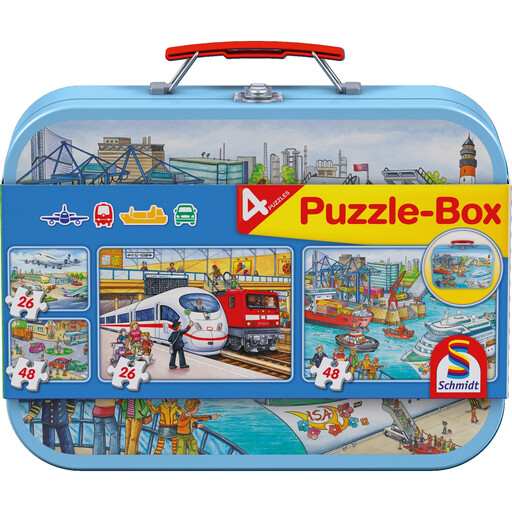
Why this product suits this type of puzzler: Four vehicle pictures, with 2 × 26 and 2 × 48 pieces, offer different levels of challenge for children aged 4 and over. The metal case also provides handy storage.
The range of piece counts means one picture won’t stay too easy or too difficult for long. The puzzle posters with outlines help children get started.
Four pictures, 2 × 26 and 2 × 48 pieces, a matt linen texture and a metal case.
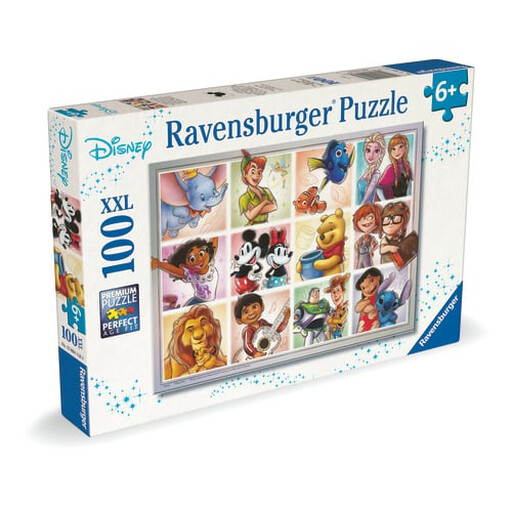
Why this product suits this type of puzzler: This Ravensburger children’s jigsaw is designed for children aged 6 and over. It has 100 XXL pieces and measures 49 × 36 cm when complete.
The XXL pieces are suited to the stated age range and, according to the product description, are made from extra-strong cardboard.
100 XXL pieces, a large finished size and a Disney picture for solo or group play.
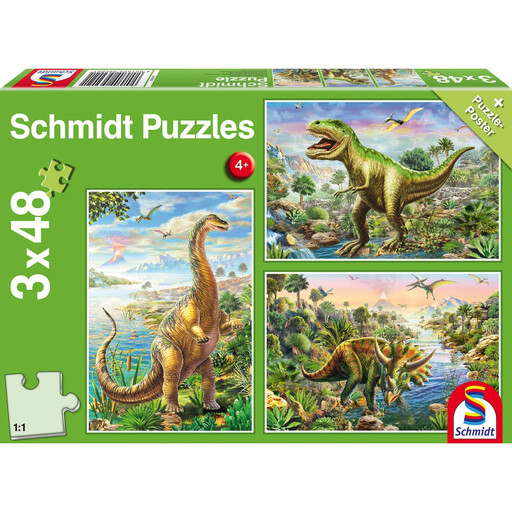
Why this product suits this type of puzzler: Three dinosaur pictures, each with 48 pieces, are designed for children aged 4 and over and are ideal for repeated puzzling.
Having several pictures helps keep things fresh. The puzzle posters with outlines make it easier to sort and match the pieces.
Three pictures, 48 pieces each, a matt finish and storage included in the set.
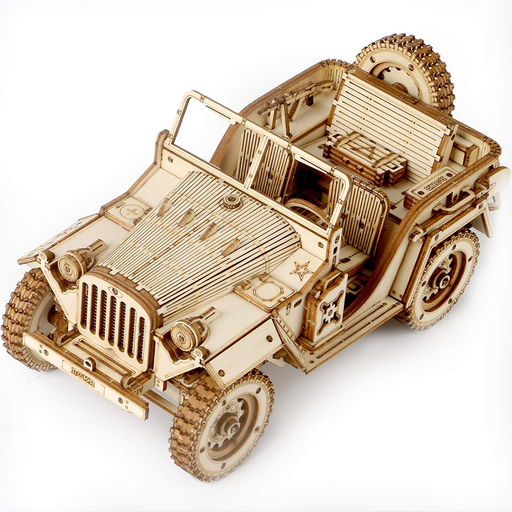
Why this product suits this type of puzzler: This 369-piece wooden model kit, in 1:18 scale, is listed in the product description as suitable for people aged 14 and over, and is aimed at model-building enthusiasts.
The clear age guidance distinguishes this kit from a children’s jigsaw. It can be assembled without glue, but the many individual pieces should still be handled with care.
369 wooden pieces, 1:18 scale and assembly without glue.
We’ve put together a complete, regularly updated list of products that meet these strict selection criteria and fully comply with the safety regulations in force in the EU.
It depends on the piece size, picture and manufacturer’s guidance. A jigsaw for children aged 3 and over should have larger pieces that are easy to grip. Sets with 26 to 48 pieces are often suitable from age 4. It’s a good idea to supervise younger children, especially if the jigsaw contains small parts.
As a rough guide, choose a small number of large pieces for beginners, around 26 to 48 pieces for many children aged 4 and over, and about 100 to 150 pieces for school-age children with more experience. The picture has a big impact on how difficult the jigsaw is. A clear image with distinct colours can make it easier to get started.
Its lifespan depends on the thickness of the cardboard, the quality of the cut, exposure to moisture and how it’s handled. Storing it in a dry place, removing the pieces carefully and keeping them all together will help it last longer. With a 3D wooden puzzle, don’t force the pieces together.