
Lieferung heute & morgen

Qualitätsgarantie

Willkommens-Angebote freischalten: KOSTENLOSE Lieferung | Bis zu 80 % RABATT | Kostenlose 30-Tage-JoyPlus-Testphase
App herunterladen
When buying kitchen appliances for everyday use, people often compare wattage, design and price first. However, these details alone do not show whether an appliance is suitable for your kitchen. For households, families and residents of small rented flats, the design, cleaning requirements, capacity and installation type are often more important.
Especially with an electric juicer, a slow juicer or a cooker hood, misleading product claims can lead to the wrong purchase. The following criteria will help you assess technical specifications objectively.
High power consumption does not automatically mean that a juicer will work faster or be suitable for all ingredients. A centrifugal juicer such as the WOOX Juicer Machine operates at 600 W, while a slow juicer is designed to work at a lower speed and uses a different pressing mechanism.
The following factors are therefore also important:
Descriptions such as “quiet”, “easy to clean” or “high juice yield” should not be assessed in isolation. More meaningful details include a noise level in decibels, the number of removable parts or a filter design without a conventional sieve.
The technical specifications of cooker hoods also need to be checked carefully. A hood with recirculation mode generally requires a suitable activated-carbon filter, while an extractor hood needs an appropriate extraction route and professional installation.
An under-cabinet cooker hood, an integrated cooker hood and a portable cooker hood differ considerably in terms of space requirements and installation. Before buying, check the available cabinet width, the distance from the hob, the socket and whether an extraction duct can be installed.
In rented flats, a portable solution or one that operates exclusively in recirculation mode may be more practical. However, this does not replace a permanently installed cooker hood in every situation, particularly if you regularly cook with high levels of steam and grease.
Measure the available space before buying. For a 60 cm hob, the hood should match the width of the hob or at least cover it sufficiently. For compact kitchens, a 52 cm integrated cooker hood such as the Ciarra model may be worth considering.
For juicers, household size is an important factor:
A large feeding chute can reduce preparation time. However, it does not mean that every fruit can be added whole. Hard stones, very fibrous ingredients or unsuitable foods can block the mechanism.
Removable parts, dishwasher-safe filters and a straightforward design reduce cleaning effort. The ROUNY Slow Juicer is described as having a filter-free design that can be rinsed clean. The components described for the Bear YZJ-F01D6 consist of just a few parts, and a cleaning brush is included.
Grease filters in cooker hoods should be cleaned regularly. The Ciarra telescopic model has two washable aluminium filters. The Heinrich’s HDU 7622 SW is described as having a dishwasher-safe five-layer aluminium grease filter. When operating in recirculation mode, the condition of the activated-carbon filter must also be taken into account.
The airflow rate of cooker hoods is usually given in m³/h. A higher figure can be useful when large amounts of steam are produced, but it must be suitable for the size of the room, the extraction duct and the noise level.
Look out for:
Energy-efficient kitchen appliances can help reduce electricity consumption in everyday use. However, the actual costs depend on usage time, power setting and your electricity tariff. LED lighting with low power consumption is a useful additional feature, but it cannot replace suitable extraction performance.
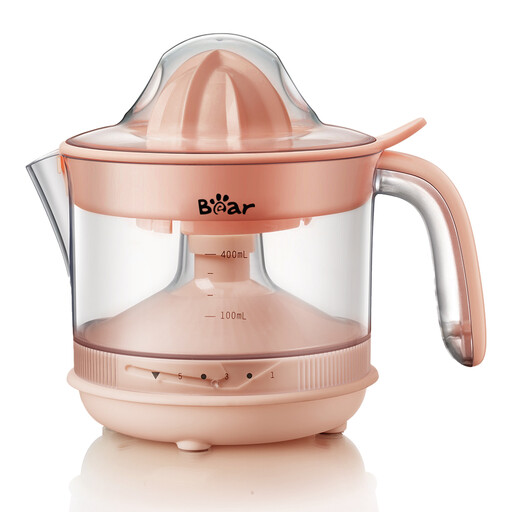
Why this product suits this profile: With 30 W of power, a 400 ml capacity and compact dimensions, this electric citrus press is designed for individual portions in smaller households.
The five adjustable settings make it easier to choose the amount of pulp than a generic advertising claim would. The removable parts help make cleaning easier.
50 rpm, 400 ml container, BPA-free specification and blade-free pressing design according to the product description.
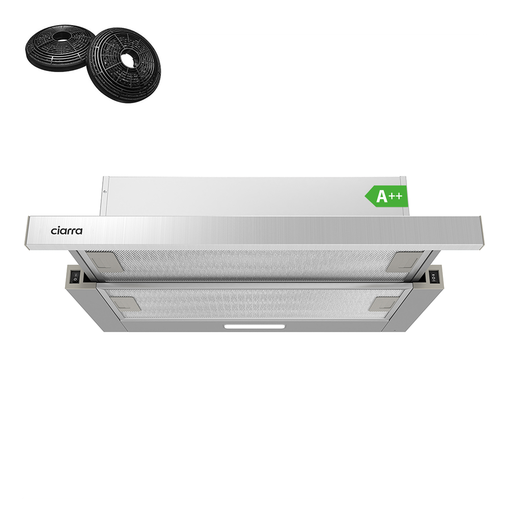
Why this product suits this profile: The space-saving design can be pushed in when not in use, helping to keep your kitchen frontage looking neat and uncluttered.
Both extraction and recirculation modes are available. Before buying, however, check the extraction connection and the compatible CBCF002X2 carbon filters.
Maximum airflow of 370 m³/h, A++ energy efficiency class and annual consumption of 10 kWh/a according to the manufacturer's specifications.
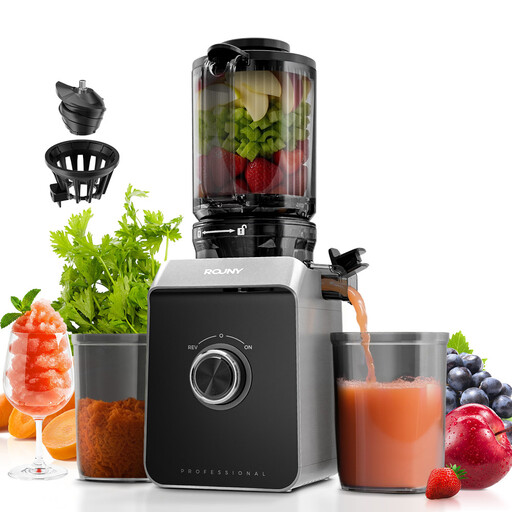
Why this product suits this profile: The 1.8-litre container and 130 mm feeding chute are designed for larger quantities and regular use in a family household.
The filter-free system may reduce cleaning effort compared with a conventional sieve. Hard stones and ingredients not approved for use are still unsuitable.
150 W, 50 rpm, reverse function, BPA-free specification and suitability for frozen fruit according to the product description.
We have put together a complete, regularly updated list of products that fully meet these strict selection criteria and the safety regulations applicable in the EU.
An integrated cooker hood is suitable when you want the hood to be discreetly incorporated into a wall cabinet. By contrast, a traditional under-cabinet cooker hood is installed beneath a cabinet or directly on the wall. For kitchen islands, portable hobs or rented flats, a portable cooker hood with filter operation may be an option.
The Ciarra Portable Tabletop Air Extraction Unit is designed for electrical appliances such as tabletop grills, fondue sets and hotplates. According to the product description, it operates in recirculation mode, with two speed settings and multiple filters. It is expressly not suitable for naked flames. This restriction should be taken into account before buying.
Compact appliances requiring minimal installation are suitable for small kitchens. A citrus press with a 400 ml container takes up very little worktop space. For extraction, you could use a portable cooker hood or a recirculating cooker hood, provided that your cooking habits and the manufacturer's approvals are suitable. Obtain your landlord's permission before carrying out any permanent installation.
Juice containers, pressing cones and feeding components should be rinsed immediately after use to prevent pulp from drying on them. Depending on how often you cook, a cooker hood's grease filters need cleaning approximately every two to four weeks. Activated-carbon filters used in recirculation mode must be checked according to the manufacturer's instructions and replaced regularly.
The costs depend on the appliance's power, usage time and electricity price. As a guide, multiply the power in kilowatts by the operating hours and the price per kilowatt-hour. A hood rated at 41.5 W uses less electricity during one hour of operation than a 72 W appliance. Filters, water consumption and potential replacement parts should also be included when considering long-term costs.