
Lieferung heute & morgen

Qualitätsgarantie

Willkommens-Angebote freischalten: KOSTENLOSE Lieferung | Bis zu 80 % RABATT | Kostenlose 30-Tage-JoyPlus-Testphase
App herunterladen
A kitchen cart promises a simple solution for more storage space and flexibility. In practice, however, many models prove to be impractical or unstable. Before you make a decision, it's important to know the typical weaknesses that often only become apparent after the purchase.
As a Joybuy Product Recommendation Officer, I analyse product data to provide you with objective and well-founded advice. This guide will show you what to look for to find a functional and durable rolling cart for your kitchen.
Many buyers are disappointed with their new kitchen cart after a short time. This is often due to three fundamental flaws that are easily overlooked during online research:
To avoid these pitfalls, focus on three core technical parameters. These determine the functionality and longevity of your kitchen cart.
The material is the foundation of stability. Pay close attention to the exact material specification. E1-grade particle board or MDF boards provide a solid base and are often finished with a protective melamine coating, making them water-repellent and easy to clean. Models with a frame made of steel or solid wood are generally more robust.
The maximum load capacity is a crucial value. A simple niche cart for light items might manage with 10–15 kg. A rolling kitchen cart that serves as a mobile workspace or for placing appliances should have a load capacity of at least 30 kg, and for models like a kitchen island on wheels, even up to 75 kg. Check the load capacity per shelf and the total load capacity.
Measure the available space precisely before you order—especially for a slim kitchen cart intended to fit in a niche between a cabinet and the refrigerator. Consider not only the width but also the depth and height. A kitchen island on wheels with a worktop should have a comfortable working height, which is typically between 85 and 95 cm. Compare this height with your existing kitchen countertop.
The mobility of a serving cart depends entirely on its casters. Look for models with 360-degree swivel casters that allow for easy movement in all directions. At least two of the four casters should have locking brakes. These are essential for securely positioning the cart when it's used as a work surface or to prevent it from rolling away on uneven floors. The material of the casters (e.g., rubber or high-quality plastic) is also relevant to avoid scratching parquet or laminate flooring.
Based on these objective criteria, we have analysed various models that are suitable for specific needs and living situations.
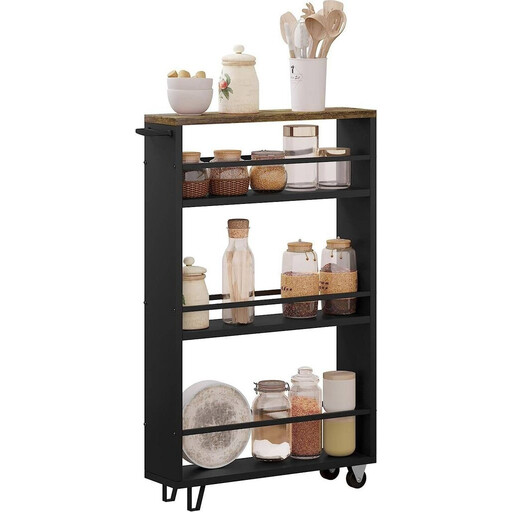
Why This Fits Their Persona: Ideal for those looking to make the most of narrow gaps in the kitchen, bathroom, or office. At only 13 cm deep, this niche cart fits into the smallest of spaces and creates valuable storage.
Addresses the problem of inaccurate dimensions with its ultra-slim design (13 cm). The construction of E1-grade engineered wood and metal struts ensures stability and prevents items from falling off.
Extremely space-saving design; two of the four casters are equipped with brakes, ensuring a stable footing.
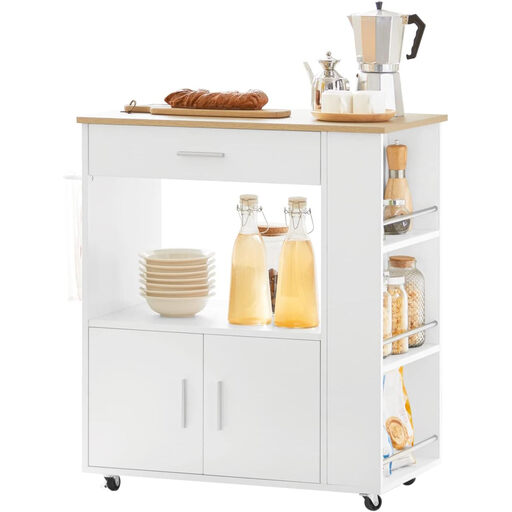
Why This Fits Their Persona: Perfect for home cooks and households that need an additional, mobile work surface and plenty of enclosed storage. Serves as a fully-fledged extension of the kitchen.
Tackles the problem of instability with a robust construction of E1-grade particle board and a high total load capacity of 75 kg. The combination of a drawer, cabinet, and shelves provides organised storage.
High load capacity and a full-sized worktop (82x46 cm). Two of the four sturdy casters are equipped with brakes, ensuring a secure stance.
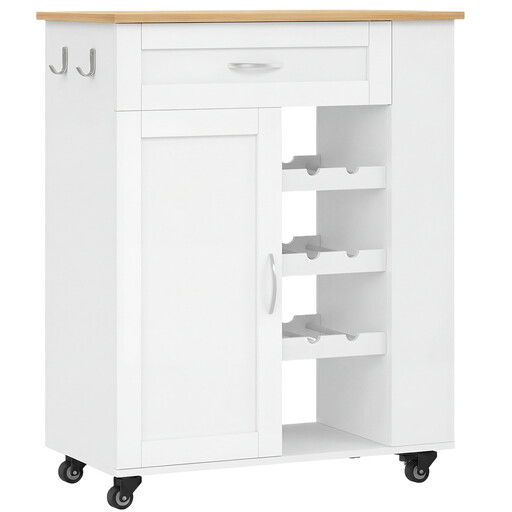
Why This Fits Their Persona: Suitable for users looking for a multifunctional serving cart for the dining or living room. The design combines open and closed compartments with a special wine rack for an attractive presentation.
Avoids the problem of unsuitable materials with an easy-to-clean, water-repellent surface. The quiet 360° casters prevent noise and scratches, a common annoyance with basic models.
Integrated wine rack for three bottles and side hooks for accessories. Independent locking brakes on two wheels ensure a stable stand when serving.
We have compiled a complete, up-to-date list of products that fully meet these strict selection criteria and relevant safety standards.
The load capacity varies greatly depending on the model and construction. Simple, narrow niche carts are often designed for a total load of only 6 to 15 kg. Robust serving carts or models with a worktop can hold between 20 and 50 kg. Particularly stable kitchen islands on wheels are designed for a load of up to 75 kg or more. Always check the manufacturer's specified maximum load capacity to avoid overloading.
Most modern kitchen carts are equipped with casters suitable for hard floors like tile, laminate, or vinyl. For very sensitive floors such as oiled parquet or soft cork, you should look for casters made of a softer material (e.g., rubber) or use a protective mat. Hard plastic casters can leave scratches over time.
Yes, most kitchen carts are delivered flat-packed for self-assembly. This reduces transport costs and the risk of damage in transit. Detailed assembly instructions, the necessary screws, and often a simple tool are included. Depending on the complexity of the model, plan for 30 to 60 minutes for assembly.