
Lieferung heute & morgen

Qualitätsgarantie

Willkommens-Angebote freischalten: KOSTENLOSE Lieferung | Bis zu 80 % RABATT | Kostenlose 30-Tage-JoyPlus-Testphase
App herunterladen
A kitchen chopping board has to do more than just look good on the surface. It needs to sit firmly, be gentle on your knives, clean up properly and offer enough space for whatever you’re preparing. At the same time, many models boast terms like “antibacterial”, “extra durable” or “multifunctional” without clearly highlighting the important limitations.
Three typical buying mistakes often lead to the wrong choice:
A bamboo chopping board is generally quite light and offers a firm, knife-friendly work surface. However, bamboo is a natural material and should be left to dry completely after washing. Regular oiling with a suitable, food-safe wood oil can help maintain the surface on products designed for it.
A wooden chopping board made from beech, walnut or rubberwood often looks impressive and, with proper care, can be used as both a chopping and serving board. Check whether the manufacturer recommends hand washing only and whether the surface should be replaced if deep cut marks appear.
Plastic models are generally easier to clean, depending on the design. For a dishwasher-safe chopping board, this must be explicitly stated in the product information. Stainless steel is resistant to moisture, but depending on the surface finish, it can affect your knives differently. A reversible chopping board with different materials on each side can therefore be useful for different types of food.
For everyday preparation of vegetables, fruit or herbs, dimensions around 30 × 20 cm are sufficient for many households. If you regularly work with several ingredients at once, you might consider a large chopping board around 40 × 28 cm. Also pay attention to:
A juice groove can catch liquid from fruit, vegetables or meat. It’s practical, but it doesn’t reduce the need for cleaning. With natural materials, the groove should be thoroughly brushed out and then dried.
A chopping board with a collection tray makes it easier to gather chopped ingredients or kitchen waste. With the Suncha model, alongside the bamboo board, there are two removable storage trays and a drip tray. A chopping board with a built-in colander can be useful if you want washed vegetables to drain directly at your workstation.
These features save you steps, but they also mean more individual parts that need cleaning. So check whether the trays and colander are removable and whether they are dishwasher-safe. With a chopping board set, you should also know which sizes are included and whether the boards can be used separately for different types of food.
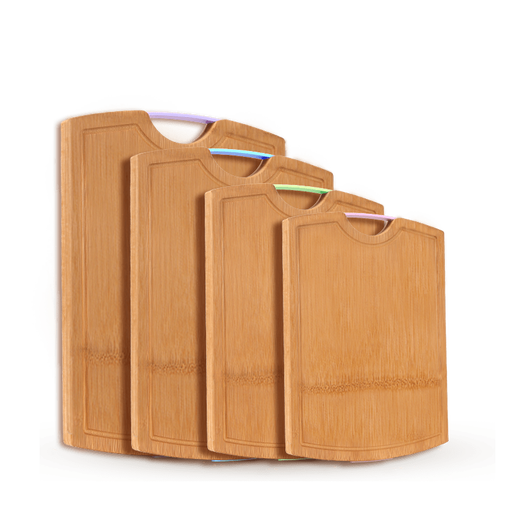
Why this product fits the profile: This bamboo board offers a large work surface of 400 × 300 mm and a curved handle for carrying or storing.
The dimensions are clearly stated, and hand washing is assumed rather than an unsubstantiated claim of dishwasher safety.
Bamboo construction, 22 mm height and integrated handle.

Why this product fits the profile: Three specified sizes from 13 × 9.5 to 16 × 11.5 inches let you choose according to ingredient and workload.
The selection is based on concrete dimensions, juice grooves and handles rather than vague durability promises. According to the product details, hand washing is required.
Set with three sizes, juice groove and integrated handles.
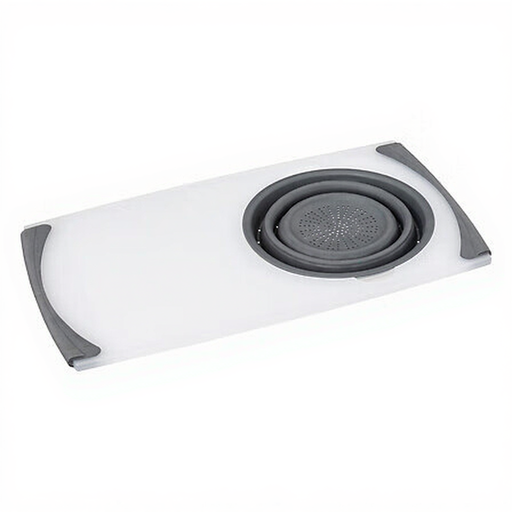
Why this product fits the profile: The combination of a plastic board and a pull-out colander is ideal for vegetable preparation, small kitchens, camping and motorhomes.
The product description explicitly lists hand washing and dishwasher as cleaning options. The colander should be fully retracted before storage.
Integrated, pull-out colander and dishwasher-safe PP construction according to product details.
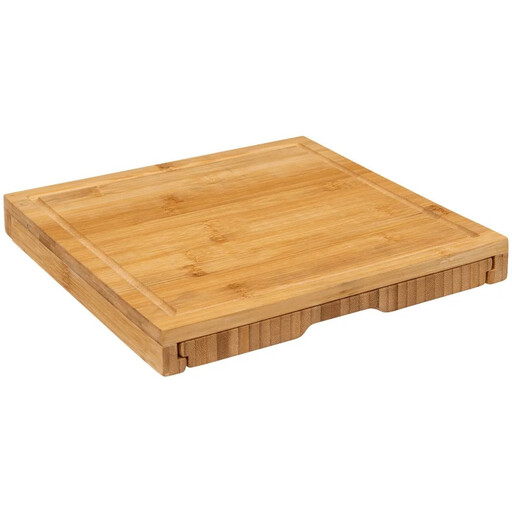
Why this product fits the profile: This square serving board combines a presentation surface with four cheese knives and a storage drawer.
Its purpose as a cheese board and serving board is clearly described. The lack of dishwasher safety should be considered when making your purchase decision.
30 × 30 cm, bamboo wood, four cheese knives and integrated storage.
We’ve put together a full, regularly updated list of products that fully meet these strict selection criteria and the safety regulations in force in the EU.
Regardless of the material, the board should be cleaned with warm water and mild washing-up liquid after each use. For natural materials, the following applies:
A product labelled as an antibacterial chopping board should not automatically be considered more hygienic. What matters are the specific material details, the care instructions and consistent cleaning.
It depends on how you use it. Bamboo and wood offer a firm, knife-friendly surface, but usually require hand washing and thorough drying. Plastic is often easier to care for. Stainless steel is simple to clean, but should be compatible with the knives you use.
For smaller preparations, around 30 × 20 cm is often enough. For families, larger quantities of ingredients or multiple steps, formats around 40 × 28 cm are more practical. Before buying, measure your worktop, sink and storage space.
There’s no one-size-fits-all answer. It depends on the material, how intensively you cut, how you clean it and how you store it. Deep grooves, cracks, warping or lingering odours are signs that it’s time to replace your kitchen board.