
Lieferung heute & morgen

Qualitätsgarantie

Willkommens-Angebote freischalten: KOSTENLOSE Lieferung | Bis zu 80 % RABATT | Kostenlose 30-Tage-JoyPlus-Testphase
App herunterladen
A kitchen chopping board gets a lot of use every day. It needs to handle vegetables, fruit, bread and sometimes raw meat without slipping easily or becoming difficult to clean. Yet many poor buying decisions come down not to price, but to choosing a board with the wrong features.
1. “Antibacterial” is mistaken for complete hygiene.
A product described as an “antibacterial chopping board” is no substitute for cleaning or keeping raw and ready-to-eat foods separate. What matters is a surface with as few pores as possible, thorough rinsing and letting the board dry completely. If a product uses this term, check whether it is simply the manufacturer’s description or whether there is specific evidence to support the claim.
2. A large cutting surface isn’t automatically practical.
A large chopping board gives you more room, but it also needs enough storage space and a stable work surface. In a small kitchen, a 30 × 20 cm board may be more practical than a heavy 50 × 35 cm model.
3. Juice grooves and handles are bought without considering the design.
A deep juice groove can catch liquid, but it takes up some cutting space and needs to be cleaned carefully. A chopping board with a handle is easier to carry or hang up. Above all, make sure the board stays securely in place while you’re chopping.
A stainless steel chopping board is non-porous and is generally easy to clean with water and washing-up liquid. However, its hard surface can affect how it feels to chop on and may put more strain on your knives. With a double-sided model, one side may be intended for meat and the other for vegetables or fruit.
A bamboo chopping board or wooden chopping board has a warm, natural look and can last a long time with the right care. Don’t leave bamboo or wooden boards soaking in water, and don’t put them in the dishwasher unless the manufacturer explicitly says you can. Make sure they dry completely after washing.
A plastic chopping board made from PP or a similar material is usually lightweight and easy to handle. Replace it if it develops deep cuts or rough patches, as it can be harder to remove food residue from damaged surfaces.
Glass is easy to care for and, according to the 5five product description, the model has antibacterial properties. However, its hard, smooth surface is less forgiving on knife blades. So the “antibacterial” claim shouldn’t be taken as a medical or hygiene guarantee.
For everyday kitchen tasks, boards measuring around 30 × 20 cm to 40 × 30 cm are often a good choice. If you prepare several ingredients at once or chop larger foods, consider a large chopping board measuring 50 × 35 cm.
Thickness affects both weight and stability. A 10 mm-thick stainless steel model is easier to store than a 26 mm-thick bamboo board. At the same time, the board shouldn’t slip with every cut. So check:
For more models designed to stay securely in place, browse our selection of non-slip chopping boards.
A chopping board with a juice groove is particularly useful for juicy foods or meat. A double-sided chopping board can make it easier to keep different foods separate, as long as you use each side clearly and consistently. A chopping board set gives you several work surfaces and can be handy in households where cooking is a frequent part of everyday life.
Check the care instructions too. “Easy to clean” doesn’t automatically mean dishwasher-safe. Follow the manufacturer’s instructions carefully, especially for bamboo, wood and composite materials.
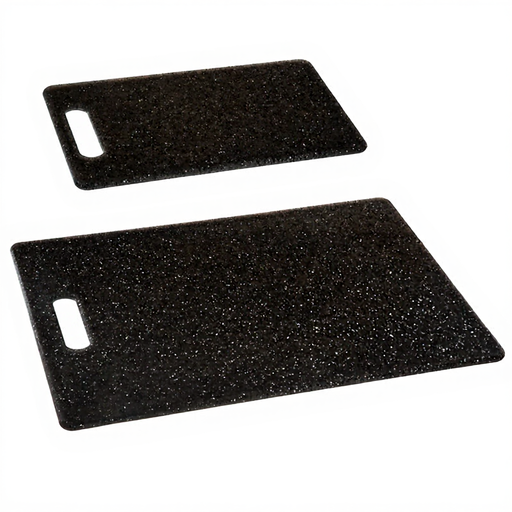
Why it suits this profile: The two PP boards each measure 36 × 27 cm, giving you separate surfaces for different ingredients. With a total set weight of 0.713 kg, they’re easy to handle.
Having two boards means you don’t need to keep switching a single board between different ingredients.
Two cutting surfaces, each board measuring 36 × 27 cm, and low-porosity PP material according to the product description.
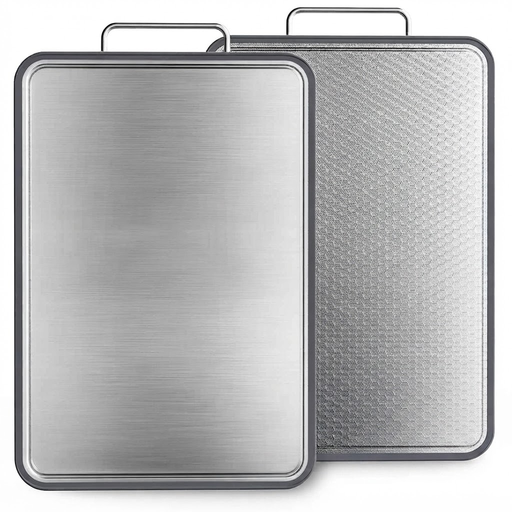
Why it suits this profile: This double-sided stainless steel board measures 435 × 281 × 10 mm. It has a juice groove on both sides and a stainless steel handle.
The non-porous stainless steel design can be used on both sides and, according to the product description, cleaned with water and washing-up liquid.
Reversible design, a juice groove on both sides and rust-resistant stainless steel according to the product details.
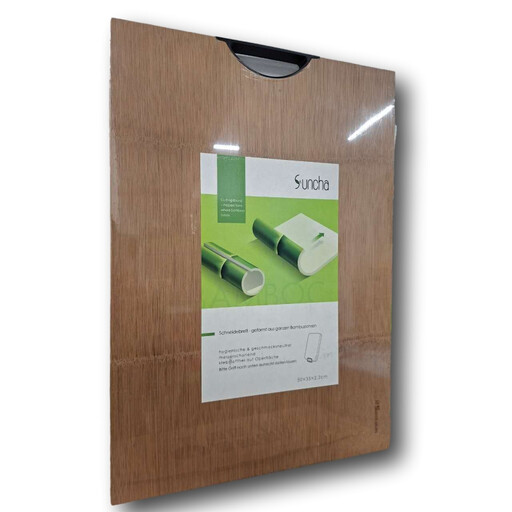
Why it suits this profile: Measuring 50 × 35 × 2.6 cm, this bamboo board gives you plenty of room for food prep, rolling out dough and serving.
Clear care instructions help you avoid damaging the board through incorrect cleaning: don’t soak it, put it in the dishwasher or store it before it has dried completely.
Generous 50 × 35 cm cutting surface, 26 mm thickness and an integrated handle according to the product details.
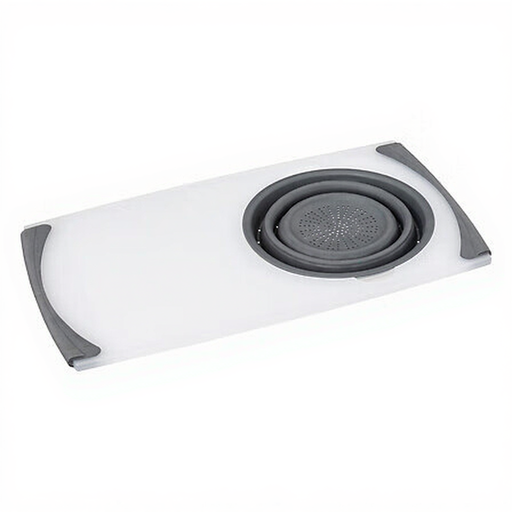
Why it suits this profile: The combination of a PP chopping surface and an integrated pull-out colander makes this a handy choice for small kitchens, motorhomes or camping.
The extra feature has a clear purpose: use the integrated colander to wash and drain food, instead of needing a separate kitchen colander.
Space-saving design, PP material and, according to the product description, suitable for hand-washing and dishwasher use.
We’ve put together a comprehensive, regularly updated list of products that meet these strict selection criteria and fully comply with the safety regulations in force in the EU.
It depends on how you’ll use it. Stainless steel and PP are easy to care for and low in porosity. Bamboo and wood offer a natural surface but need more maintenance. Glass is easy to clean, but its surface can be harder on knives.
Around 30 × 20 cm is often enough for a small kitchen. For families, frequent cooking or preparing several ingredients, a board measuring 36 × 27 cm to 50 × 35 cm is more practical. Measure your worktop and storage space before you buy.
Replace your board if it has deep grooves, cracks, warping, chips or a persistent smell. Damaged surfaces are usually harder to clean thoroughly.