
Lieferung heute & morgen

Qualitätsgarantie

Willkommens-Angebote freischalten: KOSTENLOSE Lieferung | Bis zu 80 % RABATT | Kostenlose 30-Tage-JoyPlus-Testphase
App herunterladen
A kitchen chopping board needs to do more than provide a flat surface. It should sit securely, suit your worktop and be easy to clean properly after food preparation. Chopping boards also vary considerably in their material, care requirements and intended use. If you focus only on claims such as “antibacterial” or “extra durable”, it’s easy to overlook important details.
Descriptions such as antibacterial chopping board, “hygienic” or “food-safe” should always be checked against the specific material and care instructions. These claims don’t automatically mean that the board offers special protection or doesn’t need cleaning. What matters is clear, verifiable information about the material, surface and cleaning requirements.
If you prepare raw meat, vegetables and bread on the same surface, you’ll need to clean it particularly thoroughly. A double-sided chopping board can make food preparation easier to organise by providing separate sides. However, it doesn’t replace thorough cleaning, and the board should be left to dry completely after use.
A small kitchen chopping board saves space, but leaves little room to manoeuvre when cutting cabbage, bread or larger vegetables. A large chopping board, on the other hand, needs a sufficiently deep worktop and somewhere secure to store it. A handle can also be useful, but takes up some of the available cutting surface.
For everyday kitchen tasks, a board measuring around 30 × 20 cm is compact and easy to store. Models from around 34 × 24 cm upwards give you more room for meal prep. A very large board, such as one measuring 50 × 35 cm, can be useful for preparing larger quantities, but needs a stable, clear work surface.
A thicker board may sit more securely, but thickness alone doesn’t tell you how good the board is overall. Also check:
A dishwasher-safe chopping board can make everyday cleaning easier. This must be stated explicitly in the product details. Hand-washing is often recommended for wood and bamboo boards. This applies, for example, to several of the bamboo and wooden boards featured below.
Use warm water and a mild washing-up liquid, remove all residue and dry the board straight afterwards. Cracks, severe warping or splinters are signs that a board should no longer be used. Always follow the manufacturer’s care instructions.
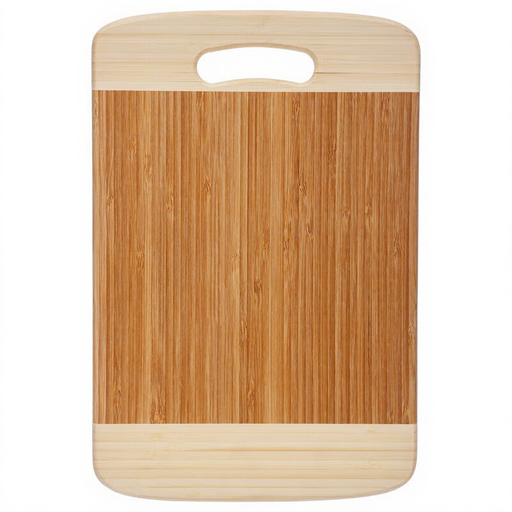
Why it suits this user: This 30 × 20 cm bamboo board is suitable for simple chopping tasks in smaller kitchens. Its built-in handle makes it easier to carry and hang up.
The dimensions are clearly stated, and the handle is described as a specific feature. The care instructions explicitly rule out soaking the board and putting it in the dishwasher.
Bamboo surface, built-in handle and compact dimensions of 30 × 20 cm.
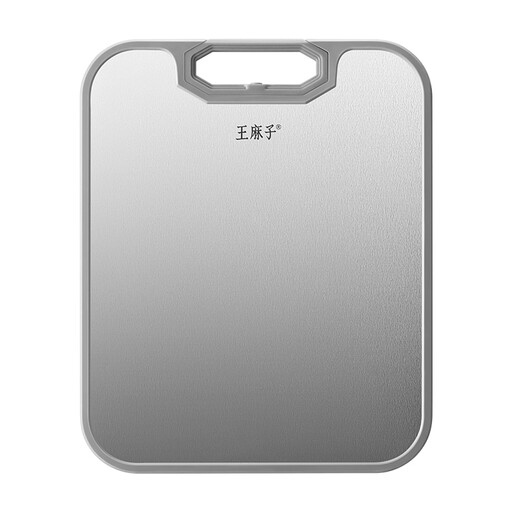
Why it suits this user: This double-sided stainless steel model is designed for households that prefer separate work surfaces and are looking for a material that is resistant to water.
Its double-sided design makes the intended use clear. The “antibacterial” description should still not be treated as a substitute for cleaning.
Stainless steel construction and two usable sides for keeping food preparation separate.

Why it suits this user: This set includes three sizes for vegetables, meat, cheese and serving. The handles and juice grooves are designed for different food preparation tasks.
The three sizes mean you won’t have to use a board that’s too small for the task. The juice groove can catch liquid on the board’s surface.
Three sizes, built-in handles and juice grooves; the product details state that it should only be washed by hand.
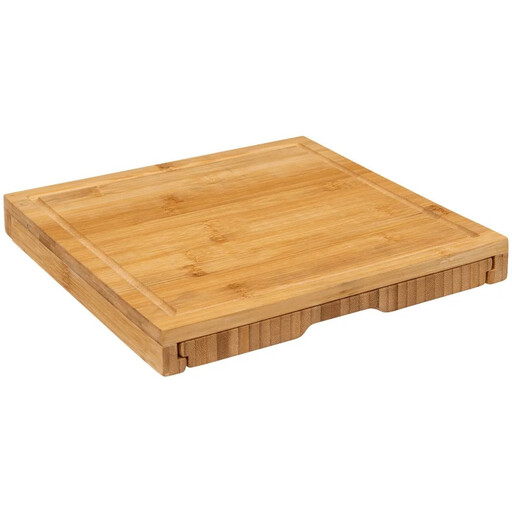
Why it suits this user: This square cheese board has a 30 × 30 cm surface and is described as coming with four cheese knives and an integrated storage solution.
Its intended use as a cheese and serving board is clearly defined. The product details explicitly state that it should be washed by hand.
A 30 × 30 cm bamboo board with four cheese knives and a drawer for storage.
We’ve put together a comprehensive, regularly updated list of products that meet these strict selection criteria and fully comply with the safety regulations in force in the EU.
For households that regularly prepare both, a double-sided chopping board can make it easier to keep food preparation separate. Alternatively, using two separate boards is a good option. After contact with raw meat, the side used should be cleaned thoroughly and dried completely.
Its lifespan depends on the material thickness, how often it’s used and how well it’s cared for. Avoid prolonged soaking, high temperatures and the dishwasher if the manufacturer advises against them. Drying the board regularly and, for suitable wooden products, treating it with food-safe oil can help preserve the surface. Replace the board if it develops deep cracks, splinters or severe warping.
Not necessarily. A dishwasher-safe plastic or composite board can make cleaning easier, while wood and bamboo boards usually need gentler hand-washing. The key is to choose a cleaning method that suits your kitchen routine and to check that the product details explicitly say it can go in the dishwasher.