
Lieferung heute & morgen

Qualitätsgarantie

Willkommens-Angebote freischalten: KOSTENLOSE Lieferung | Bis zu 80 % RABATT | Kostenlose 30-Tage-JoyPlus-Testphase
App herunterladen
A kitchen cleaver needs to do considerably more than an ordinary chef’s knife, depending on how it is used. If you want to portion pork ribs, divide meat or chop firm vegetables, you need the right combination of blade shape, weight, material and handle. At the same time, many product descriptions are phrased very generally. Terms such as “professional”, “particularly robust” or “extremely sharp” reveal little on their own about a knife’s actual suitability.
As a Joybuy Product Recommendation Officer, I filter the most important buying criteria and categorise suitable models according to typical user profiles. This makes it easier to avoid paying for a cleaver that is unsuitable for the job you have in mind.
A higher weight can support the chopping motion, but it does not replace suitable blade geometry. A kitchen cleaver for vegetables and boneless meat can be designed differently from a bone cleaver for particularly hard materials. Thin blades are practical for precise cuts, but may be damaged when they come into contact with bones or frozen food.
Before buying, you should therefore be clear about the following:
A stainless steel cleaver is generally less susceptible to rust than unprotected carbon steel. However, this does not mean it should be left wet for extended periods. Salt, acidic foods, dishwasher detergent and moisture can affect both the blade and the handle.
A long service life depends on several factors, including the following:
A Chinese cleaver with a broad blade is often suitable for chopping, rocking and slicing motions. A larger blade can be helpful when preparing large ingredients, but it also requires more space and control. For smaller kitchens or mainly fine cutting work, a more compact model may be the better choice.
For everyday food preparation, models measuring around 17 to 19 cm are often easier to control. A blade length of approximately 28 to 31 cm can offer advantages when working with larger pieces of meat or making longer cutting movements. However, suitability also depends on the blade height, thickness and weight.
A meat cleaver is not automatically suitable for cutting bones. If you want to work with hard materials, look for a sufficiently strong blade that is explicitly designed for this purpose. Take particular care with frozen food: if the manufacturer does not mention this use, it should be avoided.
A forged cleaver is shaped from a heated steel blank. The product information should also state which type of steel is used. For example, the Wangmazi model from the Shenmu Series Lu is listed as using 400 Stainless Steel. This provides specific information about the material, whereas general claims such as “high-quality steel” are less informative.
A carbon steel model may offer advantages in terms of sharpness and ease of resharpening, but it usually requires more care. Stainless steel versions are practical for users who prefer greater day-to-day durability and straightforward cleaning.
A non-slip handle, used with dry hands, is essential for every chopping motion. A full tang construction can provide additional stability. Balance should also match the amount of force you personally use: a forward-heavy butcher’s cleaver generates more momentum, but requires controlled handling.
Important: A cleaver should not be used as a lever or splitting tool. Bones and ribs require controlled, straight movements. If you notice cracks, nicks or chips, stop using the knife.
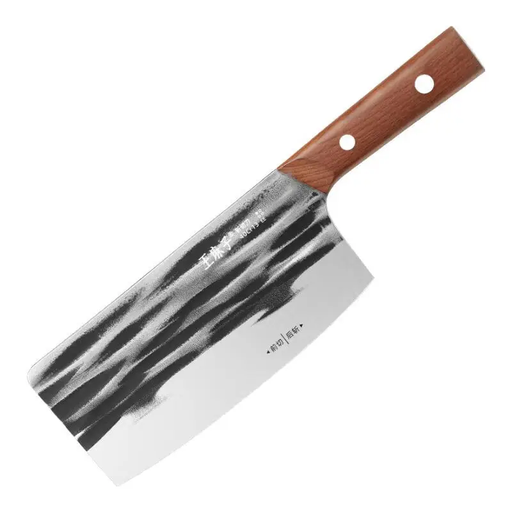
Why this product suits the profile: The product name mentions stainless steel and a general chopping function. This makes the model suitable for buyers looking for a Chinese cleaver for typical kitchen tasks and wanting to start with a versatile option.
The “stainless steel” material specification is more concrete than a purely promotional quality claim. For bones, however, you should still check the stated intended use before buying.
Stainless steel construction according to the product name; listed as a cutting and chopping knife for household use.
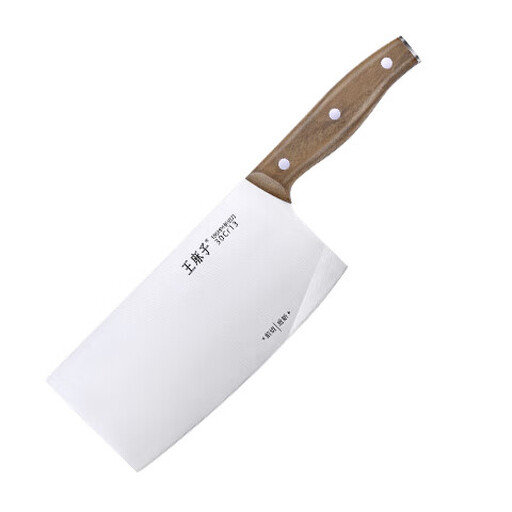
Why this product suits the profile: The stated blade length of 30.8 cm and the 400 Stainless Steel specification appeal to users who prefer a large working surface for meat, vegetables and more extensive food preparation.
The blade dimensions and steel specification are verifiable details. However, its large size makes this model better suited to users with sufficient space and confident handling skills.
400 Stainless Steel according to the product information; walnut handle; dimensions of 9.1 x 30.8 cm.
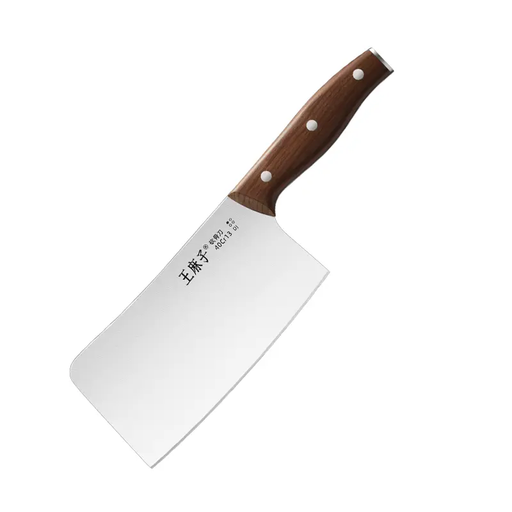
Why this product suits the profile: The model is explicitly described as suitable for chopping bones and pork ribs. It is therefore aimed at frequent users looking for a bone cleaver for clearly specified tasks.
The stated purpose explicitly mentions bones and pork ribs. Before buying, you should nevertheless check the blade thickness, weight and permitted materials in the current product information.
Forged construction according to the product description; high-carbon steel; full tang construction and a non-slip handle are specified.
A kitchen cleaver is only reliably easy to handle when its care routine is suited to the material. Food residue should be removed promptly after cutting. Avoid soaking wooden handles for extended periods. A blunt blade should not be forced through hard ingredients using increased pressure, as this reduces control.
The following points are also useful for use in UK households:
A sharp kitchen knife is not automatically safer. Controlled movements, a dry handle and an undamaged blade are what really matter.
We have put together a complete, regularly updated list of products that fully meet these strict selection criteria and the safety regulations applicable in the EU.
For meat and vegetable cleavers, a broad, sufficiently sturdy blade with a length that is easy to control is a sensible choice. If you mainly prepare boneless meat, onions or firm vegetables, a medium-sized model will usually be suitable. For ribs and bones, the product description should explicitly state that it is designed for this purpose.
It is not possible to give a reliable fixed lifespan. This depends on the steel, frequency of use, cutting surface, cleaning routine and sharpening technique. A knife that is regularly used on hard surfaces or for materials it was not designed for may develop nicks considerably sooner.
Only do this if the manufacturer expressly permits it. For many blades and handles, washing by hand with mild washing-up liquid and drying immediately is the gentler approach. With wooden handles, coated blades or high-quality forged models, it is particularly important to follow the product instructions.