
Lieferung heute & morgen

Qualitätsgarantie

Willkommens-Angebote freischalten: KOSTENLOSE Lieferung | Bis zu 80 % RABATT | Kostenlose 30-Tage-JoyPlus-Testphase
App herunterladen
A kitchen colander needs to do more than simply drain water. Depending on the household, it may be used as a pasta colander, rice strainer, fruit and vegetable drainer, or flour sieve. The differences between models are not limited to design. Material, hole size, stability and storage requirements all determine whether a colander will remain a practical addition to your kitchen or end up unused at the back of a cupboard.
A coarse drainer lets water run off quickly, but it can also allow small grains of rice, berries or herbs to escape. A very fine mesh keeps smaller ingredients contained, but takes longer to drain and can become clogged more easily with flour, starch or fruit pulp.
Before buying, consider whether you mainly want to drain pasta and potatoes, or whether you also plan to sieve rice, quinoa, berries and dry ingredients.
A collapsible colander or extendable kitchen draining basket can save storage space. However, with highly flexible plastic designs, you should check whether the colander extends fully, rests securely on the sink and remains stable when holding wet food.
For small kitchens, a compact model with a handle or hanging option is often more practical than a large colander that is only used occasionally.
‘Metal’ or ‘stainless steel effect’ does not automatically describe the actual material. Look for specific details such as stainless steel, 316 stainless steel mesh, 304 stainless steel or food-safe plastic. For coated surfaces, you should also follow the care instructions. Abrasive cleaners and steel wool can damage coatings and plastic frames.
The label ‘dishwasher-safe’ also does not necessarily mean that every component can withstand high temperatures over the long term. Intensive dishwasher cycles can affect the lifespan of plastic frames.
For a single portion or small amounts of fruit, a small colander with a capacity of around 0.5 to 1 litre is sufficient. Families and anyone who regularly prepares pasta or larger quantities of vegetables will generally benefit from 2 to 3.6 litres.
The external dimensions are also important. A large pasta colander must fit in the sink and should still be safe to lift when full. Extendable models work with sinks of different widths, but require enough surface area to rest on.
A stainless steel colander is resistant to moisture and suitable for regular washing and draining. Specific product details such as 304 or 316 stainless steel make it easier to assess the material. Plastic models are often lighter and may have a non-slip handle. In this case, check the temperature limits and care instructions.
For dry ingredients, a fine-mesh sieve with an even mesh structure is a sensible choice. A kitchen strainer with larger openings, on the other hand, is designed primarily for draining liquids.
A pasta colander with a handle can be held more securely when pouring. Two side handles distribute the weight, while a long handle is particularly practical for smaller portions. Feet or a wide supporting rim prevent the colander from tipping in the sink.
For a strainer used for washing and draining, the openings should ideally be distributed evenly rather than being located only in the base. This allows water to drain even when the colander is not completely level.
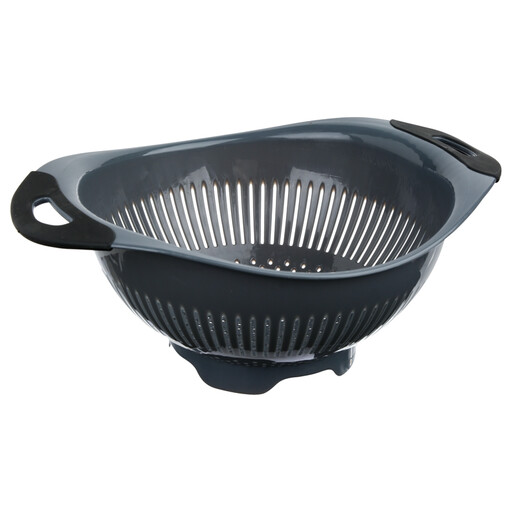
Why this product suits this profile: The 2.5-litre model is suitable for pasta, vegetables and fruit in a typical family household. The lightweight PP body and TPR handle make it easier to use with wet hands.
The stated capacity helps prevent larger portions from spilling over the rim of an undersized colander. Before cleaning, check the care instructions for PP and TPR.
2.5-litre capacity; lightweight material with an ergonomically designed TPR handle.
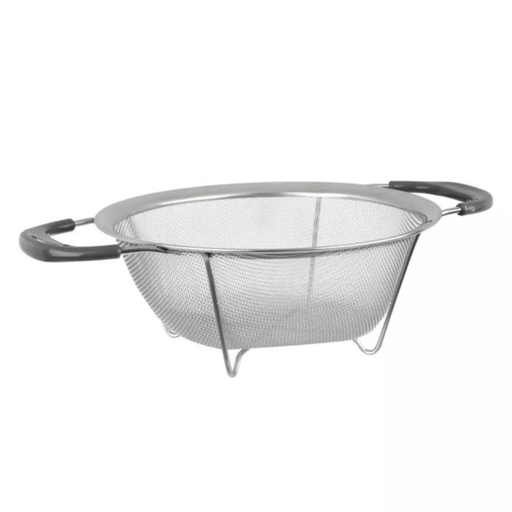
Why this product suits this profile: Measuring 22 cm, this sieve combines the stated 316 stainless steel mesh with a plastic frame. It is suitable for households that want to sieve flour while also draining pasta, fruit or vegetables.
The specific mesh description is more informative than a general label such as ‘metal sieve’. The manufacturer states a plastic temperature limit of 70 °C, so boiling liquids should not be poured in directly.
22 cm diameter; stated to be dishwasher-safe and suitable for dry ingredients and draining.
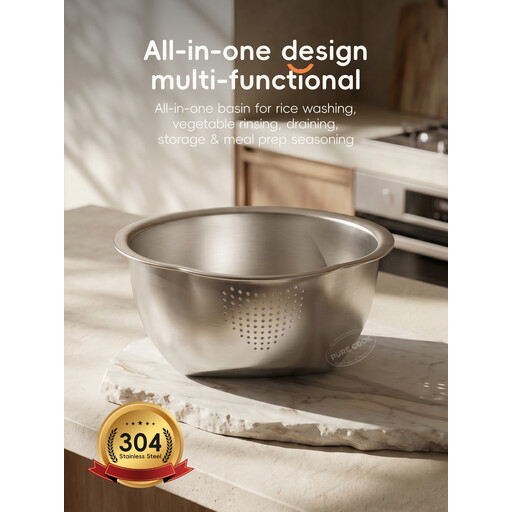
Why this product suits this profile: Made from stated 304 stainless steel, this rice-washing basket is designed for rice, quinoa, fruit, vegetables and other food preparation tasks. Two side handles make pouring easier.
The product details specify the material, a diameter of 27 cm, evenly distributed openings and smooth edges. This makes it easier to assess than metal baskets with no further material information.
304 stainless steel; 27 cm diameter and stated to be dishwasher-safe according to the product description.
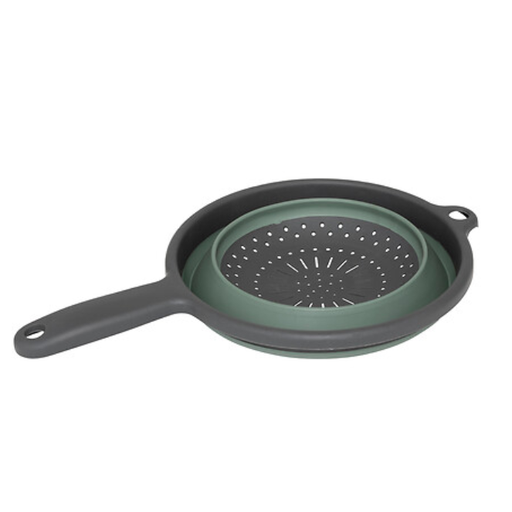
Why this product suits this profile: The extendable mini colander is designed for small quantities, travel and kitchens with limited cupboard space. According to the product description, it can be folded away.
The extendable design directly addresses the issue of limited storage. Before buying, however, check that the dimensions of 22.5 × 36.5 × 3.5 cm are suitable for your sink.
Foldable design; low stated weight of 0.155 kg.
We have put together a complete, regularly updated list of products that fully meet these strict selection criteria and the safety regulations applicable in the EU.
For rice, a colander with fine, evenly sized holes is a sensible choice, as it prevents the grains from falling through. A dedicated rice-washing basket made from 304 stainless steel can also be used for quinoa, vegetables and fruit. The actual opening size and a secure handle are the key considerations.
A compact model is sufficient for individual portions. If you regularly cook for several people, consider capacity, diameter and handles together. A colander with a capacity of 2.5 litres or more provides extra room, but should not be so large that it stands unstably in the sink.
Its lifespan depends on the material, level of use and cleaning method. Stainless steel can last for many years with normal care. With plastic models, high temperatures, stiff brushes and permanent deformation can shorten their useful life. Without information from the manufacturer, it is not possible to give a reliable specific lifespan.