
Lieferung heute & morgen

Qualitätsgarantie

Willkommens-Angebote freischalten: KOSTENLOSE Lieferung | Bis zu 80 % RABATT | Kostenlose 30-Tage-JoyPlus-Testphase
App herunterladen
A kitchen colander is one of the most frequently used helpers by the sink: draining pasta, washing vegetables, draining fruit or straining tinned food. Even so, not every model is suitable for every household. Small details in the design, material and drainage can determine whether a kitchen sieve remains practical in everyday use or quickly ends up unused in the cupboard.
A foldable colander takes up less room in the cupboard. However, what matters is whether it can be opened fully and stands securely in the sink. With movable sections, you should also check whether they are easy to clean. If pasta pieces or fruit pulp become trapped in the joints, the cleaning effort increases.
Fine holes also retain smaller ingredients, but allow liquid to drain more slowly. A finely meshed colander can be useful for rice, fine noodles or small berries. For large quantities of pasta or potatoes, however, a sufficiently large drainage opening and a stable base are more important.
A stainless steel sieve is often chosen for its hard-wearing surface. With enamelled models, you should also check the care instructions, as damaged coatings can make cleaning more difficult. A plastic sieve is usually lighter and can be practical for camping or everyday use. The specific manufacturer’s instructions on cleaning, temperature and food contact are always decisive.
First measure the available space in the sink and kitchen cupboard. A model with a capacity of around 2 to 2.5 litres is suitable for many households where vegetables, fruit or a standard portion of pasta are regularly drained. For larger family portions, a wider colander may be more suitable. It is important that the rim does not extend beyond the width of the sink and that it can safely support the weight of the contents.
Pay attention to three dimensions:
A sieve with a handle can be used directly over a saucepan or bowl. Wide handles or a continuous rim make it easier to lift with wet hands. For use in the sink, feet, a contoured base or a sturdy rim are useful. The sieve should not tip over when water and food are moved together.
A stainless steel sieve is an interesting option for frequent use, provided the construction and care instructions are suitable. A plastic sieve, on the other hand, often scores points for its low weight and flexible shape. With both variants, it is worth looking at the hole structure: openings that are too narrow make cleaning more difficult, while openings that are too large allow small foods to pass through.
For catering businesses, house shares or families who cook frequently, a kitchen sieve set with several diameters may meet their needs better than a single model. For travellers and campers, foldable designs or compact dimensions are often more important than a large capacity.
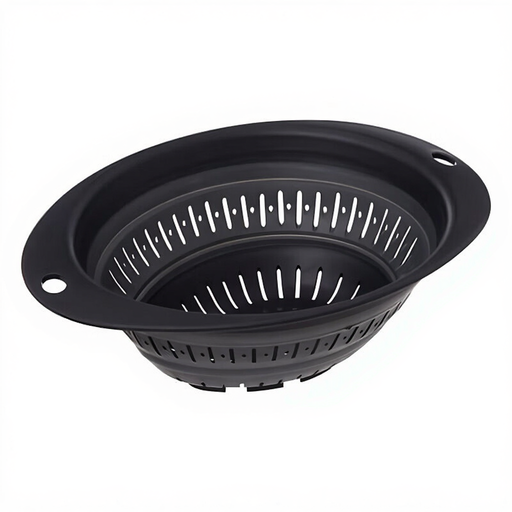
Why this product suits the profile: This foldable plastic sieve offers a 2.5-litre capacity and measures approximately 31 × 23 × 11 cm when opened. It is suitable for households with limited storage space and for camping.
The movable sections fold together, while the contoured base provides stability in the sink. The wide rim makes it easier to grip.
Foldable design, 2.5-litre capacity and a hanging option on the rim.
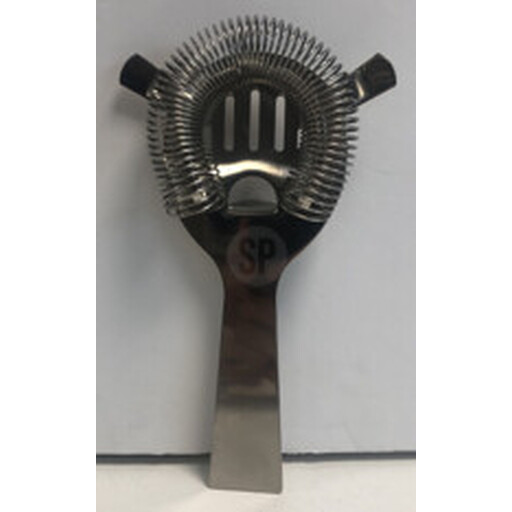
Why this product suits the profile: This compact stainless steel sieve with a handle is designed for smaller quantities, straining tinned food and washing fruit and vegetables.
The clearly defined size of 17 × 10 cm makes its intended use transparent. It is not chosen as a large sieve for family portions.
Stainless steel construction, compact dimensions and an integrated handle; according to the product details, it is dishwasher-safe.
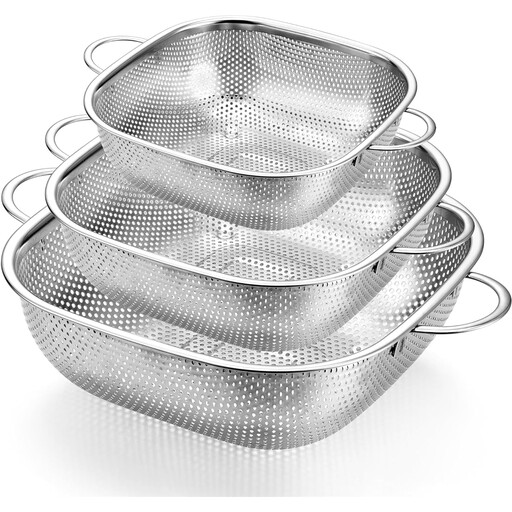
Why this product suits the profile: The three-piece set, with diameters of 20, 24 and 28 cm, covers different quantities and preparation tasks. It is aimed at frequent users, keen home cooks and professional kitchens.
The three sizes reduce the compromise between insufficient capacity and the need for unnecessarily large amounts of storage space.
Three diameters and handles on the sieves; the product name indicates a steel construction.
A dish drainer serves a different purpose from a colander. It holds plates, glasses and cutlery after washing up and requires a draining area or collection tray. When buying one, the footprint, tiers, cutlery basket and drip tray are all relevant. For example, the 5five 2-Tier model is listed as having two tiers, a removable cutlery basket, a drip tray and space for up to 17 plates. It may therefore also be suitable for the kitchen or camping: 5five 2-Tier Dish Drainer.
A sink strainer or plughole sieve, on the other hand, keeps food scraps out of the drain. Before buying, the diameter and shape must match those of the plughole. According to the product details, a set of two stainless steel sink grids with a diameter of 7 cm is intended for small sink drains and use in professional kitchens: Set of 2 Stainless Steel Sink Grids.
We have put together a complete, regularly updated list of products that fully meet these strict selection criteria and the safety regulations applicable in the EU.
A compact model is often sufficient for individual portions or side dishes. For pasta, potatoes and larger quantities of vegetables, around 2 to 2.5 litres or a diameter of approximately 24 cm or more is more practical. The dimensions of the sink and available storage space remain the key considerations.
Both materials have different properties. Stainless steel retains its shape and is suitable for frequent use, while plastic is often lighter and more space-saving. Before buying, check the information on food contact, temperature, cleaning and dishwasher suitability.
A plughole sieve is useful if you want to prevent food scraps from entering the drain. However, it does not replace a kitchen sieve for washing or draining food. Check the diameter and make sure that the grid fits the plughole in your sink.