
Lieferung heute & morgen

Qualitätsgarantie

Willkommens-Angebote freischalten: KOSTENLOSE Lieferung | Bis zu 80 % RABATT | Kostenlose 30-Tage-JoyPlus-Testphase
App herunterladen
A kitchen colander needs to do more than just let water drain through. It should fit the width of your sink, sit securely, and be easy to clean after use. Requirements vary significantly depending on the household: a single person often needs a small kitchen strainer, while families require a larger pasta strainer, vegetable colander or a dish-drying rack.
When buying, however, eye-catching product promises don't always lead to the right solution. What really matters are clear details about material, dimensions, capacity and cleaning.
An expandable colander can save space, but it must match the actual internal width of your sink basin. So check before you buy:
If the model is too short, there's a risk of slipping. If the colander is too long, it may not sit securely.
The term 'stainless steel' alone tells you very little about the specific grade. More meaningful details are things like 304 stainless steel or 18/8 stainless steel, provided they're mentioned in the product information. Even with rust-resistant materials, the colander should be dried after cleaning. Residues from salt, washing-up liquid or hard water can affect the surface over time.
With plastic, material details like PP or polypropylene are helpful. A plastic colander is often lightweight and easy to handle, but should not be placed on a direct heat source.
A sink colander channels water directly into the sink. A dish-drying rack for the worktop, on the other hand, usually needs a drip tray. Without a removable tray, water can collect under the rack and leave limescale marks on the worktop.
For plates, glasses and cutlery, different design features matter than for rice, fruit or pasta. A fine-mesh stainless steel strainer is suitable for smaller foods, while a dish-drying rack needs holders and a larger base area.
For fruit, vegetables, rice and pasta, the manufacturer should state that the product is suitable for food contact. With the models listed here, materials such as stainless steel, 304 stainless steel, PP or steel are specified. Coated surfaces should show no visible chipping. Smooth, rounded edges make cleaning easier and reduce the risk of sharp edges.
A stainless steel strainer is generally more heat-resistant than many plastic versions. However, no colander should be placed on a hob or in a hot oven unless this is expressly stated.
The right size depends on the intended use:
Pay attention not only to the volume, but also to the external dimensions and shape. A tall colander can be impractical with small sinks. For a narrow kitchen, an expandable colander is often more space-saving than a fixed model.
Food residue should be removed after every use. Evenly spaced holes, smooth interior surfaces and removable parts are practical. Whether a model is dishwasher-safe must be checked in the product details. For the 5five Dish Drain Rack with Tray, for example, it states that it is not dishwasher-safe.
For a colander over the sink, a secure fit is also crucial. Load it evenly and do not exceed any stated weight capacity. The Excellent Houseware Kitchen Dish Drainer specifies a maximum load of 8 kg.
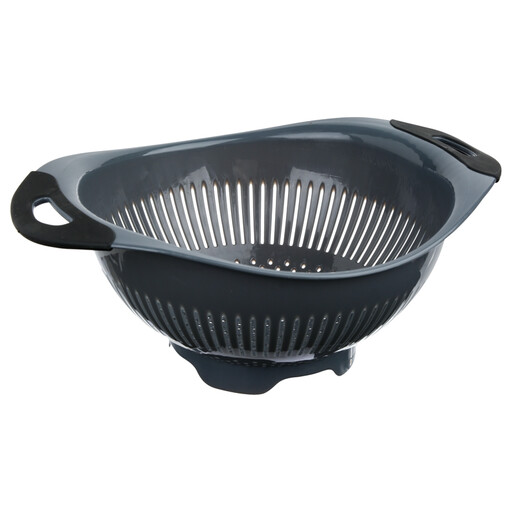
Why this product fits the profile: This 2.5-litre model made from PP is designed for pasta, vegetables and fruit. The TPR handle helps with grip when your hands are wet.
The stated volume and dimensions of 31.6 × 24.3 × 12.5 cm make it easy to check the size before buying.
2.5-litre capacity, lightweight at 0.162 kg and plenty of drainage holes.
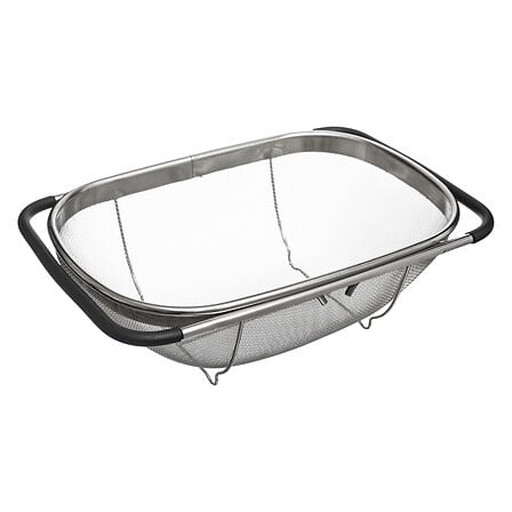
Why this product fits the profile: This expandable stainless steel strainer is designed for sinks of different widths and offers a 3.6-litre capacity.
The adjustment range should be compared with your sink width before buying; dimensions are given as 53.5 × 24.7 × 10.5 cm.
Stainless steel construction, 3.6-litre capacity and expandable design for vegetables, pasta and fried foods.

Why this product fits the profile: This model made from 304 stainless steel expands from 29 to 44 cm and serves as a sink colander, dish rack and vegetable strainer.
The adjustable length reduces the risk of buying the wrong size for sinks of different widths. Check it sits securely before use.
304 stainless steel, 29–44 cm adjustment range and base dimensions of 21.2 × 10.5 cm for use directly over the sink.
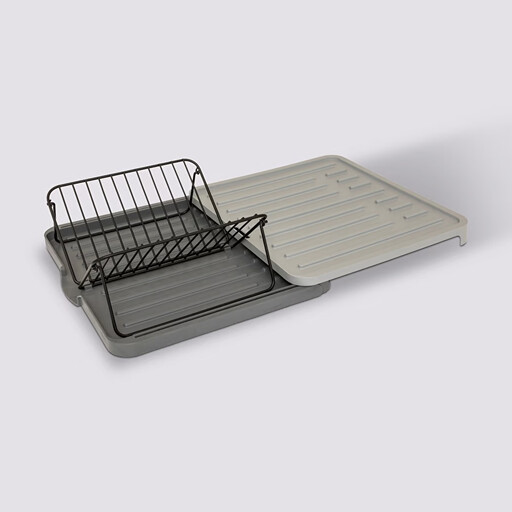
Why this product fits the profile: This dish-drying rack measures 58.2 × 36.2 × 10.3 cm and comes with a polypropylene drip tray.
The separate tray prevents dripping water from reaching the worktop directly. Check the dimensions against your available space.
Steel frame, PP drip tray, space for up to six glasses according to the product details and 12 additional positions.
We've put together a complete, regularly updated list of products that fully meet these strict selection criteria and the safety regulations in force in the EU.
For small kitchens, compact models or an expandable colander that can be shortened when not in use are ideal. Measure your sink and the available worktop space before buying. A colander over the sink saves worktop space, while a model with a drip tray can be used on the worktop independently of the sink width.
The lifespan depends on the material, how much it's used and how it's cared for. Stainless steel and steel models should be dried after cleaning to remove water residue. Plastic colanders must not be overheated or treated with unsuitable cleaning products. Regularly check handles, supports, coatings and for any sharp edges.
Yes, provided the volume, hole size and handle suit the task. A pasta strainer needs enough capacity, while a vegetable colander with smaller holes can be more practical for rice, berries or chopped vegetables. For dishes, however, a sturdy dish-drying rack with a drip tray is the more suitable solution.