
Lieferung heute & morgen

Qualitätsgarantie

Willkommens-Angebote freischalten: KOSTENLOSE Lieferung | Bis zu 80 % RABATT | Kostenlose 30-Tage-JoyPlus-Testphase
App herunterladen
A kitchen cutting board needs to do more than provide an attractive surface. It should remain stable while you cut, fit the size of your worktop and be cleaned according to its material. At the same time, terms such as “antibacterial”, “sustainable” and “knife-friendly” are often used without clearly stating the product’s practical limitations.
With an antibacterial cutting board, the description may refer to the material or to information provided by the manufacturer. It does not mean that the board will remain hygienic without thorough cleaning. Raw meat, fish, vegetables and bread should ideally be prepared separately. Clear care instructions, a smooth surface and the ability to dry the board completely after each use are therefore essential.
A large cutting board provides space for several ingredients, but it also requires sufficient worktop and storage space. A format of 45 × 30 cm or 50 × 35 cm may be impractical on a small German kitchen worktop. Weight also often increases with the size and material. Before buying, you should therefore measure your worktop, sink and storage space.
A decorative serving board, cheese board or slate cutting board is not necessarily suitable for every cutting task. Slate has a distinctive appearance, but it can be more prone to scratches and, for the selection mentioned here, is not dishwasher-safe. Wooden boards with handles are also not automatically suitable for the dishwasher or for prolonged soaking.
For everyday use, sizes of around 30 × 20 cm or 36 × 25 cm are often easy to handle. If you regularly prepare large quantities, you can choose a format of 40 × 28 cm or larger. A thicker board may sit more securely, but it will also be heavier and require more space.
A cutting board with a handle makes it easier to carry food from the fridge to the worktop or from the kitchen to the dining table. However, the handle can reduce the usable cutting area. With round boards, you should also check whether the shape suits your way of working and available storage space.
A non-slip cutting board may sit more securely thanks to silicone edges, textured undersides or a higher weight. The actual construction is more important than the marketing claim alone. If necessary, place a lightweight board on a damp cloth or non-slip mat.
You should also look out for the following information:
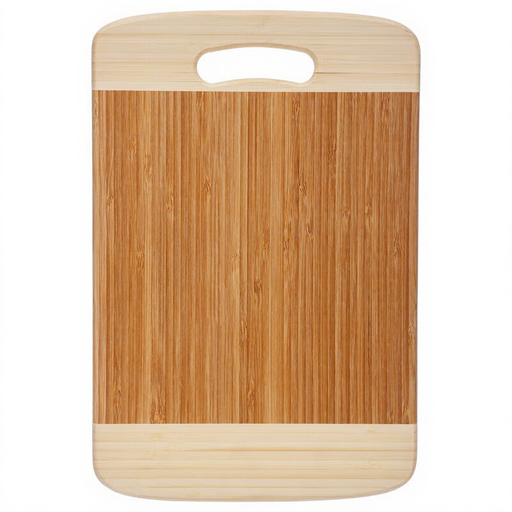
Why this product suits the profile: The 30 × 20 cm format is easy to handle in smaller kitchens and for everyday cutting tasks. The integrated handle makes it easier to carry and hang up.
The product description specifically recommends hand-washing with mild washing-up liquid and advises against prolonged soaking and using the dishwasher.
Bamboo surface, integrated handle and a smaller footprint than many larger boards.

Why this product suits the profile: The large 45 × 30 cm format, 1.9 cm thickness and juice groove are designed for extensive food preparation.
The dimensions and care instructions are clearly stated. The juice groove helps contain spills, but it does not replace cleaning after use.
Reversible design, juice groove and ample work surface for vegetables, bread or larger ingredients.
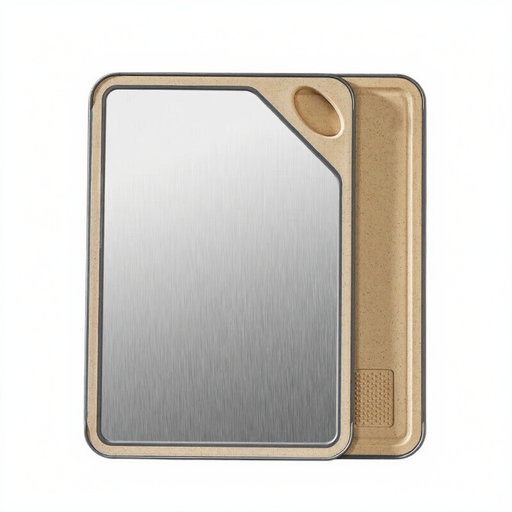
Why this product suits the profile: The double-sided design combines a stainless-steel side with a wheat straw fibre and PP side. This can make it easier to use each side for different ingredients.
The materials used on each side are clearly stated. Nevertheless, “antibacterial” should be understood as a product claim and does not make thorough cleaning unnecessary.
304 stainless steel on one side, a second cutting surface made from composite material and a hanging hole.
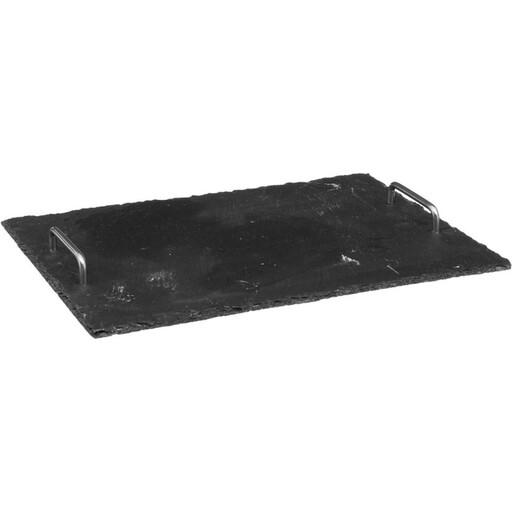
Why this product suits the profile: The rectangular slate board, measuring 40 × 30 cm and weighing 1.5 kg, is suitable for serving cheese, bread and appetisers.
The care instructions recommend a damp cloth and mild soap. According to the product information, the board is not dishwasher-safe.
Large serving surface, grey slate look, rectangular shape and, according to the product description, non-slip properties.
We have put together a complete, regularly updated list of products that fully meet these strict selection criteria and the safety regulations applicable in the EU.
The service life of a kitchen board depends largely on its material, level of use and care. The following basic rules apply to wooden and bamboo boards:
For stainless-steel or composite models, the relevant manufacturer’s instructions take precedence. A non-slip cutting board should also be checked regularly for damaged silicone or plastic areas.
That depends on how you intend to use it. Wood and bamboo are well suited to everyday cutting tasks and are comparatively straightforward to care for when washed by hand. Stainless steel is easy to wipe clean, while slate is mainly used as a serving board and cheese board. A separate board may be advisable for raw animal products.
For small kitchens, 30 × 20 cm or similar dimensions are practical. Families and frequent users will often benefit from sizes ranging from 36 × 25 cm to 45 × 30 cm. Before buying, measure your worktop, sink and cupboard compartment.
It is not possible to give a reliable fixed service life. With regular cleaning, complete drying and gentle treatment, a wooden cutting board can be used for a long time. Deep cracks, splinters, mould or permanent warping are reasons to replace it.